Petrov Defends Judiciary Laws, Criticizes Slow EU Progress
The Constitutional Court president called the revised judiciary laws progress after the Venice Commission's opinion, but said Serbia must not tie judicial reform to opening EU clusters.

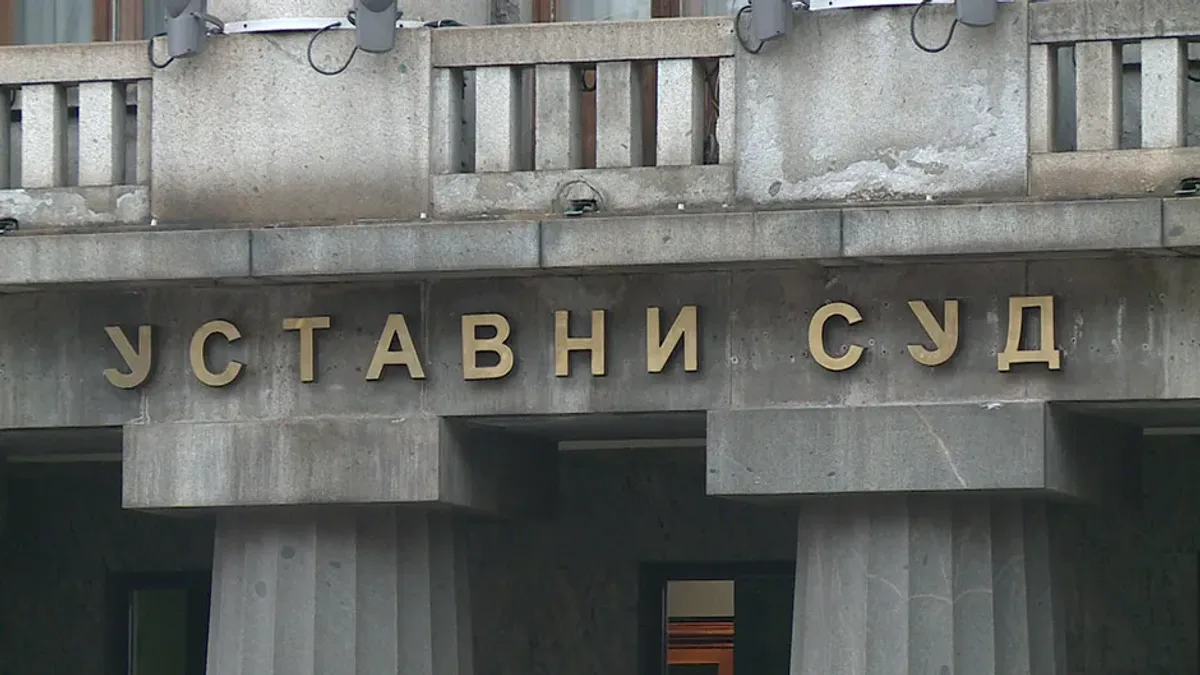
Vladan Petrov, president of Serbia’s Constitutional Court, discussed Serbia’s judiciary laws on Pink TV on August 7, saying Serbian Progressive Party lawmaker Ugljesa Mrdic deserves a special medal for courage for proposing the amendments to the set of laws. The first excerpts from the appearance were published that same morning at 9:37 am.
The set of laws was adopted by Serbia’s National Assembly in early 2026 based on Mrdic’s own lawmaker proposal, then amended following recommendations from the Venice Commission, the Council of Europe’s advisory body. Petrov spoke for the first time after that body gave a positive assessment of the draft amendments Serbia prepared following its urgent opinion from April.
Petrov did not soften his assessment of the laws themselves.
Mrdic’s laws were, as the Venice Commission itself said, progress in one part and a step backward in another, compared to the standards we achieved with the constitutional amendments and judiciary laws from 2023. That’s the full stop, there’s no room left for interpretation.
He credited the positive outcome to the engagement of National Assembly Speaker Ana Brnabic and the involvement of legal experts in reconciling the text. Petrov himself is a member of the Venice Commission on behalf of the Republic of Serbia, alongside his tenured professorship at the University of Belgrade Faculty of Law, so under the body’s new rules he was barred from attending the part of the plenary session that discussed the opinion on his own country.
What Did the Venice Commission Object to in Mrdic’s Laws?
The main objection was not about substance but procedure. The law making process was not sufficiently transparent, which Petrov called indisputable, adding that the flaw was significantly corrected in the second phase, after the urgent opinion.
Of the nine specific recommendations from the April opinion, Petrov said, eight have been fully implemented, while one still requires technical reconciliation concerning prosecutors whose secondments were terminated by operation of law. He considers the core of the amendments to be the strengthening of the High Prosecutorial Council, which now decides on the temporary secondment of public prosecutors, a job previously handled by the Supreme Public Prosecutor alone.
The Same Objection He Raised in January
This is not the first time Petrov has discussed Mrdic’s laws on Pink TV. In late January 2026, he said Mrdic made a mistake by not seeking an opinion from the High Judicial Council and the High Prosecutorial Council for his proposal, while noting that lawmakers should generally propose legislation more often.
So let that opinion be negative, even. Better still, maybe they wouldn’t give any opinion at all. Then you take that straight to the public and say: ‘Look, people, these guys aren’t doing their job.’
Seven months later, it turned out that the absence of that very opinion was one of the Venice Commission’s main procedural objections. That is why Petrov, ahead of the amendments’ return to the parliamentary procedure, is now asking that adoption not be rushed and that the opinion of the competent judicial councils be sought this time, since a day or two, as he put it, ultimately mean nothing.
The Cluster That Never Opened
The second part of Petrov’s appearance was sharper toward Serbia’s European path. He recalled that some fifteen to twenty days earlier there had been talk of opening Cluster 3 in negotiations with the European Union, and that it did not happen.
In that area we genuinely achieved so much in such a short period that up until 15 or 20 days ago there was talk that this famous Cluster 3 would open. Unfortunately, that did not happen. There’s no need to despair. It has simply long been clear that the European integration process is, first and foremost, a political process.
His conclusion is that enlargement will not happen before the Union itself reforms, and that Serbia should no longer tie its progress on the rule of law to the opening of new chapters. He used Montenegro as his example.
What good does it do us to open yet another, as I call it, little cluster if we’re not substantially closer to full EU membership? Look at Montenegro, they worked themselves to the bone to meet everything asked of them and more, and they’re probably among the countries, if not the very first, formally furthest along that path. And who guarantees them when, or whether, they’ll actually join the EU? We shouldn’t tie our progress on the rule of law to such purely formal conditions.
The comparison with Podgorica is a politically loaded choice. Montenegro has closed the largest number of chapters among candidate countries, so the same figure can be read both as proof that formal progress does not deliver an accession date, and as proof that meeting the conditions is in fact how one gets there at all.
The next step is concrete: the final text of the Venice Commission’s opinion is to be published on the body’s website, then sent to Serbia’s National Assembly, where the government still has to submit the proposed amendments. Only then will it become clear whether the judicial councils’ opinion will be sought before the vote, or whether the January scenario will repeat itself.