Metropolitan Teodosije: KFOR Handover at Decani Is Premature
Metropolitan Teodosije met US Senator Joni Ernst in Gracanica and said a handover of security duties from KFOR at Visoki Decani and the Mitrovica bridge would be premature.

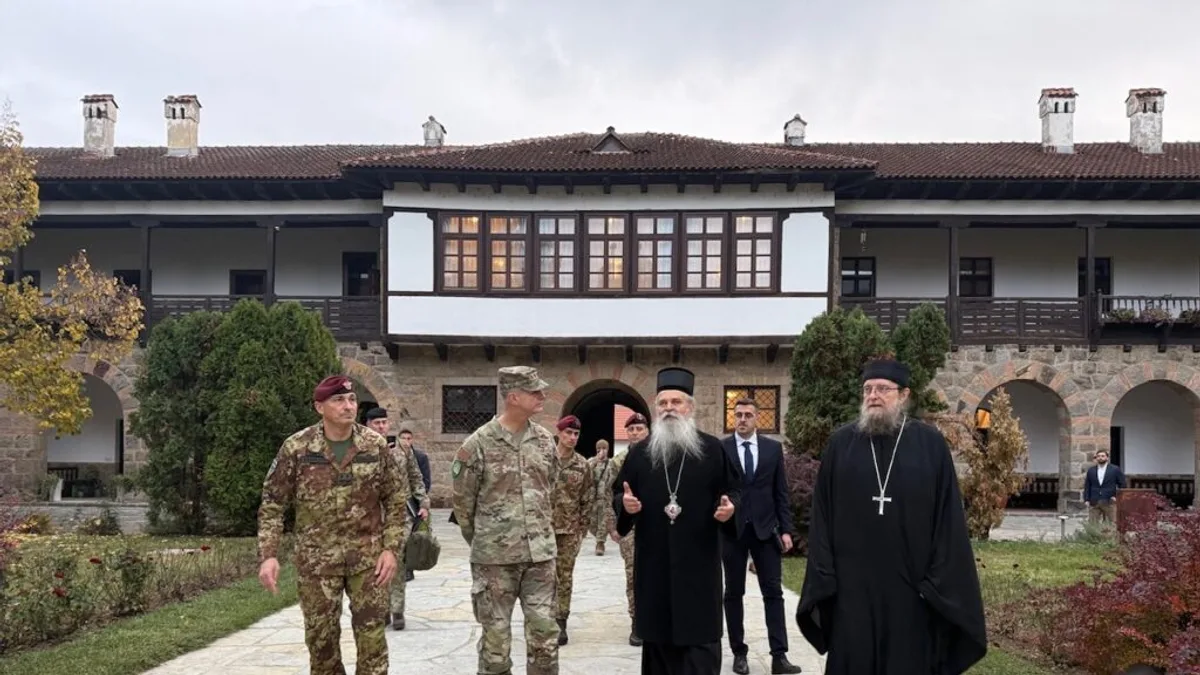
Metropolitan of Raska and Prizren Teodosije received US Senator Joni Ernst at Gracanica Monastery on Monday, August 10, and told her the Diocese believes a handover of primary security responsibility from KFOR at the Visoki Decani monastery and the main bridge over the Ibar in Mitrovica would be premature at this point. The meeting was also attended by Ana Pratapati, chargée d’affaires at the US Embassy in Pristina, along with staff from both delegations.
Before the talks, the senator toured the monastery and was briefed on its spiritual, historical and cultural significance. According to a statement from the Diocese of Raska and Prizren, the conversation covered the position of the Serbian Orthodox Church and the Serb community in Kosovo and Metohija, as well as everyday problems the community faces.
The timing of the meeting was not incidental. That same day, KFOR launched two changes that touch on arrangements as old as the mission itself.
What KFOR changed the same day
At Visoki Decani, the gradual inclusion of Kosovo Police officers in KFOR’s security setup began. On the main Ibar bridge, the tent and static post staffed by Italian carabinieri on the northern half, present there for years, were removed. The mission attributed the move to an improved security situation and a previously announced streamlining of its footprint, adding that it would keep a visible presence in both parts of Mitrovica and across northern Kosovo.
Teodosije said the Diocese is following the process with particular concern, though he also noted KFOR’s assurances that bringing in the Kosovo Police at Decani does not amount to a transfer of primary responsibility for the monastery’s security, but rather coordinated work within the existing system. KFOR stressed that it remains the first security responder for the monastery.
Kosovo’s acting Interior Minister, Xhelal Svecla, addressed the change from the southern side of the bridge the same day, framing it differently.
“Today we are all witnesses to the start of a process in which responsibility for security on the Mitrovica bridge will pass to the Kosovo Police,” Svecla said, linking the step to the bridge’s future opening to car traffic.
In its own statement, KFOR used more cautious language, describing a gradual transition of its permanent presence away from the bridge without confirming that the Kosovo Police is taking on primary responsibility.
What the Metropolitan told the American delegation
Teodosije spoke about a deterioration in the security and institutional situation and about a sense of insecurity that, in the Diocese’s assessment, is experienced as persecution and open discrimination by the authorities in Pristina. He listed several recent cases:
- obstacles during religious gatherings at Gazimestan and near the Holy Archangels Monastery outside Prizren
- the demolition of a number of Serb houses in the area around Lake Gazivode
- arrests of Serbs that the Diocese says were carried out without clear evidence of criminal responsibility
- new works on the disputed road near Visoki Decani, which the Diocese views as a violation of the Law on Special Protective Zones
He also referred back to earlier disputes over the protective-zone regime, including at the hermitage of St. Peter of Korisa and the Bogorodica Hvostanska monastery. Taken together, he said, these developments create a cumulative effect of pressure.
Why changing the security regime at Decani is difficult
Visoki Decani is the last Orthodox monastery in Kosovo under direct military protection from KFOR, a protection that has been in place since 1999. The 14th century royal lavra has been the target of several armed attacks, including mortar fire in 2000 and 2004 and a rocket-propelled grenade attack in 2007. The monastery is on the UNESCO World Heritage list, and in 2021 Europa Nostra placed it among the seven most endangered heritage sites in Europe, a designation Kosovo officials rejected sharply at the time.
The Metropolitan described the main Ibar bridge as a highly sensitive point, a location repeatedly linked to security incidents and interethnic tension. “Any change to the existing security regime at such a sensitive location could carry serious consequences for stability,” the Diocese said in its statement.
The Diocese, the same statement adds, does not question the professional cooperation between the security actors involved.
“It is therefore essential that every further step remain gradual, grounded in real and verifiable conditions on the ground, and built on trust earned through concrete results,” the statement reads.
Teodosije thanked the United States, NATO and KFOR for their engagement so far and said he expects future security decisions to be made in a way that avoids a security vacuum. He said the Church remains committed to peace, dialogue and building trust with all communities, adding that lasting stability can only rest on the rule of law, consistent respect for acquired rights and concrete guarantees.
The Diocese ties the assurances it received about Decani to messages the monastery’s abbot, Archimandrite Sava Janjic, received during a recent visit by George M. Vikof, commander of NATO’s Allied Joint Force Command in Naples.