NATO Trims KFOR Presence, Kreni-Promeni Wants a Pause
NATO spokesperson Alis Hart confirmed KFOR is adjusting its presence in Kosovo, with the caveat that the process can be reversed. The Kreni-Promeni movement called the same day for it to stop.

NATO spokesperson Alis Hart said on August 12 that the alliance has begun adjusting KFOR’s presence in Kosovo, citing an improved security situation. The adjustments, she said, are being carried out under the command of KFOR commander Major General Ozkan Ulutas, in coordination with all relevant authorities and stakeholders.
It was the first time NATO addressed the matter under the spokesperson’s name, after KFOR had already announced in previous days what exactly was changing on the ground.
“NATO is working to ensure that our peacekeeping mission in Kosovo, KFOR, is adapted to the current environment,” Hart said.
She also spelled out the limits of the move: “This process is conditions based and can be reversed if warranted.” The alliance grounded its explanation in the mandate of UN Security Council Resolution 1244, adopted in 1999.
What is changing on the ground
Two locations are involved, both of which the Serb community in Kosovo and Metohija regards as highly sensitive.
- KFOR has begun a gradual transition of its permanent presence at the main bridge over the Ibar in northern Mitrovica, in coordination with Kosovo Police and the EU Rule of Law Mission in Kosovo (EULEX).
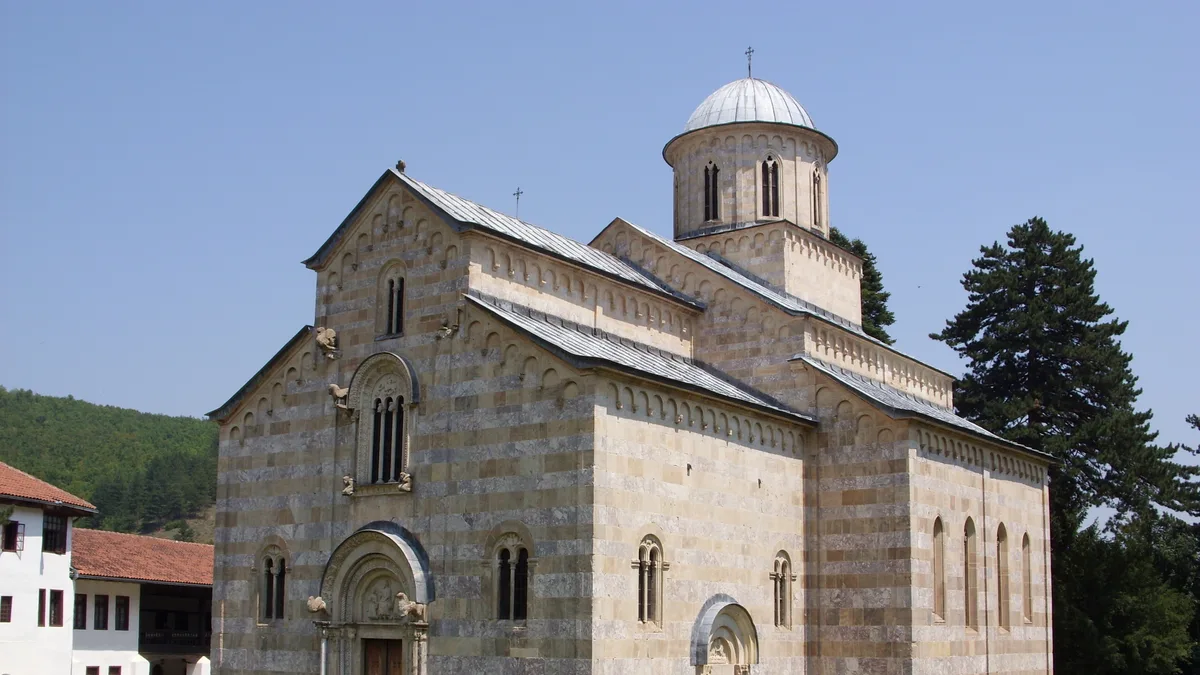
- Kosovo Police is also joining the security perimeter around the Visoki Decani monastery.
We previously reported on the withdrawal of KFOR’s permanent checkpoint at the Ibar bridge, when the decision was announced without a broader explanation. NATO has now added a reason, along with the caveat that the situation can be reversed.
Why Kreni-Promeni spoke out the same day
The Kreni-Promeni movement issued a statement on August 12 at 5:54 p.m., asking KFOR to reconsider the pace and scope of Kosovo Police’s involvement in securing Visoki Decani and other sensitive sites.
The argument is not abstract. The movement ties it to three specific cases. The first is Nenad Raskovic from the village of Dren, near Zubin Potok, who says he was injured during an encounter with Kosovo Police officers. The second is the detention of 37 Serbs after a memorial gathering at Gazimestan on June 28, Vidovdan, following which complaints of physical and psychological abuse, ethnic insults and humiliation led the Ombudsperson Institution to open proceedings. The third is the raising of Kosovo Liberation Army (KLA) and Albanian flags on the fence of an Orthodox church compound in Lipljan, where the movement is demanding accountability and notes this is not the first incident targeting the same church complex.
Kreni-Promeni describes Serb public trust in Kosovo Police as low and argues there is not enough basis for further reducing the international security presence while the abuse allegations remain unresolved. At the same time, it wants KFOR to keep the ability to rapidly reinforce its presence if the situation worsens.
Can the decision be reversed?
Formally, yes, and that is the one point on which the two sides agree. NATO says the process is conditions based and reversible, while Kreni-Promeni is asking that this option stay open and actually usable.
The disagreement is over what counts as evidence of conditions on the ground. For the alliance, it is an improved security situation that justifies a smaller footprint. For the movement, it is the unresolved investigations that argue for keeping the presence strong until the facts are established.
Neither statement set a deadline for completing the transition at the Ibar bridge and around Visoki Decani, nor specified what would have to happen for KFOR to return to its previous deployment.