RIK Voting Screens: 830 Million Dinar Contract
Contracts for voting screens, ballot boxes, UV lamps and spray total about 1.02 billion dinars, and Transparency Serbia asks whether RIK broke the law buying the screens.
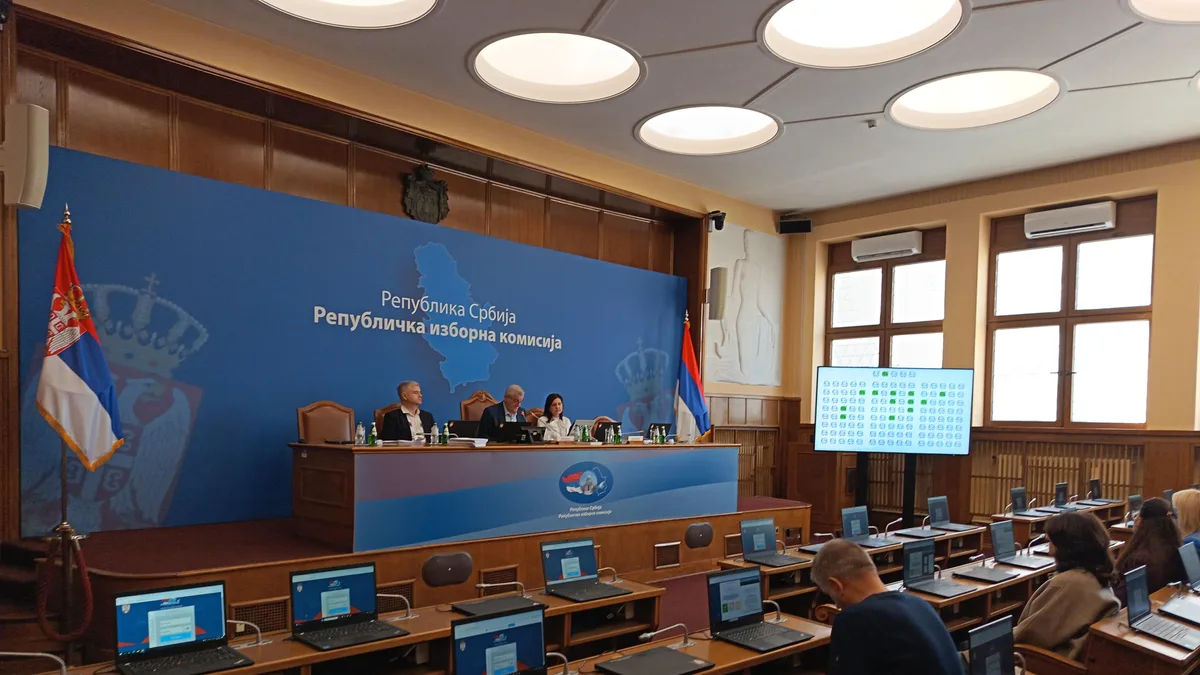
The Republic Electoral Commission (RIK) bought its equipment for the October 25 parliamentary election through emergency negotiated procedures worth a combined 1.02 billion dinars, according to a tally Nova ekonomija published on October 18. The largest single contract, at 830.27 million dinars including VAT, covers 30,000 voting screens meant to protect the secrecy of the ballot.
For election materials at the previous vote, RIK set aside 70.36 million dinars. Over the screens purchase, the organization Transparency Serbia has asked the Public Procurement Office to determine whether the commission broke the law, and the purchase was contested inside RIK itself: the decision to launch the procedure passed with ten votes for and three against, and the proposal to award the contract with 11 for and four against.
How much do the voting screens cost and who supplies them?
The screens contract went to Klima plus d.o.o. in a negotiated procedure without a public call. It is worth 691.9 million dinars before VAT, or 830.27 million with VAT. Divide the pre-VAT figure by 30,000 units and each screen comes to a little over 23,000 dinars.
Nova ekonomija notes that, unlike the other purchases, this one has a known quantity of goods. RIK documents, as the outlet reports them, say that screens of this kind would secure the secrecy of the vote in line with the recommendations of the OSCE Office for Democratic Institutions and Human Rights (ODIHR).
The estimated value of the purchase has been reported in different ways. Vreme, reporting from the session at which the procedure was launched, wrote about roughly six million euros, while RIK member Sofija Mandic mentioned around seven million euros. The same source says that at the time the talk was of 8,253 polling stations, whereas Vladimir Dimitrijevic, the RIK chair, now speaks of 8,392.
What did RIK members say about the purchase?
At the session that decided on launching the purchase, Dimitrijevic said both existing and new screens would be used at the election. He said a finance working group had met before the session and prepared a cost analysis, and that the urgency of the procedure was justified by the announced calling of the election and by the need to meet ODIHR recommendations.
“We are practically buying half of what we need,” Dimitrijevic said.
RIK member Vladimir Dragas pointed out then that there was no urgency, since the election had not yet been called:
I had to open the Radio-Television of Serbia website to see whether the election had been called. We have the next regular election in April and we have enough time to carry out a purchase twice as large. The election has not been called, and announcements that it might be called do not oblige us to anything.
Marko Zivanovic, a deputy member of RIK, questioned the scale of the purchase. After the decision to use both old and new booths, he concluded that the new ones amount to a kind of “pilot project.”
“I do not understand such a large purchase of 30,000 screens, at a total price of six million euros. That would mean four screens per polling station, and I believe it would be more economical to buy a smaller number, because we are already using the existing ones,” Zivanovic said.
When RIK adopted the proposal to award the contract, commission member Veljko Petrovic explained that the negotiated procedure had been conducted as an urgent one. Member Tanasije Marinkovic proposed dropping the decision, arguing that there was neither a formal nor a material legal basis for it. He also asked why exactly 30,000 screens, and why the commission had not begun carrying out the decision at the end of 2024, but is doing so now, even though no election had been called then.
“I am sorry that we are entering the next electoral system with this kind of irregularity, as if it were a sign of what awaits us in that electoral process,” Marinkovic said.
Sofija Mandic backed the proposal to abandon the procedure so that RIK could save about seven million euros. In her words, ODIHR did not ask this of Serbia. She also said the proposed company has seven employees and does not make booths, but trades in and services air conditioning units. By her calculation, at the highest European prices, what RIK is buying should be more than 40 percent cheaper for that quantity.
Why does Transparency Serbia consider the procedure unlawful?
Milos Djordjevic of Transparency Serbia told Nova ekonomija that the Public Procurement Office, after the organization’s initiative, gave a positive opinion on using a negotiated procedure without a public call. According to him, the office also mentioned in its opinion that there were five bids in the procedure.
“The office gave a positive opinion and even stated that there were five bids in that procedure,” Djordjevic said.
Transparency Serbia still maintains that using that procedure was not justified. Djordjevic laid out the reasons:
The Republic Electoral Commission stated that there are grounds for applying urgency in this procedure and that it used this type of public procurement for that reason. We considered that unlawful, because the ODIHR recommendation RIK relies on has existed since 2023. Elections were announced several times, both during 2025 and this year, so RIK could have planned this purchase much earlier.
He added that RIK could have put the purchase into its plan if it wanted to meet the ODIHR recommendations.
“On one hand, RIK probably got a tip that the election would really be held after countless rounds of speculation, which, from this time distance, turned out to be true. On the other hand, it does not hold water that there were as many as five bids in this procedure, even though a negotiated procedure without a public call was used,” he said.
How do the other purchases compare with the previous election?
The VAT-inclusive amounts from the individual contracts add up to about 1.02 billion dinars, which matches the total cited by Nova ekonomija. The screens make up the largest share, but the other items are rising too:
- Ballot boxes: the job went to DPC d.o.o. (Digital Printing Center Belgrade) for 99.2 million dinars before VAT, or 119.04 million with VAT. The same company did the same job for the 2023 election for 8.7 million before VAT, so the contract is now more than eleven times larger.
- UV lamps: Master Team d.o.o. is supplying 25,000 units for 22.8 million dinars before VAT (27.45 million with VAT). At the previous election the lamps cost 16.4 million before VAT.
- Marking spray for fingers: Kandelaber d.o.o. received a contract of 28.6 million before VAT (34.38 million with VAT), while the same company did the same job in 2023 for 26.4 million before VAT.
- Scanner checks and servicing: Digitron Ist d.o.o. received a contract of 8.9 million before VAT (10.6 million with VAT). The service covers on-call duty on election night at ten locations in Serbia and, where needed, a spare device in every municipality. The same company did the job in 2023 for 7.09 million before VAT.
How much was RIK’s budget raised and what is being printed?
The original 2026 budget for RIK’s regular work provided 159.7 million dinars. A budget revision raised that to 294.5 million. The materials line jumped from 600,000 to 165.3 million dinars, and the increase is earmarked for buying voting and administrative materials. A total of 263.05 million dinars is set aside for the elections of national minority councils.
At its session on October 10, RIK decided to print 6,450,523 ballots for the vote for members of parliament. Dimitrijevic said voting will take place at 8,392 polling stations: 93 abroad, in 37 countries, 29 in penal institutions, and 60 for voters from Kosovo and Metohija, in Vranje, Kursumlija, Raska and Tutin. The ballots are purple with a watermark, and the control sheet used to check that a ballot box is in order is white. They are printed in 29 language versions, according to the languages and scripts in official use in individual municipalities and cities.
We previously reported that the Constitutional Court rejected a motion against RIK’s voting booths.