Hague Court Rules Tomorrow in Thaci Obstruction Case
The Kosovo Specialist Chambers deliver a first-instance verdict in the second case against the former Kosovo president. Prosecutors seek six years, to follow his 25-year sentence.
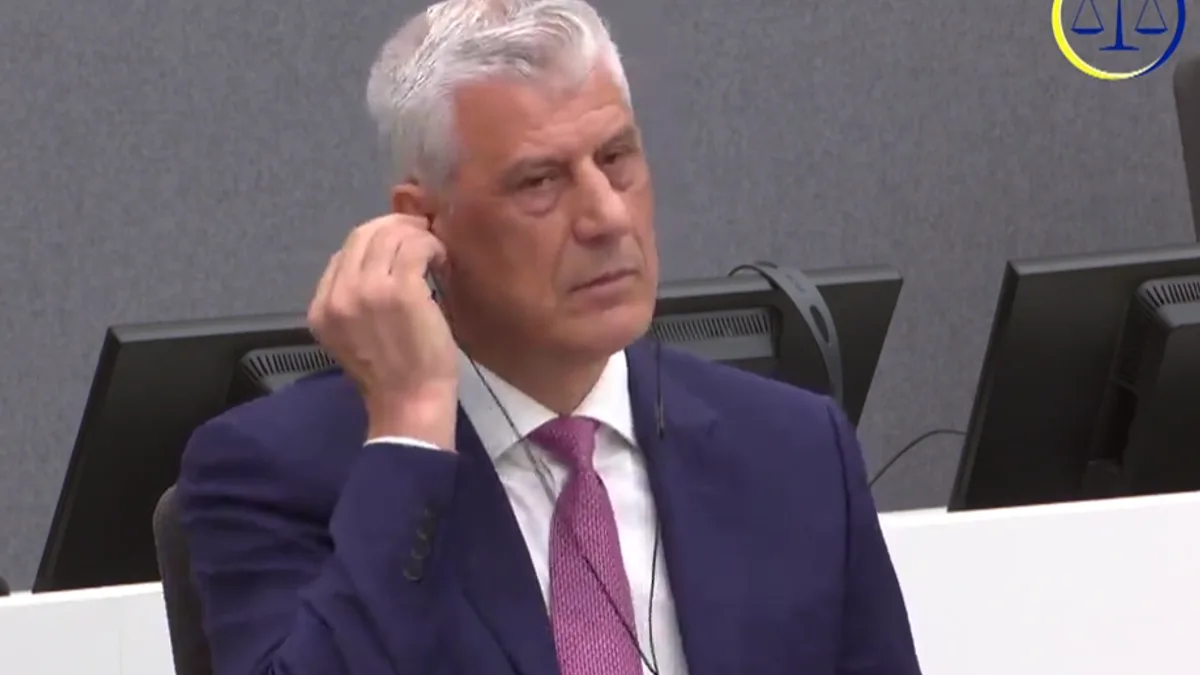
The Kosovo Specialist Chambers in The Hague hand down a first-instance verdict tomorrow, November 17, against Hashim Thaci and four other defendants in an obstruction of justice case. Prosecutors want six years in prison for the former Kosovo president, to be served after the 25-year sentence he received in the main war crimes trial.
The case is registered as KSC-BC-2023-12 and is tried separately from the proceedings in which Thaci faced war crimes charges. The verdict will be delivered by single judge Christopher Gosnell, on a date set by a decision of October 12. The hearing is public and will be interpreted into Albanian, English and Serbian.
Who are the other defendants in the second case against Thaci?
Alongside Thaci, four men from his circle are in the dock. The descriptions below come from the indictment, as the court presents them on its website:
- Baskim Smakaj, former director of the Kosovo Intelligence Agency, whom Thaci employed from 2017 to 2020
- Isni Kiljaj, founder of the KLA in Malisevo, former commander of the Lumi unit and chairman of Thaci’s PDK party in the municipality of Malisevo
- Fadil Fazliju, a KLA veteran from the Llap operational zone
- Hajredin Kuci, at the time covered by the indictment a member of Kadri Veselji’s defense team, and earlier deputy prime minister and justice minister in Thaci’s cabinet
In its own article, KoSSev calls Kiljaj a former mayor of Malisevo, which does not match the indictment’s description word for word. All five men have pleaded not guilty.
What are the defendants charged with?
The indictment states that from April to early November 2023, during visits to his detention cell in The Hague, Thaci disclosed confidential information about prosecution witnesses to Smakaj, Kiljaj, Fazliju and Kuci, and instructed them on how to influence witness statements. According to prosecutors, Thaci coordinated three groups, formed with Smakaj, Fazliju and Kiljaj and other people who are not charged, and a fourth contact with Kuci, with the aim of obstructing testimony in the main trial against him. The indictment also charges Kuci with agreeing with Thaci to contact prosecution witnesses despite a court order forbidding it.
According to KoSSev, Thaci faces 11 counts: three for attempting to obstruct an official person, four for violating the secrecy of proceedings and four for contempt of court. Smakaj, Kiljaj and Fazliju face charges of attempting to obstruct an official person and contempt of court, and Kuci faces two counts of contempt of court.
What do prosecutors want, and what does the defense say?
The Specialist Prosecutor’s Office seeks six years in prison for Thaci, three years each for Smakaj, Kiljaj and Fazliju, and nine months for Kuci. For Thaci it also asks that he serve the sentence in this case after the one from the main trial, with the time spent in detention credited only against the war crimes sentence. If the court accepts both requests, the total would come to 31 years in prison.
In its closing argument, the prosecution said it holds about 28 hours of recordings from nine visits to Thaci in detention, spread over four months. The defense disputes the interpretation of those conversations, argues that unlawful influence on witnesses has not been proven and seeks acquittal for all the accused.
The indictment was confirmed on November 29, 2024. Kiljaj was arrested in early November 2023, and Smakaj and Fazliju in early December 2024. The trial opened on February 27, 2026, and ended on September 14 after closing arguments.
Background: the September 16 verdict and the dispute over the court
In the main trial, Thaci was convicted at first instance on September 16 and sentenced to 25 years in prison, as was Jakup Krasnici. Kadri Veselji received 18 years and Redzep Selimi 13. All four were found guilty of unlawful or arbitrary arrest and deprivation of liberty, cruel treatment, torture and murder, and were acquitted of crimes against humanity. The verdict is not final, and the deadline to announce an appeal expires on November 27.
After that verdict, protests under the slogan “Not in My Name” went on for weeks in Pristina, and at the rallies the court was called a seal of shame. On October 5, the Kosovo Assembly passed in first reading, with 90 votes in favor and none against, amendments to the law on the Specialist Chambers that would limit the court’s mandate. President Justina Siroka-Pulja returned them to the Assembly for reconsideration, and Kosovo’s international partners opposed them. Lawmakers still had not voted on Friday, November 13: after almost 12 hours, the session was adjourned for lack of a quorum.
Tomorrow’s verdict arrives in that atmosphere. The decision in this case does not change the outcome of the main trial, but it determines whether Thaci, on top of the 25 years from the first case, receives a new sentence.