Bomb at Moscow restaurant kills three, guard among dead
Three people died when an improvised device went off at the door of the Balzi Rossi restaurant on Kudrinskaya Square in central Moscow. Russian investigators are treating it as terrorism.

Three people were killed on Saturday evening when a bomb went off in the middle of Moscow, on Kudrinskaya Square. The improvised device detonated at around 8:10 p.m. local time on the summer terrace of the Italian restaurant Balzi Rossi, which occupies the ground floor of a Stalin-era high-rise at Kudrinskaya Square 1. Russia’s National Anti-Terrorism Committee, or NAC, classified the blast as a terrorist attack the same day.
The Interior Ministry first put the number of wounded at 15, some reports said 17, and by late evening the count had risen to 21. Four of the injured are restaurant staff. The address is not a distant abstraction for readers in Serbia either: Belgrade is one of the few European capitals still running direct flights to Moscow, and Kudrinskaya Square sits on the Garden Ring, among the busiest points in the city centre.
What the anti-terrorism committee said
According to the committee, an unidentified woman tried to carry an explosive device into the restaurant and was stopped at the door. A security guard grew suspicious of the box she was holding, which had been presented as a gift, and began to search her. The device went off at that moment.
An unidentified woman attempted to smuggle an improvised explosive device into the restaurant, where it exploded at the entrance once the suspect was stopped by a security guard.
The statement was carried by the TASS news agency. The dead are the guard, the woman holding the box and one restaurant guest. Her identity has not been released and no one has claimed responsibility.
Why the first reports mentioned gas
In the first hour after the blast, Russian official channels also floated a fault in kitchen gas equipment. That version collapsed as soon as investigators described an improvised device on the terrace. Head chef Carmine Alfieri said the explosion happened outside the premises and that no gas is piped into the building at all. The restaurant said the venue itself was fine and thanked people for their messages of support.
Who was inside that evening?
The restaurant was closed to the public on August 1 for a private event, with roughly 50 people inside. What exactly was being celebrated has not been established. Part of the Russian coverage describes the gathering as a wedding party for about fifty guests.
Journalist Oleg Kashin wrote, citing no source, that the birthday of Colonel General Alexander Chaiko was being marked at Balzi Rossi. Vladimir Putin appointed Chaiko commander-in-chief of Russia’s Aerospace Forces in May 2026; he turned 55 on July 27 and is under European Union sanctions. There is no official confirmation that the event was held in his honour, nor that he was in the restaurant when the bomb went off.
A courier who may not have known
The Telegram channel VChK-OGPU and part of the Russian press report that investigators are not ruling out that the courier was used without her knowledge and that the device was triggered remotely. That account has not been officially confirmed, but it has a precedent in Russia.
In April 2023, military blogger Vladlen Tatarsky, whose real name was Maxim Fomin, was killed in a St Petersburg cafe when a figurine handed to him by a visitor, Darya Trepova, exploded. Trepova told the court she did not know what was inside the gift and was sentenced to 27 years. The pattern is the same: a present, a carrier, a trigger pulled from somewhere else.
The killings of senior Russian officers have continued since. In December 2024, General Igor Kirillov, head of Russia’s radiological, chemical and biological defence troops, was killed in Moscow by explosives planted on a scooter outside his apartment block. In April 2025, General Yaroslav Moskalik, deputy head of the General Staff’s Main Operational Directorate, died in a car bombing in Balashikha outside Moscow. Moscow blamed Ukrainian services in both cases.
What comes next
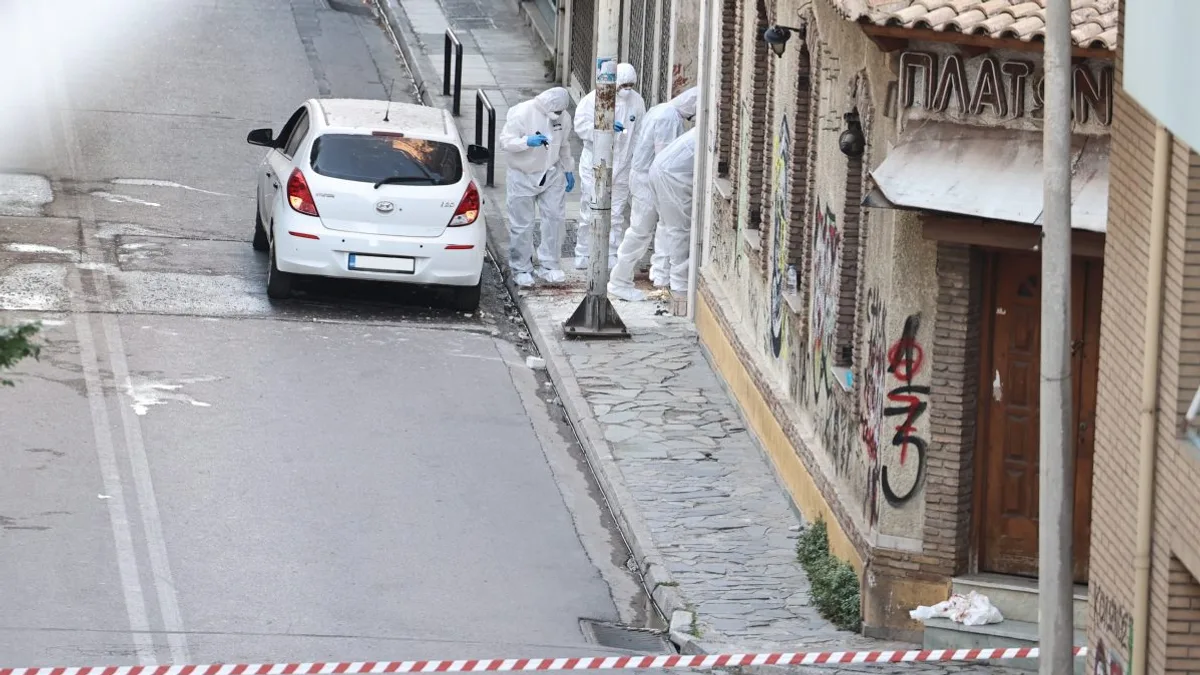
Moscow’s Investigative Committee opened a terrorism case, and armed officers, sappers and investigators sealed off the site. Three restrictions were imposed in the city centre during the evening:
- entrances to Barrikadnaya metro station were closed for a time
- traffic was blocked from Barrikadnaya to Novinsky Boulevard
- a night cycling festival was cancelled
The next step is identifying the woman who carried the box, and whether Moscow formally ties the case to Kyiv depends on it. Until then, what stands is the committee’s first account: an improvised device, a restaurant door, and a guard who got there in time to stop her.