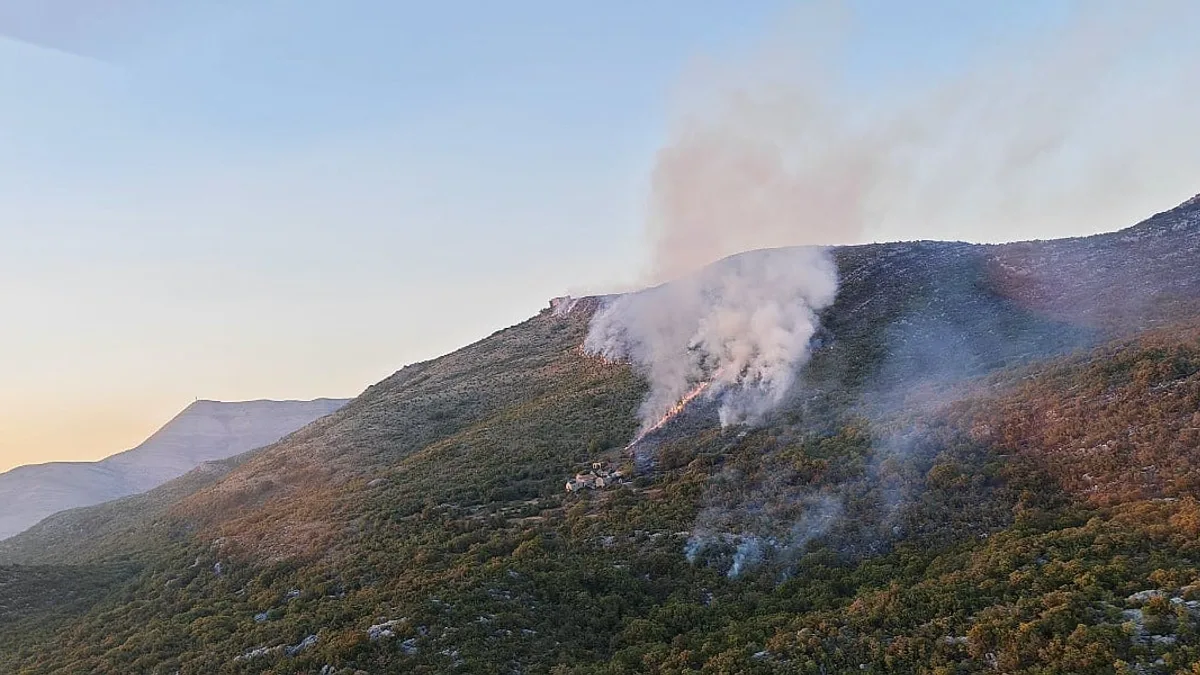
Trebinje Fire Extinguished After Nine Days on the Karst
The fire near Trebinje was extinguished on its ninth day. The front at one point stretched nearly ten kilometers, and Luke, Tretina and Poljice Petrovo were defended without losing a house.

A fire that burned for nine days in the karst around Trebinje was extinguished on Saturday, August 8, after firefighters worked through the last remaining hot spots along a front that at one point stretched nearly ten kilometers. Dejan Kasikovic, commander of the Trebinje Territorial Fire and Rescue Unit, confirmed the operation was over. His crews had held that line for nine days alongside volunteers and local residents. From Belgrade this story does not read as a distant chronicle, and not only because it happened in Republika Srpska: defending villages with a single aviation unit, one volunteer fire brigade and neighbors from the area is the same question that comes up in Serbia every summer.
The fire first threatened homes in the villages of Bihovo and Volujac, with one arm spreading from there toward Petrovo Polje. The hardest fighting was in the villages of Luke, Tretina and Poljice Petrovo, where flames repeatedly came within reach of houses. Not a single home or outbuilding was lost, even though the fire reached the edge of yards in all three villages. The fire in the village of Malici had already been brought under control earlier.
After the fire was put out, Kasikovic again urged residents to be careful with open flame.
“One moment of carelessness can start the fire again and undo everything people have spent days defending,” he warned.
The warning is not a formality. Burned ground on the karst stays hot for days, and dry brush among the rocks can ignite from a single spark, which is why fire crews remain in the field even after the fire is out, to keep watch over the fire line.
Who fought the fire, and with what
Alongside Trebinje’s professional firefighters, the operation involved civil protection personnel from Hidroelektrane na Trebisnjici, the Lastva volunteer fire brigade, workers from companies whose property was under threat, and residents of the villages the fire passed through. In the air, a helicopter from the Aviation Directorate of the Republika Srpska Interior Ministry (MUP) dropped water on the fire in the Poljice and Luke area.
While the operation was still underway, Kasikovic described how the forces were deployed:
“The helicopter of the Aviation Directorate of the Republika Srpska Ministry of Interior, engaged again this afternoon in fighting the fire in the area of the villages of Poljice and Luke, is dropping water on the fire ground. Trebinje firefighters will remain through the coming night as well, to keep watch over the fire line.”
Air support was what separated a controlled burn from a breakthrough toward the houses, since most of the front could not be reached by vehicle. The fire also seriously threatened the asphalt plant of the company Hercegovinaputevi, which was successfully defended.
Why was the Trebinje front so hard to fight?
Because of the terrain and the wind. The Herzegovina karst is rocky ground with low scrub, with no roads to most of the hot spots, so hoses have to be hauled up the slope by hand, and getting a crew back to the same spot takes longer than the extinguishing itself. Kasikovic said the job was made harder still by wind that kept changing direction during the night, precisely the hours when air support is grounded. Nine days is not a measure of incompetence but a measure of that arithmetic: a front longer than most urban fire departments handle, equipment that reaches only part of it, and nights when the line is held by people alone.
That leaves a consequence that can already be named while the burned ground is still fresh. Pastures and low woodland on the karst recover slowly, and bare ground near the villages changes how the next fire on the same stretch will behave. Trebinje got through this summer without losing a house, but it got through with an exhausted unit and with a single helicopter as the only resource that reaches the places roads do not.
Thanks from Banja Luka
Republika Srpska Prime Minister Savo Minic thanked the Trebinje firefighters on Sunday, August 9, for their courage and persistence in fighting the blaze over the preceding days. The response from Banja Luka came a day after the last hot spot was extinguished, which is the usual order of things: the firefighting is followed locally, and the official accounting comes once everything is over.
Kasikovic turned that gratitude back toward the people on the ground.
“I am proud of my people, of the volunteers who came to help, of every resident who defended their village,” he said.
The next test for the Trebinje unit is already on the calendar, since the wildfire season in Herzegovina lasts until the first autumn rains, and the crews who spent nine days on the rock are heading into that period without a break.