

Brac Fire Burns 250 Hectares of Pine Above Pucisca
A fire that broke out above Pucisca at 2:27 a.m. Thursday burned through more than 250 hectares of pine forest, forced 50 people from some twenty buildings, and knocked out power for five hours.

A wildfire broke out overnight into Thursday, August 13, above Pucisca on the northern coast of Brac, and over more than thirteen hours of firefighting consumed more than 250 hectares of dense pine forest, in the middle of the Adriatic’s August season, a destination that at this time of year regularly draws travelers from Serbia as well. The Split-Dalmatia County fire operations center logged the call at 2:27 a.m., though a statement from the Croatian Firefighting Association put the time at 2:30 a.m. Grass, low brush and pine forest burned on terrain that is hard to reach and sits directly above the houses.
During the night, at least 50 people, mostly tourists staying in apartments, were led out of some twenty buildings on the edge of the settlement. By morning they were returning to homes that firefighters had managed to save. No building was damaged, and there were no injuries among residents or firefighters.
How the Response Was Mounted
The first wave on the ground numbered 65 firefighters with 20 vehicles from the Brac operational area and the Split Intervention Fire Brigade. The rest of the county sent reinforcements of 47 firefighters and ten vehicles. A ferry from Split at 6:15 a.m. carried over crews from the Split Public Fire Brigade, the volunteer brigades of Split, Solin and Vranjic, the Trogir Public Fire Brigade, the Slatine volunteer brigade, the Imotski operational area and the Split Intervention Brigade, while forces from the Makarska operational area were also sent over by ferry.
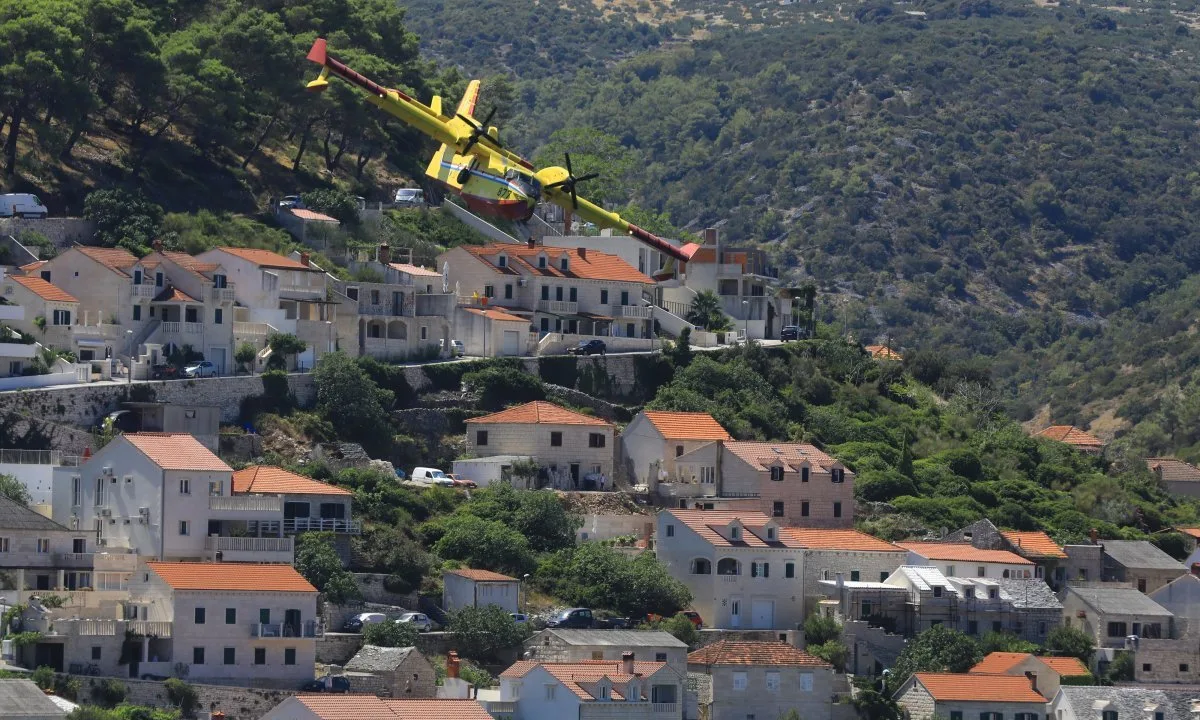
The numbers kept climbing through the morning: at one point 106 firefighters with 31 vehicles were on scene, the news site Dalmatinski portal reported 115 firefighters with about 40 vehicles at 7:24 a.m., and by the afternoon the count was near 120. From the air, four Canadair CL-415 water bombers fought the blaze, later joined by two air tractors, though the number of Canadairs was reduced around noon after one was diverted to a fire on Hvar.
The water bombers refilled in the coves along the island coast, a few minutes of flying time from the fire.
Slavko Tucakovic, chief fire commander of the Croatian Firefighting Association, described in a statement how the fire spread and where it was stopped.
The fire spread quickly, driven by strong wind. Firefighting units on the ground successfully pushed the fire back from the houses.
The defense line held on the outskirts of Pucisca, where commercial buildings were under threat alongside homes.
Why Was Power Cut for Five Hours?
For the safety of ground crews and the aircraft flying over the burned area, power lines were shut off for five hours on the Pucisca to Praznica and Pucisca to Selca sections. Cutting the grid is standard practice when a fire moves along rocky terrain beneath power lines, but for the town itself it meant part of the night and morning passed without electricity.
Nikola Martinic Dragan, commander of the Brac operational area, said during the day that conditions were improving.
The situation is somewhat better than it was this morning.
The same official told HRT that the situation was getting better by the hour, while noting that the bura wind was still causing problems. He told N1 that there was no longer any danger to buildings.
At the moment there is no more threat to the houses.
Asked about the consequences, he answered briefly that “not a single object was damaged, and there are no injuries.”
Fire Returns to the Same Stretch of Coast
The fire was brought under control in the afternoon, but firefighters did not withdraw. With stronger bura winds forecast, they stayed at the site through the night ahead of August 14, and two Canadairs remained stationed at Brac Airport in case the fire flared up again.
This was not the first fire on this stretch of the island this week. A day earlier, on August 12 at 11:20 a.m., a fire broke out above Lovrecina cove, between Postira and Pucisca, burning around 4.5 hectares of low brush and forest. Thirty seven firefighters with 12 vehicles and two Canadairs responded there. The gap in scale between the two incidents, less than a day apart, shows how quickly the same terrain under bura winds can turn from a controlled fire into an uncontrolled one.
Brac was not the only hot spot in Croatia that Thursday. At the same time, a fire was burning near Skrljevo in Primorje-Gorski Kotar County starting at 1:06 a.m., with 101 firefighters, 30 vehicles and one air tractor working roughly 30 hectares of grass and low brush. In this year’s tally since January 1, Croatia has recorded 8,832 fires, in which 23 people have died.
The Firefighting Association once again urged the public to stay cautious and reminded people that open fires are banned outdoors. The forecast for August 14 calls for the bura to strengthen further across the central Adriatic, so on Brac no pullback of forces is expected before the wind dies down.


