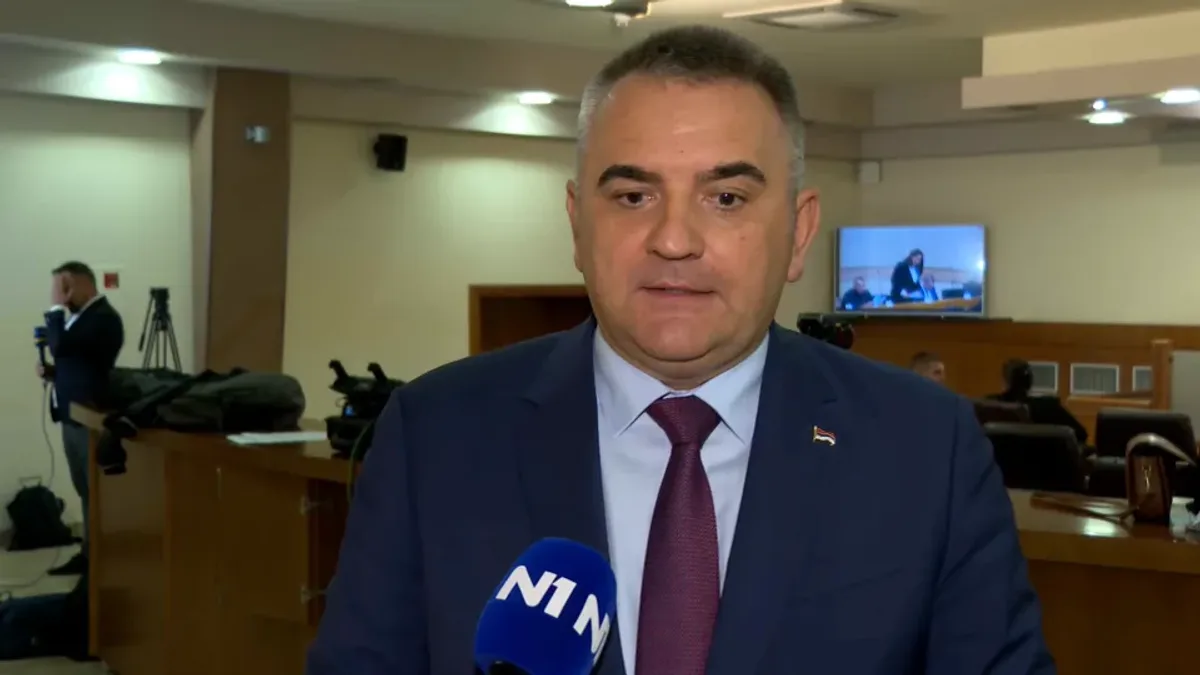
Stevandic Meets Slovenian Parliament Speaker in Ljubljana
Republika Srpska National Assembly Speaker Nenad Stevandic met in Ljubljana with Slovenian National Assembly Speaker Zoran Stevanovic, in a meeting that had not been announced in advance.

Nenad Stevandic, speaker of the Republika Srpska National Assembly, was received on August 27 in Ljubljana by Zoran Stevanovic, speaker of Slovenia’s National Assembly. For Belgrade and the wider region, the meeting carries a clear message: since Janez Jansa returned to power in Ljubljana, having long maintained close ties with Milorad Dodik, Slovenian policy toward the Republika Srpska entity has been shifting in tone, a shift that is being watched closely by partners in Brussels, who treat the approach to Banja Luka as a benchmark for consistency toward Bosnia and Herzegovina as a whole, and by extension toward the European prospects of a region that includes Serbia.
The visit was not listed on the official schedule published on the National Assembly’s website. Its existence was confirmed to reporters by Resnica, the party led by Stevanovic, which noted that Stevandic was being received in his capacity as parliament speaker. The previous Slovenian government had observed a protocol under which the leadership of Bosnia and Herzegovina’s state-level parliament was received first, with entity-level officials meeting Slovenian counterparts only afterward: according to publicly available information, Stevanovic has not held a bilateral meeting with the leadership of the Parliamentary Assembly of Bosnia and Herzegovina, or with any other top state-level official, since taking over Slovenia’s National Assembly. Judging by today’s reception, that order no longer applies.
After the talks, Stevandic said he views parliamentary diplomacy as one of the mechanisms for preserving peace and security in the region. “We talked, of course, about respecting the Dayton Agreement, which means that everyone in Bosnia and Herzegovina is equal, that decisions cannot be made against any people, and that everything is based on the consent of the peoples and the entities,” Stevandic said, adding that it is unacceptable, in his view, for international representatives in Bosnia and Herzegovina to take one side, since such an approach, he argued, can fuel political crises.
He thanked his host for what he described as an understanding of the policy pursued by Republika Srpska, and offered a message on how the two sides should proceed. “We asked him that our communication going forward continue to be based on peace, equality and good neighborly relations between Slovenia and Bosnia and Herzegovina, but also Republika Srpska,” Stevandic said. He added that, in his assessment, the Serb community in Slovenia is well integrated into society and contributes to the country’s development and stability. According to a statement from the Republika Srpska National Assembly, Stevandic used the occasion to invite Stevanovic on an official visit to Banja Luka.
The meeting comes at a time when relations between Ljubljana and Banja Luka remain formally strained. On September 11 of last year, Slovenia imposed sanctions on Milorad Dodik that bar him from traveling to the country, and those sanctions remain in force, though Ljubljana, judging by last night’s reception of Stevandic, has not ruled out reviewing them. Stevandic himself has been under United States sanctions since 2023, imposed, according to Washington’s explanation, over undermining the Dayton Agreement. In March 2025, the Prosecutor’s Office of Bosnia and Herzegovina opened an investigation against him, Dodik and then Republika Srpska prime minister Radovan Viskovic on suspicion of an attack on the constitutional order, before dropping the case that November for lack of evidence.
For Republika Srpska, which has spent the past year and a half stepping up efforts to represent the entity internationally, the change of government in Ljubljana is an opening that Banja Luka is clearly not letting pass. Stevandic, who also chairs the United Srpska party and has led the entity parliament since 2022, is known for a direct, often sharp tone toward critics, something Srpske.rs has reported on before, when he said he would not advise certain individuals to come to Banja Luka. The same pattern, a blunt message rather than diplomatic restraint, was visible in his appearance in Ljubljana as well, only aimed at his host in a more conciliatory register.
Stevanovic’s Resnica helped bring Janez Jansa and his Slovenian Democratic Party (SDS) to power after this year’s March parliamentary election, and Stevanovic was given the post of National Assembly speaker in return. For European Union institutions, which have for years treated the approach to Republika Srpska as a test of a unified policy toward the Western Balkans, Slovenia opening its doors to Banja Luka before Sarajevo is a signal that will be hard to overlook, especially with the question of sanctions against Dodik still unresolved.
Whether Stevanovic will accept the invitation and travel to Republika Srpska’s National Assembly on an official visit, and when, remains unanswered from Ljubljana for now.