Grlic Radman: BiH Vote Must Correct Wrong to Croats
Croatian Foreign Minister Gordan Grlic Radman said in Jajce, ahead of Bosnia's October 4 election, that the vote should correct the wrong done to Croats, an issue tied to Serb representation too.
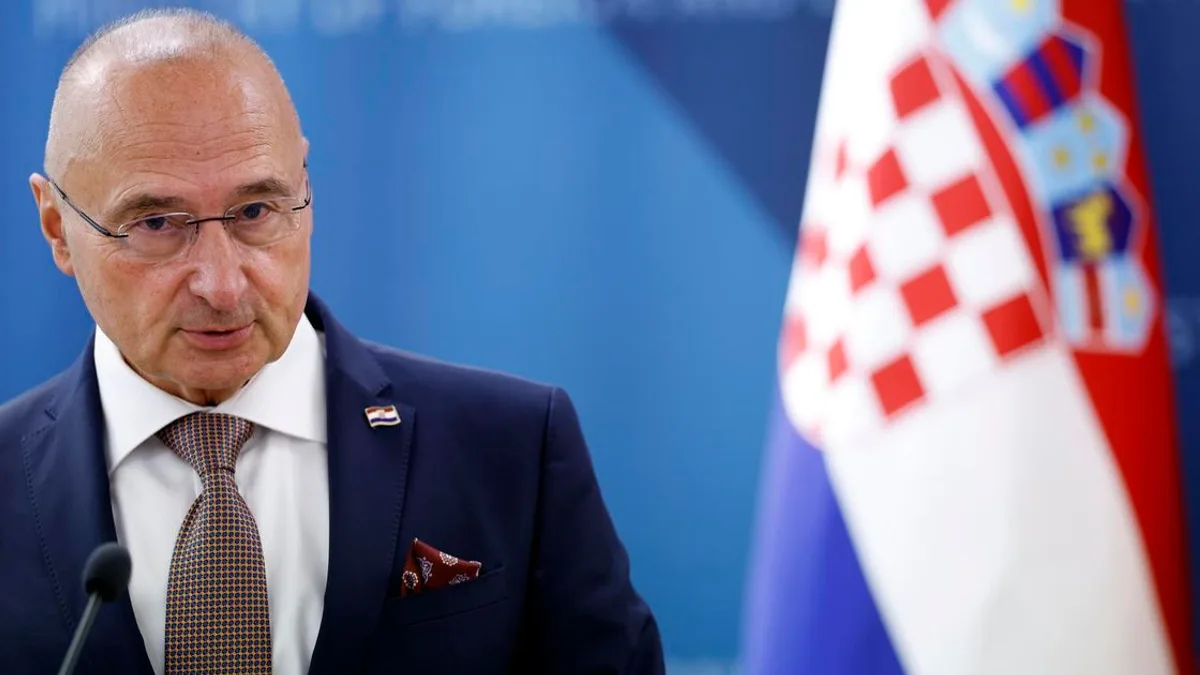
Croatian Foreign Minister Gordan Grlic Radman said on Sunday, September 13, in the Bosnian town of Jajce, that Zagreb expects the upcoming general election in Bosnia and Herzegovina to “correct the injustice” done to Bosnian Croats. The statement comes three weeks before the vote scheduled for October 4, and it raises a question that goes beyond Croat-Bosniak relations: the legitimacy of the entire system for electing the Presidency of Bosnia and Herzegovina, the same system under which the Serb people, through the Republika Srpska entity, elect their own representative by the identical Dayton-era logic that Zagreb has now publicly called into question.
Grlic Radman traveled to Jajce as an envoy of Prime Minister Andrej Plenkovic, for the commemoration of the 31st anniversary of the city’s liberation in the military and police operation “Maestral,” carried out on September 13, 1995. The Croatian minister used the occasion to repeat that Zagreb still openly backs the candidacy of Darijana Filipovic, deputy leader of HDZ BiH, for the Croat seat on the Presidency of Bosnia and Herzegovina.
“We are talking about the peace that was finally implemented through the Dayton Agreement, which was supposed to bring equality to all three constituent peoples. We expect the injustice that has occurred in practice to be corrected. We hope it will be corrected now, in this upcoming election,” Grlic Radman told reporters in Jajce.
Three candidates for the Croat seat
Three candidates are competing for the Croat seat on the Presidency of Bosnia and Herzegovina in the October 4 election. Alongside Darijana Filipovic, backed by HDZ BiH and by the parties gathered in the Croatian National Assembly (HNS), a candidacy was also filed by the so-called Croat opposition five, a coalition of five parties that has put forward Zdenko Lucic, a retired brigadier general and lawyer from Ljubuski, as its candidate. The third candidate is Slaven Kovacevic, nominated by the Democratic Front, led by Zeljko Komsic.
Komsic is precisely the reason Croatian officials have spoken of “injustice” for years: on four occasions he was elected to the Croat seat on the Presidency of Bosnia and Herzegovina largely with Bosniak votes, against the will of the majority of Croat voters, and a similar pattern has repeated itself in the election of delegates to the Croat caucus of the House of Peoples, both at the level of the Federation of Bosnia and Herzegovina and at the state level. Kovacevic, according to Croatian media, follows the same political pattern as Komsic and is counting on support from outside the Croat electorate.
Grlic Radman repeated that Croatia wants to see politically responsible people of mature character on the Presidency, with experience, knowledge and continuity, and he called on citizens, and especially Croat voters, to turn out to vote.
“I hope for success in the election, but it is equally important that all citizens, and all Croats, turn out to vote,” he said.
Why Bosnia’s election is being watched in Belgrade too
Although the Croatian minister’s statement addresses only the election of the Croat representative, it opens a broader debate about the fairness of the formula used to elect the Presidency of Bosnia and Herzegovina, the same formula that determines how the Serb member from Republika Srpska is elected. Any argument that entity or Bosniak majorities can outvote the electoral will of one constituent people, in this case the Croats, sets a precedent that Banja Luka and Belgrade follow just as closely whenever it touches Serb representation in Bosnia’s joint institutions. The October 4 presidential election will therefore not be only an internal matter for Bosnian Croats, but also a test of how well the Dayton architecture, the same architecture that underpins the status of Republika Srpska, still functions as it was designed in 1995.
Jajce, a symbol linking military and election history
Grlic Radman also stressed the significance of Operation Maestral itself, in which the Croatian Army and the Croatian Defence Council, together with actions by the Army of Bosnia and Herzegovina on other fronts, liberated Jajce, Drvar, Sipovo, Bosansko Grahovo and Glamoc on September 13, 1995, along with the mountain passes of Ostrelj and Mliniste, more than 1,000 square kilometers of territory in total. Seventy-four Croatian soldiers were killed in the operation and 226 were wounded. Maestral was followed by “Juzni potez” (Southern Move), in which Croatian forces and the Croatian Defence Council took Mrkonjic Grad and advanced to the outskirts of Banja Luka, a push that, as it is still assessed in Zagreb today, significantly shifted the balance of power on the battlefield and helped force the Serb side into peace talks at Dayton.
That link between the military past and the electoral present is not incidental in the Croatian minister’s remarks. In Croatian political narrative, the Maestral anniversary serves as a reminder of the price Croatian forces paid for territorial gains that, Zagreb argues, were never sufficiently translated into political equality for Croats in postwar Bosnia and Herzegovina.
Bosnia’s general election will be held on October 4, and the result of the vote for the Croat member of the Presidency will show whether the injustice Croatian diplomacy has pointed to for years actually produces a different outcome than in the previous four election cycles.