Kolasin Ski Pass Proposed at 40 Euros for 45 km of Slopes
The Kolasin 1450 and Kolasin 1600 ski resorts could operate as one again after two seasons. The price is not yet agreed, and there will be no artificial snow on Bjelasica this winter either.
Skiers from Serbia who spend the winter in the Montenegrin mountains now have the figure that decides both the price and the scope of the offer: Montenegro Ski Resorts has proposed that a joint ski pass for Kolasin 1600 and Kolasin 1450 cost 40 euros, which after two seasons apart would again mean about 45 kilometers of slopes on a single ticket. The price is only a proposal, though, and no opening date for the season has been announced.
How much would a joint ski pass in Kolasin cost?
Bojana Medenica, director of Montenegro Ski Resorts, said negotiations with the Kolasin 1450 ski center are under way and that the proposed price is already on the table.
“The Kolasin 1600 and Kolasin 1450 ski centers will have a unified ski pass. Negotiations are under way, and the price proposed by Montenegro Ski Resorts, let me put it that way, is that the ski pass for both ski centers, that is, for some 45 km of slopes, will be 40 euros. The Kolasin 1600 ski center will have a ski pass only for the infrastructure it controls, and the price will be 30 euros,” Medenica said.
In other words, 40 euros covers both areas, and 30 euros buys a ticket valid only on the Kolasin 1600 slopes. The portal Aktuelno, citing its own information, reports that the joint day pass was originally agreed at 35 euros and that the state-owned resort is now asking for more. It sees the reason in the government’s announcement of a “Euro model” for wages, but no participant in the negotiations has confirmed this, so it is the portal’s claim, not a confirmed fact. For comparison, Aktuelno says an adult day ticket at Kolasin 1450 cost 15 euros last season, according to the official price list.
What happened to the K7 cable car pylon?
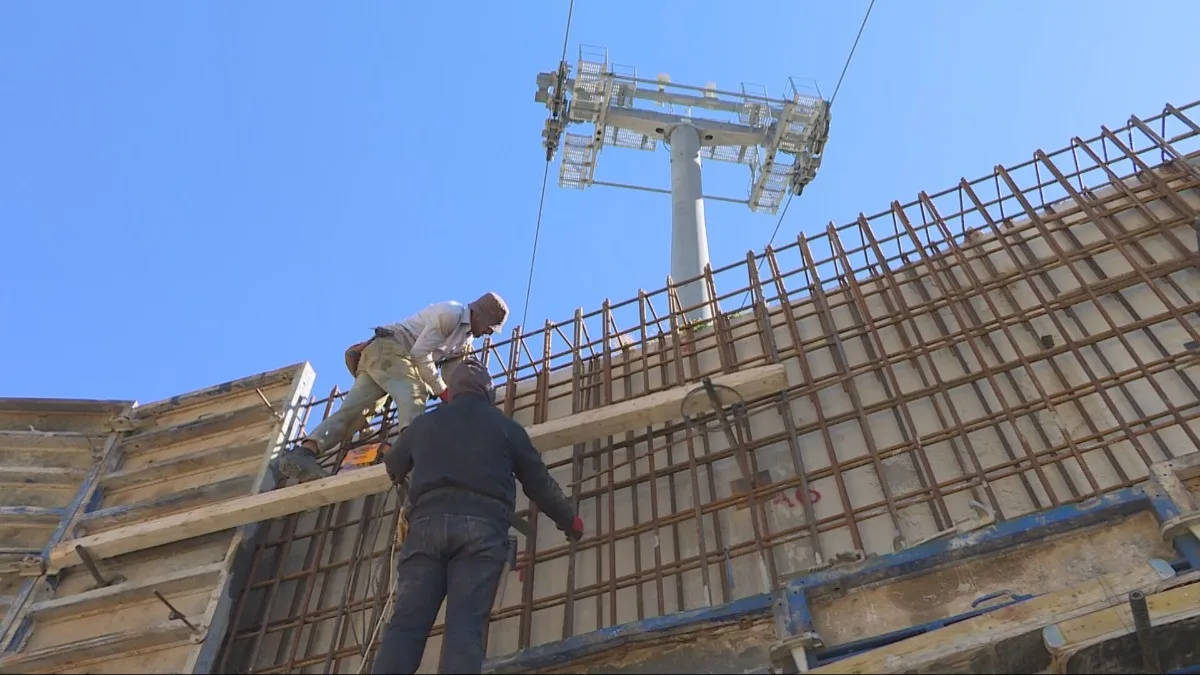
The two centers have been separated since spring 2024, when pylon number 4 on the K7 cable car was damaged by works on a neighboring private plot. According to RTCG, a contract for stabilizing the ground was signed over the summer. Contractor Mirko Maksimovic of the firm M solution says the job is nearing completion.
“The drilling and grouting of the horizontal and vertical anchors is finished. The reinforcement and formwork of the retaining wall are also finished. The first section of the retaining wall has been poured, and literally today the second section is being poured, so we are entering the final stretch of the works,” Maksimovic said.
He settled the question of the pylon’s safety with surveying measurements:
“The geodetic tests showed that, although the old wall gave way and, let me put it that way, structurally shifted slightly, the foundation of the pylon itself and the pylon did not move. So I am sure that, after all the works that will be carried out, the pylon will be 100% safe,” Maksimovic said.
The contractors promise the reconstruction will be finished before the season starts.
Why is there still no artificial snow on Bjelasica?
Reconnecting the slopes does not mean Kolasin will keep up with regional ski centers, because the snowmaking system will not be running this winter either. Vasilije Ivanovic, deputy mayor of Kolasin, explained where the project stands.
“We are currently at the stage of choosing the best bidder, or rather not us, but the Ministry of Public Works, for building the storage lakes on Bjelasica, and the final stage is procuring the snowmaking system, or rather the cannons, and I think that could happen relatively quickly, but the main precondition is the water, which is simply essential for producing artificial snow, and we think we should soon have some outcome of that tender procedure,” Ivanovic said.
The Ministry of Public Works published the tender Ivanovic mentions on July 10, 2026. It covers the main design and construction of artificial reservoirs with pipelines for Kolasin 1600, on a “design and build” basis. The estimated value is 6.2 million euros without VAT, and two reservoirs with a combined capacity of about 77,000 cubic meters are planned. Aktuelno recalls that the state first planned snowmaking back in 2018, as part of the K7 cable car tender, and comments that “a tender is not snow”, meaning that a published procurement does not yet mean a working system. That is the portal’s assessment, not a statement from the responsible ministry.
So the outcome remains tied to the weather: whether skiers get all 45 kilometers depends solely on snowfall.