East Sarajevo: 'Genocidaires' Graffiti on Tricolor Mural
The writing appeared a day after posters of Alija Izetbegovic went up. Sinisa Karan wants those responsible identified, and Milorad Dodik says he will not be shaken.
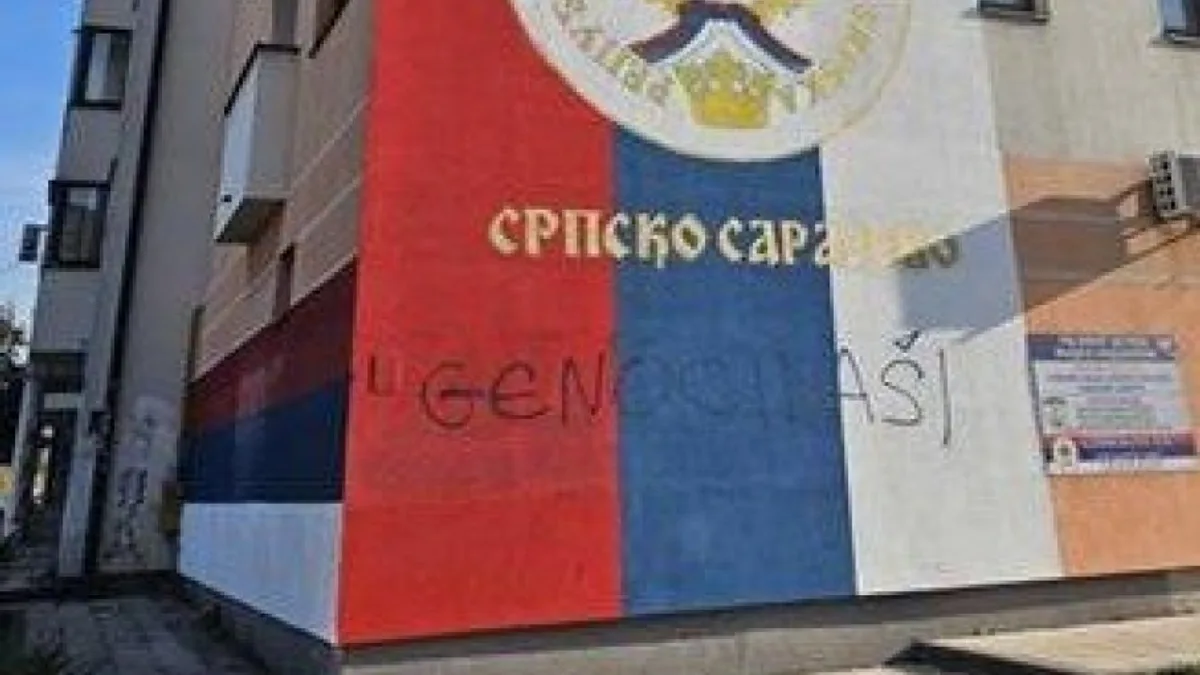
The dispute over the wartime legacy, which Sarajevo and East Sarajevo have fought for years over signs, billboards and walls, has gained a new episode, and the top officials of Republika Srpska reacted to it at once. This morning, October 20, it was noticed on Spasovdanska Street in East Sarajevo that the word “genocidaires” had been written across a mural of the Serbian tricolor painted on one of the buildings.
Police have secured that part of the street since this morning. Local police arrived to conduct an on-site investigation and identify the perpetrators, but who wrote the graffiti is not known.
What came before the graffiti in East Sarajevo?
A day earlier, October 19, on the 23rd anniversary of the death of Alija Izetbegovic, the former president of the Presidency of Bosnia and Herzegovina, posters with his image appeared on billboards in East Sarajevo. The text was written in Cyrillic and in English: “23 years later - bloody hands have not been washed clean by death, nor have those responsible for crimes against the Serbian people been forgotten.”
Who put up and paid for the posters is still unknown. East Sarajevo Mayor Ljubisa Cosic, a member of the Alliance of Independent Social Democrats (SNSD), said he does not know who is behind the action himself, but that he supports it. The Sarajevo Memorial Center and the youth wing of the Party of Democratic Action (SDA) condemned the posters. The municipal police acted only after a report from the company that owns the billboards, and some of the posters were removed. We have already reported on the posters and the mayor’s support.
The back-and-forth over monuments, signs and messages is not new. It began in 2023, when welcome signs were put up on the approaches to Sarajevo reminding visitors that the city was under siege for more than 1,675 days. East Sarajevo’s city administration answered with its own signs at the city entrances, saying that 175,000 Serbs live there who had to leave Sarajevo.
What did Karan and Dodik say?
Republika Srpska President Sinisa Karan, in a statement to Srna, condemned the graffiti in the strongest terms and asked the competent institutions to establish all the circumstances without delay, identify those responsible and take the measures prescribed by law. He added:
“The Serbian people do not dispute anyone’s right to an identity, but they also do not accept having their name, history and tradition of freedom humiliated. The Serbian tricolor is a symbol of our pride, freedom and endurance, and its colors cannot be defiled by anyone’s hatred through an offensive inscription.”
Karan also said it was an act of vandalism that is “deeply offensive” and “unjust to its history and its victims,” and that peace, stability and mutual respect have no alternative.
SNSD leader Milorad Dodik, in a statement to Srna, said the vandals who wrote the graffiti should know that neither threats nor shameful messages will shake the Serbs, just as they did not shake them in the 1990s. He said:
“Our flag, our symbols and our Republika Srpska did not arise from genocide, but in peace, from the will of a people to survive, because where it lived it was no longer free or accepted.”
Dodik recalled that East Sarajevo was not created out of spite, but out of the need of the Serbian people to endure:
“We know who we are, what we are and where we were expelled from. We know what we defend today in East Sarajevo and across Republika Srpska, and their provocations only prove how necessary and inevitable our perseverance is, especially in a city that rose from the ashes.”
He finished by adding: “We wish no harm to anyone, nor do we want to insult anyone, but we will not allow ourselves to be trampled either. East Sarajevo is a witness to our sacrifice and a symbol of our struggle for life.”
What is known about the investigations?
Police went to the scene of the mural graffiti immediately and are conducting an on-site investigation, whereas the posters required a report from the billboard owner. The author of the posters is not known so far, and neither is the person who wrote the graffiti. The outcome of the investigation led by local police has not been announced.