

Schmidt on Dodik and Putin: 11 Meetings, but No War Ahead
Bosnia's former high representative tells EUobserver he sees no danger of a new war, but warns of Russian influence in Republika Srpska and criticizes Belgrade.
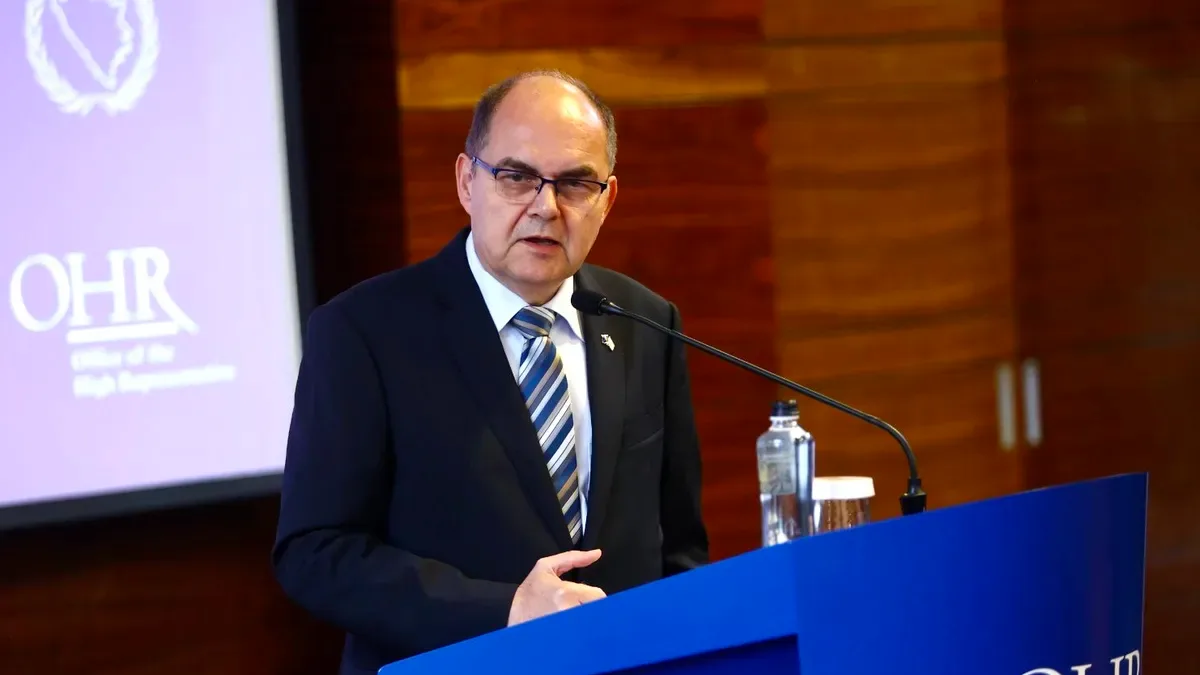
Christian Schmidt, the former High Representative in Bosnia and Herzegovina, openly criticizes Belgrade in an interview with EUobserver published October 12, citing Serbia’s reaction to the UN General Assembly resolution on Srebrenica and the burial of Ratko Mladic in the Serbian capital. He says Milorad Dodik has now met Vladimir Putin for the eleventh time since the war in Ukraine began, yet claims he sees no danger of a new armed conflict in Bosnia.
Schmidt held the post of High Representative from 2021 to June 2026. No successor has been chosen, and his former deputy, the American diplomat Louis Crishock, is temporarily running the office.
Why does Schmidt see no war, yet still sound a warning?
In Schmidt’s assessment, political quarrels and ethnic divisions are eroding citizens’ confidence that the state will survive as a whole, but that does not lead back to armed conflict. He bases that on the experience of people who lived through the war.
“The middle generation in particular suffered so much from the war and the siege of Sarajevo that it truly has no inclination toward any military conflict or conflict involving force. I think that is good news,” Schmidt said.
He sees the danger elsewhere: younger generations could come to accept the present situation as normal while not truly accepting it. “Even though I do not see a danger of war, I see that the positive achievements and success of Dayton could increasingly lose the high level of recognition they enjoy,” he warned. He described the slow approach to the European Union this way: “So we have ended up neither here nor there. We only have the principle of hope. Hope that something will come.”
What does Schmidt say about Dodik and Russia?
Schmidt says Russia is trying to influence part of Bosnia, above all Banja Luka and Republika Srpska, relying on ties with the Serbian Orthodox community as well as on media and social networks.
“Russia is trying to influence part of Bosnia and Herzegovina, especially Banja Luka and Republika Srpska, and Dodik in a way acts as a promoter of Russian interests. That truly is the case,” he said. On the meetings with the Russian president he added: “Dodik has met Putin for the eleventh time since the start of the war in Ukraine. That is truly striking.”
He rates Bosnia’s value to Moscow as almost nil, both economically and strategically. The country and Dodik are, as he puts it, useful to Russia as a tool for disrupting European and American action: “So it is seen more as an instrument than as an area of influence.”
Of the SNSD, Dodik’s party, Schmidt says it uses ethnic differences as an argument for support, “but, to be honest, not only they do,” and that “one can doubt their actual pro-European commitment.”
Where does Serbia fit in?
Schmidt notes that the Dayton Agreement provides for special ties between Serbia and Croatia and parts of Bosnia, and that these are not in themselves a violation of it. But he believes there are attempts at influence that go beyond that framework. As an example he cites Serbia’s reaction to the 2024 UN resolution on an international day of remembrance of the Srebrenica genocide.
“A truly striking attack was launched against it, even though Serbia was not named in the resolution,” he said. In his assessment, the All-Serb Declaration came out of that wave. It can be seen as cultural bonding among members of the same people, but Schmidt also sees a political purpose in it: “At the same time it should be seen as an instrument of an attempt to achieve greater political influence in part of another country.”
He gave no simple answer to the question of whether the Office of the High Representative is still needed. Instead he brought up the burial of Ratko Mladic: “How is it possible that one of the main war criminals and perpetrators of genocide, General Ratko Mladic, receives a state-like funeral ceremony in Belgrade and obviously enjoys great support?” In his view, that shows an honest debate about the past has not yet taken place.
What does he ask of Brussels?
Schmidt says the European Union must not rely only on programs and money, and that accession negotiations should not be treated as the whole set of instruments. He praised the work of European Commissioner Marta Kos, but calls for a more direct approach to young people and a stronger EU presence on social networks. “If we go back to Russian influence, they are masters at it. The European Union is very restrained,” he said.
He recalled that the Thessaloniki summit took place in 2003, while Bosnia received candidate status only in December 2022, with, as he sees it, considerably lowered expectations and conditions. “Now not even those small steps are being taken,” he warned. The consequence shows up in demographics: some young people, he says, decide to leave, most often for EU member states.
Still, Schmidt finds reasons for optimism too, among them protests by students and teachers in central Bosnia against divided schooling. He closes the interview with the line: “So, a community exists, but not a political community.”
What is Dodik’s version of Schmidt’s departure?
Schmidt’s assessments come after Dodik’s appearance on RTS over the weekend. The SNSD leader gave his own account there of talks with the administration of Donald Trump which, according to him, led to the lifting of American sanctions and to Schmidt’s departure. He claimed that one of the demands was that Schmidt leave, that he was told in America he could go straight to Germany, and that he asked only to pick up his things in Sarajevo. According to Dodik, he learned of the lifting of sanctions upon landing in Moscow, on a flight from Minsk.
In the same conversation Dodik softened his own thesis: asked whether the Americans had heeded his demand, he replied that he does not think they listen to him, but that “circumstances aligned.” None of the reports carried by the media has independently confirmed his claims, and the parts of Schmidt’s interview published by N1 BiH and Index.hr contain no reference to Dodik’s version.


