Alta Banka Bitola Branch Opens for Pensioners Without Cards
After the central bank imposed temporary administration, Bitola branches serve pensioners without cards, while the opposition SDSM demands a probe into how Serbia's Alta Banka got in.
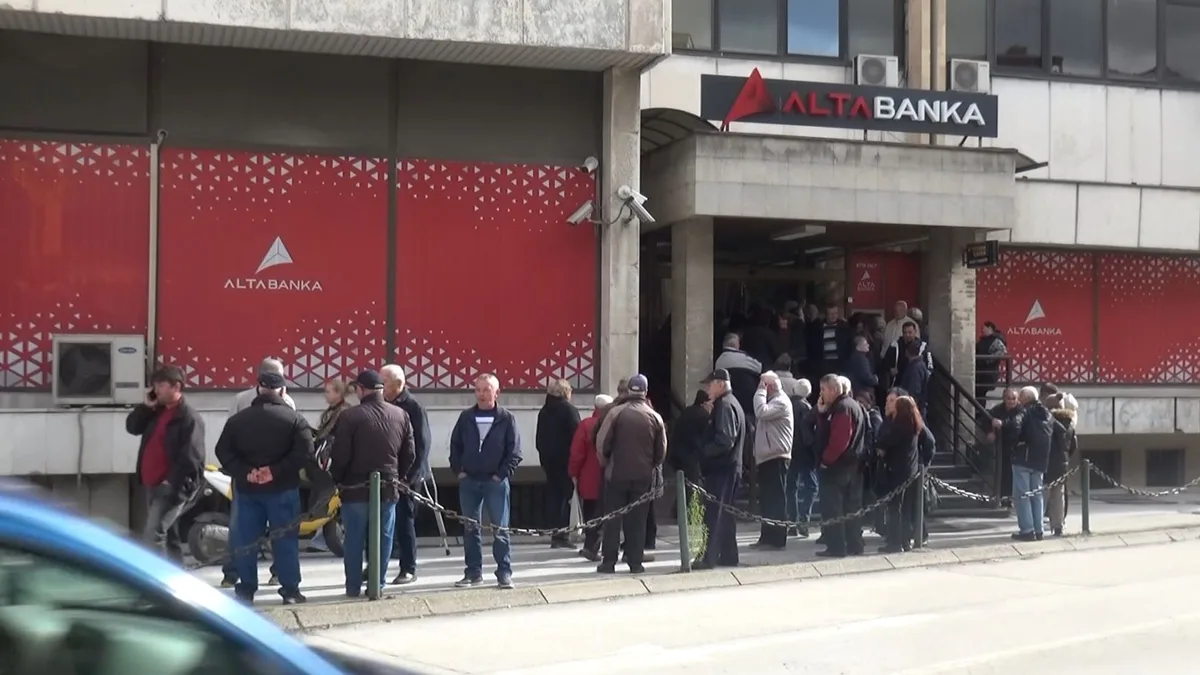
Alta Banka branches in Bitola are opening for pensioners and welfare recipients who have no payment cards, according to N1, after the National Bank of North Macedonia placed the bank under temporary administration on Sunday, November 1. The Bitola bank, formerly Stopanska Banka, is majority owned by Alta banka a.d. Beograd, whose license the National Bank of Serbia revoked overnight between October 30 and 31, so the fallout from the decision made in Belgrade is now being felt in a neighboring country. We reported earlier on the temporary administration itself and the cap on cash withdrawals.
What has changed for customers in Bitola?
The National Bank of North Macedonia’s measures can last up to three months. Account holders without payment cards, mostly pensioners and welfare recipients, have been unable to withdraw money since Monday, and the branch doors were last open on Saturday. Until the reopening, they could only use ATMs.
N1 gives the withdrawal limit differently in two articles. One says it is capped at 10,000 denars a week, which by that outlet’s calculation is slightly more than 600 euros a month, roughly the average salary in the country. The other puts it at about 150 euros a week, or about 600 euros a month.
An N1 reporter noted deep distrust among the people gathered outside the bank. One local woman, whose name was not published, told the outlet:
“A closed bank, closed doors, everything is closed.”
The Macedonian Stock Exchange put the bank on its Watch List on November 2.
What does the central bank governor say?
Trajko Slaveski, governor of the National Bank of North Macedonia, maintains there were no illegal transfers and no large inflow of money, and that both regular and extraordinary inspections were carried out. According to him, after October 26 the outflow from Alta Banka Bitola to Serbia came to about 180,000 euros, and the inflow from Serbia to about 16,000 euros. He told N1:
“In the period from October 26, after the elections in Serbia, until Monday, when we had complete control, only 16,000 euros was transferred to Macedonia through Alta Banka to clients.”
Slaveski added that he has no insight into other banks and sees no indication of other transfers. N1 also reports that the governor said they learned about developments around Alta Banka in Serbia from the internet and received no communication or request for checks from Serbia, even though the two central banks have a cooperation memorandum. The Macedonian Finance Ministry told N1 it has received no request from Serbia for cooperation or for checks on fund transfers. In Serbia, meanwhile, the talk is of more than 380 million euros that prosecutors say the bank’s owner, Davor Macura, took out of its vault.
What does the opposition claim?
Jan Fickoski, a member of the Executive Committee of the Social Democratic Union of Macedonia (SDSM), stood in front of the Bitola branch and told N1 that Alta Banka’s entry was a political deal between Aleksandar Vucic, whom N1 calls the former president of Serbia, and Prime Minister Hristijan Mickoski:
“Eleven months ago we said publicly for the first time that the entry of Alta Banka Belgrade into Macedonia’s banking system was practically an order from Vucic to Mickoski, a piece of political servility that the citizens of Bitola are paying for today, as you can see behind me.”
Fickoski claims the intention was to turn Macedonia into a “laundromat for dirty cash taken out of Serbia.” He recalled that, as he puts it, the European Central Bank opposed Alta Banka’s purchase of shares in Adiko Banka, yet the Macedonian National Bank allowed the entry anyway. According to him, as soon as Alta Banka lost its license in Serbia, SDSM demanded an investigation in North Macedonia as well.
He singled out the timing and scope of the measure:
“On Saturday the governor of the National Bank claimed there was no need for any fear or panic and that the opposition was spreading panic. Twenty four hours later he came out with a decision to impose temporary administration on Alta Banka Bitola and to limit the amount individuals can withdraw. What is very telling is that they did not introduce such a limit for companies.”
Fickoski considers that a channel through which money can keep flowing. He described Macura as a man who, since 2008, when he ran an exchange office in Zemun, quickly became one of the most serious bankers in Serbia and the region. Macura was recently arrested in Serbia.
Cooperation between the authorities in the two countries, according to Fickoski, was built by Deputy Prime Minister Ivan Stojiljkovic. Fickoski also spoke about politics:
“Yesterday I saw a video of Aleksandar Vucic in which he started getting involved in politics in Macedonia. We can probably expect him to campaign for the ruling VMRO here, because I assume he has reasons to protect them.”
He also noted that the Informer television channel, which Serbia’s regulator REM penalized for a serious breach of the law, is broadcast in the country, and that Euronews has been broadcasting without a license since September. He added: “And even before that, 40 percent of the media was owned by businessmen close to Viktor Orban.”
Andrej Zernovski, SDSM’s secretary for international cooperation, takes the same line. In an interview with Alsat television he said:
“That bank was pushed to get in. Why? Because it was a business deal between Mickoski and Vucic.”
Zernovski recalled that SDSM warned almost a year ago about the bank’s questionable capital.