

Iran's Guard Lifts 2,000 km Missile Range Limit
Guard spokesman Hossein Mohebi says the self-imposed range cap no longer applies, while US Central Command extends its Iran blockade to land borders and the Caspian Sea.
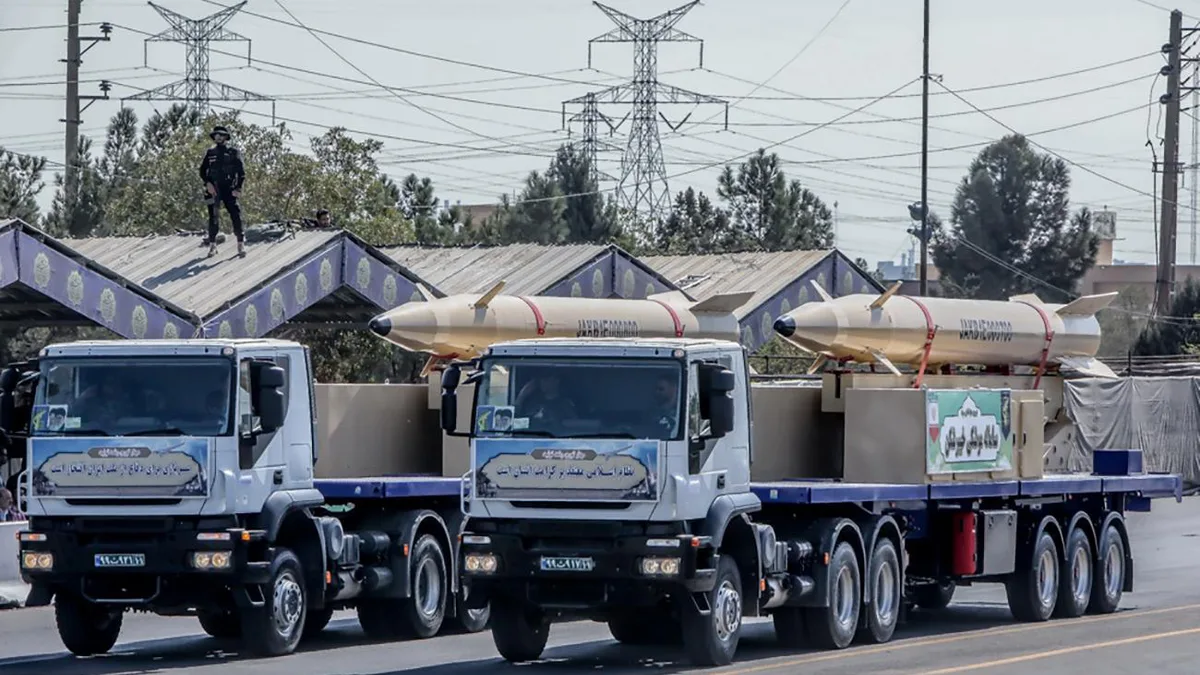
The Revolutionary Guard said on Saturday, November 7, that Iran is no longer bound by the 2,000-kilometer limit on ballistic missile range that it had set for itself. Guard spokesman Gen. Hossein Mohebi announced the decision at a press conference in Tehran. For the region that includes Serbia, the question is how far Iranian missiles can reach: according to Australia’s public broadcaster ABC, a longer range would cover parts of Greece and the Balkans, the whole Arabian Peninsula, the Levant and most of Egypt.
What did Mohebi say, and what did he leave out?
The press conference was held to mark the Guard’s Aerospace Force Week. Asked about the range limit, Mohebi answered briefly:
“For us, that limit has been lifted.”
For years Iran has claimed it voluntarily kept its missile range at about 2,000 kilometers, enough to reach Israel and US bases across most of the Middle East. Mohebi did not say whether Tehran has missiles that fly farther. He said only that capabilities should be shown in practice, not in statements. According to the Associated Press, it is not known that Iran possesses longer-range missiles.
The same day, Ali Bilali, an adviser to the commander of the Guard’s Aerospace Force, said Iranian missiles have a range of about 2,000 kilometers and strike accurately. Two statements from the same institution on one day do not say the same thing. Mohebi tied the decision to a recent message from the supreme leader that the response to any threat from the US or Israel will have no geographic limits. Sources differ on the leader’s name: Iran International names Mojtaba Khamenei, while the AP, in a report carried by KSAT, names Mojtaba Khomeini.
Mohebi also gave some historical background. In his telling, the late supreme leader Ali Khamenei ordered at some points that missile range not be increased, and at others allowed an increase. He also claims the Guard moved missile and drone production underground during the wars with Israel and the US, so production did not stop even during the bombing. He added:
“Any point from which we sense a serious threat to our country can become our target.”
Why is the range question back on the table?
American officials say technology from Iran’s space program could be redirected to build intercontinental ballistic missiles. In March, US and British officials said two ballistic missiles were fired toward Diego Garcia, a base in the Indian Ocean almost 4,000 kilometers from Iran. British Defense Secretary John Healey said one fell short of its target and the other was shot down. Iran denied responsibility.
Task Force Iron Gate: the blockade moves onto land
The same day, US Central Command (CENTCOM) set up Task Force Iron Gate, a unit of about 20 civilian and military personnel based in Tampa, Florida. Its job is to stop advanced weapons, sanctioned goods, dual-use technology and illicit proceeds from crossing Iran’s land borders and the Caspian Sea. CENTCOM commander Adm. Brad Cooper said in a statement:
“The establishment of Task Force Iron Gate cements the success of our tough blockade of Iran at sea.”
The statement does not make clear how the unit will operate or whether it will use military force. According to US figures, the naval blockade had diverted 144 merchant ships by the end of October. On Saturday, American forces used precision munitions to disable the St. Kitts and Nevis-flagged cargo ship M/V Huda in the Gulf of Oman: after visiting an Iranian port, its crew repeatedly ignored blockade warnings.
What else happened in the Strait of Hormuz?
The Iranian military said on Saturday evening that two tankers in the area hit mines and caught fire. Iranian state media also reported two explosions on Qeshm Island, as well as several explosions in the port of Jask. What caused them was not immediately known, and CENTCOM did not immediately respond to an inquiry from the AP. We reported earlier on the strikes on Qeshm and the burning tanker near Hormuz; these are new decisions from both sides.
President Donald Trump said on Friday that American forces had carried out new limited strikes on Iran’s air defense system, which he described to reporters as a “minor” action. The same day he spoke with the emir of Qatar about mediation. According to the AP, Iran is considering Qatari proposals on its nuclear program, but officials say Tehran does not want to negotiate over atomic activities until the US meets several conditions.


