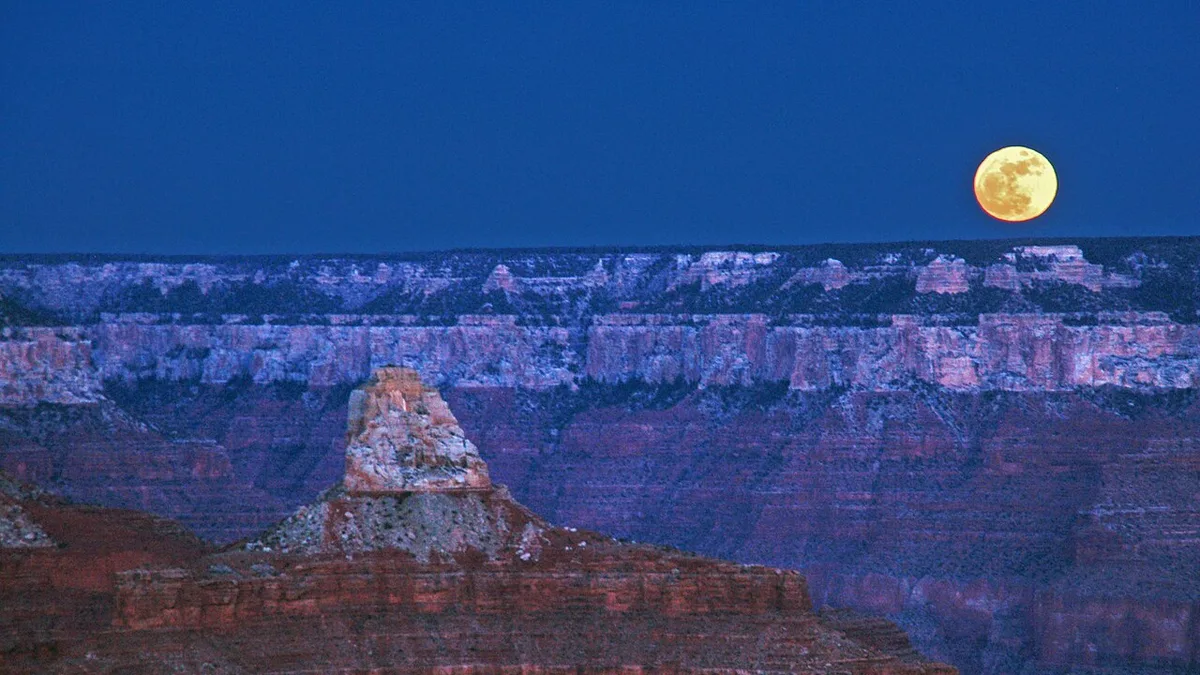
Strawberry Full Moon Rides Low: a Weekend Sky Show
The first full Moon after the solstice, on the night of June 29 to 30, hangs unusually low and may look orange, and before dawn on July 4 Mars and Uranus pass close together.

- The Strawberry full Moon, the first after the summer solstice, peaks on the night of June 29 to 30.
- Because it arrives right after the solstice, the Moon stays unusually low over the horizon and can look golden, orange or reddish.
- Before dawn on July 4, Mars and Uranus form a close conjunction, just about 6 arcminutes apart.
- All of these events are within reach of the naked eye or minimal optical aid, depending on sky clarity and light pollution.
Skywatchers in Serbia have an interesting weekend ahead. On the night of June 29 to 30 the Strawberry full Moon reaches its peak, the first full Moon after the summer solstice, and because of its place in the sky it will sit unusually low over the horizon. Only a few days later, before dawn on July 4, Mars and Uranus draw close together to form a tight conjunction that can be seen with minimal optical help.
The name “Strawberry Moon” has nothing to do with color. It comes from traditional Native American calendars, in which the full Moon at this time of year marked the short ripening season of wild strawberries. The color, by contrast, comes from geometry and the atmosphere, and that is exactly why this full Moon looks different to an observer than the ones we see in winter.
Why does the Moon look so low and orange?
A full Moon always sits opposite the Sun in the sky, so its path across the night mirrors the Sun’s, just shifted by six months. Since the summer solstice put the Sun at its highest, the full Moon that follows travels along a low arc and stays close to the horizon all night. That is a predictable consequence of the tilt of Earth’s axis, not a rare anomaly.
The low altitude is also the reason for the warm color. When we look at an object near the horizon, its light passes through a much thicker layer of atmosphere than when it is high overhead. The air scatters the blue wavelengths and lets the reds and oranges through, the same effect that gives the setting Sun its reddish tone. That is why the Moon can look golden, orange or even reddish as it rises, before gradually fading back to its usual white as it climbs.
The best moment to watch is around moonrise, just after sunset, when the sky is still bright and the Moon appears right above the landscape. No equipment is needed for this, only the naked eye and a clear view toward the eastern horizon, ideally away from strong street lighting.
A meeting of Mars and Uranus before dawn
The second half of the weekend’s program is a close conjunction. Before dawn on July 4, Mars and Uranus will appear separated by only about 6 arcminutes, roughly a fifth of the full Moon’s diameter. This is an apparent rather than a real approach, since the two planets are tens of millions of kilometers apart, but from our viewpoint they fall almost into the same line of sight.
Mars is bright enough to spot easily with the naked eye as an orange point, while Uranus is far fainter and, under light pollution, usually needs binoculars. Because of the small apparent gap, the nearby brightness of Mars helps locate Uranus, serving as a marker within the same binocular field.
All of this, of course, depends on weather and location. Clouds, haze and artificial light can cut visibility sharply, especially for the faint Uranus, and the low altitude of the Strawberry Moon means it needs an open view toward the horizon free of buildings and trees. None of these events is rare or one of a kind. The low post-solstice path of the full Moon repeats every year, and planetary conjunctions are routine. They are still worth following, because this pairing of a low orange Moon and a close meeting of two planets in the same week does not come around often.
Will you look for a clear view to the east this weekend and try to catch the Strawberry Moon just above the horizon?