Betelgeuse's Hot Spot Has Lasted Seven Years, ALMA Finds
Radio telescope ALMA has imaged the surface of red supergiant Betelgeuse and found a hot spot that has stayed in the same place for at least seven years, longer than models predict.

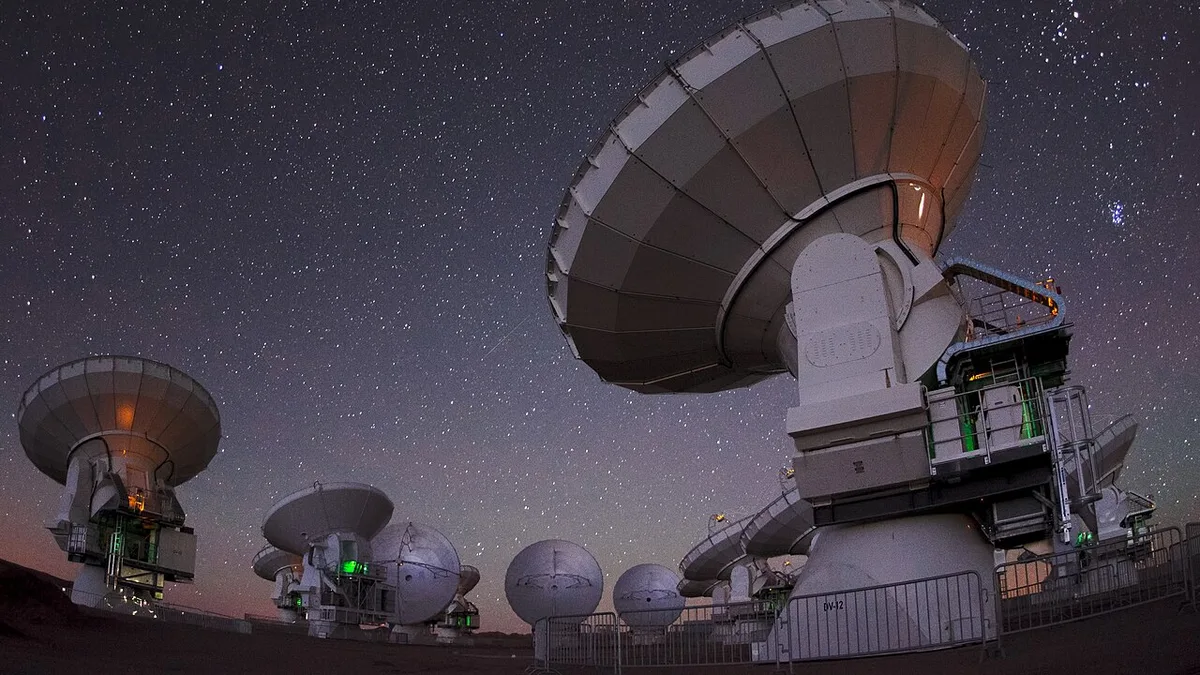
A team of astronomers led by Bill Dent, a researcher at the European Southern Observatory (ESO), has published a detailed image of the surface of Betelgeuse, the red supergiant in the constellation Orion, captured by the ALMA radio antenna array in the Chilean Andes. The image shows a highly uneven stellar surface with at least two hot regions, one in the northeast and one in the southwest of the star’s disk. By comparing the new data with older observations, the team found that the northeastern hot spot has stayed in the same place, at nearly the same intensity, for at least seven years. The paper has been accepted by the journal Astronomy & Astrophysics, and the ALMA observatory announced the results on August 24.
Betelgeuse has long been known as a star with a restless, bulging atmosphere, and in late 2019 and early 2020 it drew attention with a sudden, unusual dimming that was explained at the time by a cloud of dust ejected from its surface. The new observation goes a step further: rather than a single snapshot of a dimming event, it offers a comparison between two separate epochs, 2015 and 2023, and shows that at least one hot structure on the star’s surface persists far longer than astronomers expect.
The data were collected in 2023, when ALMA was used in its longest-baseline configuration, achieving an image resolution of about seven milliarcseconds. Such fine resolution is possible only because Betelgeuse, despite its enormous distance, is large enough for ALMA to resolve structures in its atmosphere that remain invisible on most other stars. The average temperature of the atmosphere is about 2,300 kelvin, while the brightest hot spot runs up to about 800 kelvin hotter than the surrounding gas.
Why has the hot spot lasted seven years?
The team interprets the structures as the result of enormous convective currents inside Betelgeuse. Hot gas rises from the star’s deeper layers and, on hitting the outer atmosphere, produces shock waves that leave brighter, hotter zones on the surface. Existing models predict that convective cells in stars this large should last considerably less than seven years, so the longevity of the northeastern spot, revealed by comparing the new data with 2015 images, does not fit easily with current expectations. The atmosphere also shows traces of silicon monoxide and carbon monoxide, molecules that point to a complex, uneven environment around the star. Betelgeuse’s apparent radius, according to the measurements, varies around its rim by as much as six percent, further confirming that the star’s shape is far from a perfect sphere.
A star whose size is still disputed
Sources disagree on the star’s basic parameters. The ALMA observatory’s statement puts Betelgeuse at about 600 light years away with a radius roughly 800 times that of the Sun, while the science news site Sci.News, citing the same paper, gives a distance of 724 light years and a radius about 1,400 times solar. Both sources agree it is one of the brightest known stars, radiating more light than 100,000 Suns, with an estimated age of eight million years. The paper itself, whose lead author is Bill Dent, is in preparation for Astronomy & Astrophysics, and a preprint is already available under the designation arXiv 2608.19339.
“Because it will one day end its life as a supernova, it’s fascinating to know what it actually looks like right now,” Dent said in the ALMA observatory’s statement. “When Betelgeuse finally explodes, it will be bright enough to be seen from Earth even in broad daylight.”
Even so, astronomers estimate that the explosion is not coming any time soon on a human timescale. The team notes that the orientation of the long-lived hot spots also raises the question of a possible link to a close companion of Betelgeuse, whose existence other papers have pointed to before, though this observation does not establish a direct connection between the two. What the image likewise fails to resolve is why this particular spot has held on longer than any previous prediction, or how long the convective structure will remain in place. Answering that, the authors say, will require new observations with the ALMA array in the years ahead.