ALMA images ring around dying star IRAS 06530-0213
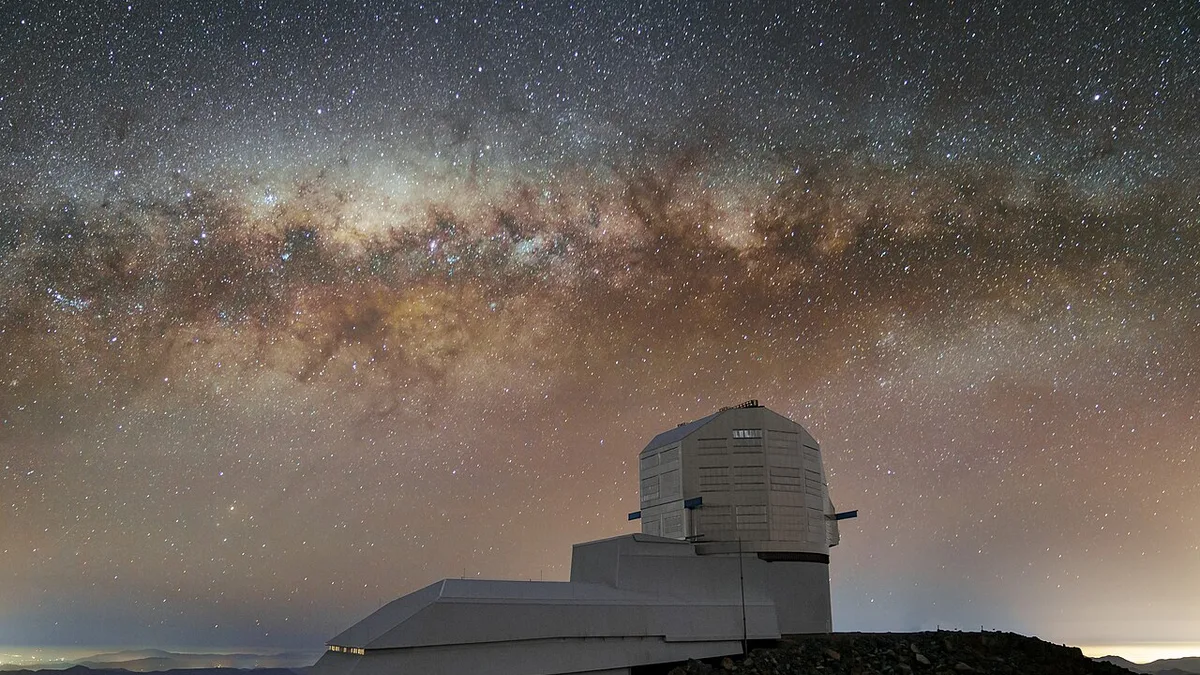
ALMA radio telescopes in Chile have imaged a circular ring around the pre-planetary nebula IRAS 06530-0213, which the authors read as a trace of a carbon star's last thermal pulse.
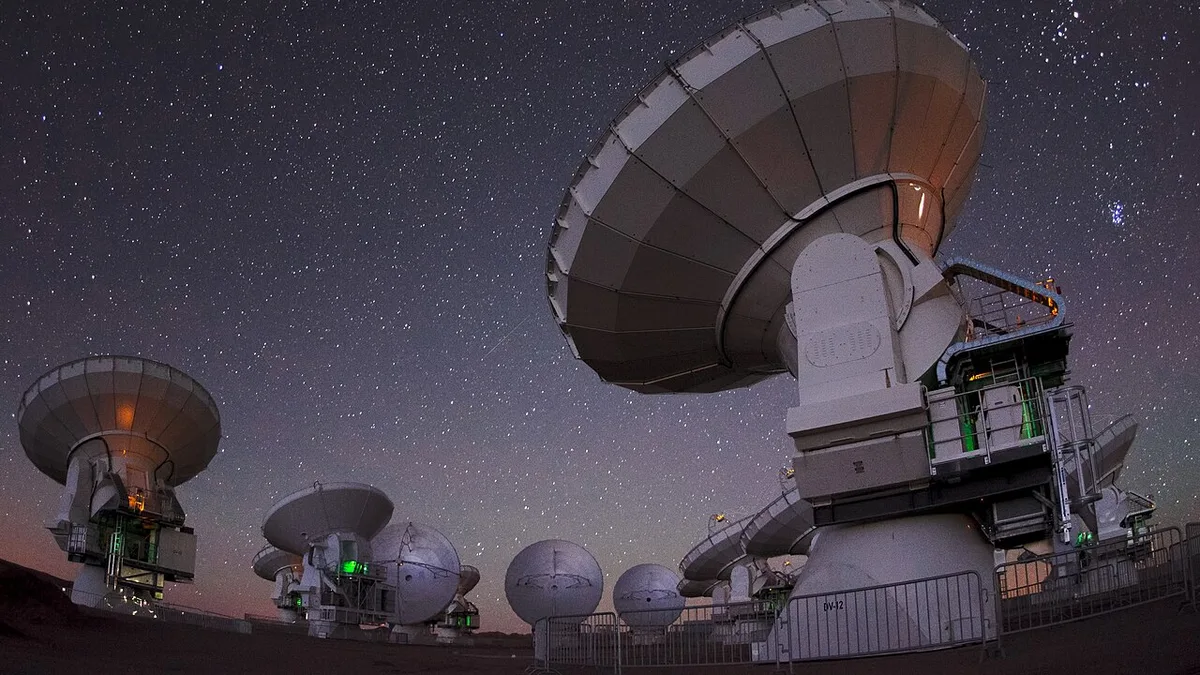
Around the star IRAS 06530-0213, which is on its way to becoming a planetary nebula, astronomers using the ALMA radio telescope array in Chile have imaged a circular ring with a radius of about 16,950 astronomical units. An astronomical unit is the average distance from Earth to the Sun, about 150 million kilometers, so the ring has a radius of roughly 0.27 light years. The authors of the paper, which has been accepted by The Astrophysical Journal, interpret the ring as the first evidence of a carbon star’s last thermal pulse before the post-asymptotic giant branch phase.
The paper was posted to arXiv on September 18, 2026, and accepted a day earlier, on September 17. The first author is Raghvendra Sahai of the Jet Propulsion Laboratory (JPL), and 19 researchers in all are listed on it.
What is IRAS 06530-0213?
It is a carbon-rich bipolar pre-planetary nebula. Stars with masses in the range of the Sun’s shed their gas shells at the end of life and become planetary nebulae rather than supernovae. In most of these objects the shape is not circular but two-lobed, multi-lobed or elliptical, which has long been an open question. The leading explanation is that fast, directed jets, most likely launched through an interaction with a companion, shape the slower wind from the inside.
The study is part of the PANORAMA survey, which aims to give simulations of that process high-resolution measurements of masses and gas motions. The object had also been imaged earlier by the Hubble Space Telescope, which made it a good target.
How was the ring measured, and what does it show?
The observations were made at an angular resolution of about 0.1 to 0.5 arcseconds, at wavelengths of about 0.44 and 0.88 millimeters. The team tracked carbon monoxide and other molecules to work out the density, temperature and mass of each region, and used the gas velocities to derive the age of the structures and the rate at which the star lost mass. From the star’s brightness, they estimated its initial mass at 1.6 to 3.4 times the mass of the Sun.
According to the authors, mass loss dropped after the flash and lasted about 2,000 years, then rose again ahead of the transition to the next phase. The central torus and the bipolar nebula formed within the last 700 years or so.
The region of arcs between the torus and the ring holds the most mass: it contains 0.12 to 0.25 solar masses of molecular gas, more than the ring or the central nebula. The arcs probably form part of a three-dimensional Archimedean spiral, like those seen around some swollen red giants with a companion. Their shape points to a hidden star at a distance of about 155 to 340 astronomical units from the main one.
Why are the fast jets missing?
Gas speeds above 50 kilometers per second are common in pre-planetary nebulae. In IRAS 06530-0213 no gas faster than 16.5 kilometers per second was found, and there is no compact dusty disk at the position of the star. The authors write in the paper:
“So it is rather surprising that we find no evidence for such high velocities in IRAS 06530’s spectra.”
The researchers offer a possible explanation: a short-lived disk may once have launched brief jets and then vanished. The separation from the companion makes strong interaction difficult, which they rate as “somewhat unlikely,” unless the orbit is elongated enough for the companion to approach the primary star. They also estimate that gas falling onto the companion could supply the energy for an outflow even at a distance of about 75 astronomical units.
The torus is strongly enriched in the isotopes carbon-13 and oxygen-17, and moderately in nitrogen-15, relative to solar values. That pattern does not fit standard models of nucleosynthesis.
What does this not prove?
The companion has not been seen but inferred from the shape of the arcs, so its existence and orbit rest for now only on an interpretation of the data. The claim that the ring comes from a last thermal pulse is the authors’ interpretation, not an independently confirmed finding. The absence of fast jets narrows the explanations but does not settle the open question of how non-circular shapes arise in pre-planetary nebulae. This is a single object, and PANORAMA has yet to show how typical the case is.