NASA Swift telescope falls to Earth, risk 1 in 2,100
The Swift observatory is due to re-enter the atmosphere on November 4, with an 11-hour uncertainty. Debris can land only near the equator, far from Serbia.
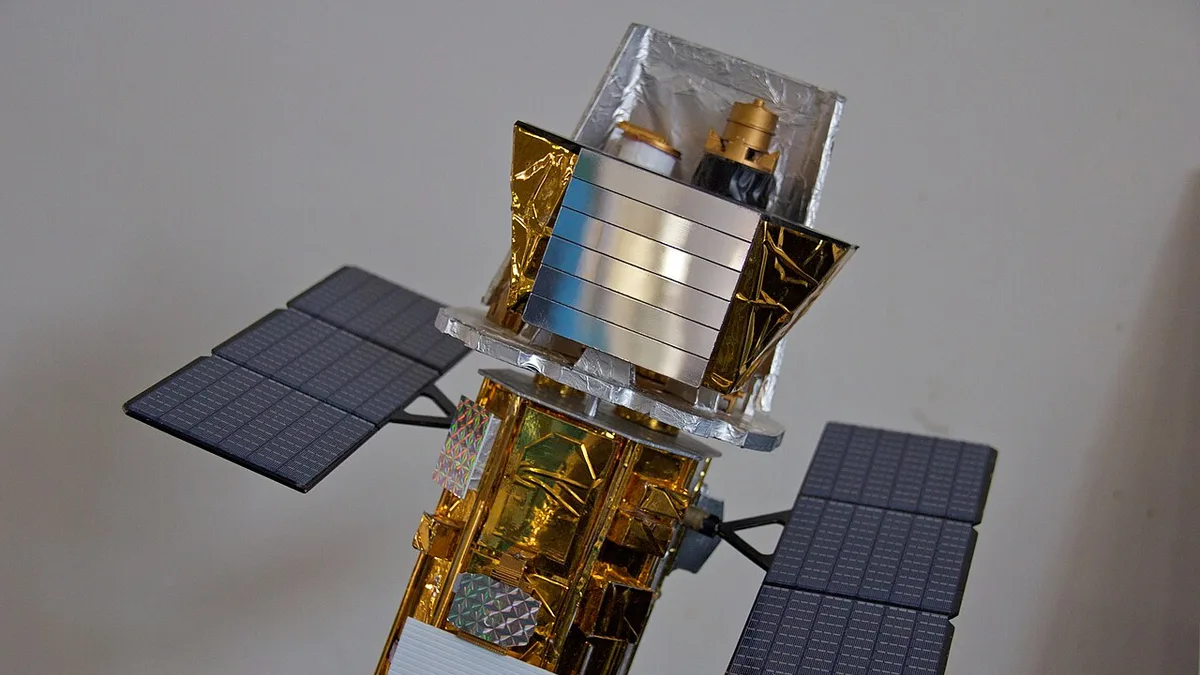
The Swift telescope, a NASA spacecraft weighing about 1,450 kilograms (3,200 pounds), is expected to fall out of orbit and enter Earth’s atmosphere today. According to a NASA blog post from November 2, the US Space Force estimates this will happen around 3:30 a.m. Eastern time on November 4, or about 9:30 a.m. Belgrade time, with an uncertainty of 11 hours. As of publication, no source has confirmed that the reentry has already taken place.
When exactly will it fall: three different estimates
Because the spacecraft is out of control, its reentry time is calculated from radar data and from measurements of the upper atmosphere, so the estimates shift as the end approaches. The window given by NASA runs from about 10:30 p.m. on Tuesday, November 3, to about 8:30 p.m. on Wednesday, Belgrade time. Australia’s ABC News cited two estimates that differ from it, which makes three in all:
- the SWORD program, funded by NASA: about 6:37 p.m. Belgrade time on November 3, give or take several hours
- the Aerospace Corporation: about 10:11 a.m. Belgrade time on November 4, give or take 12 hours
- the US Space Force, as reported by NASA: about 9:30 a.m. Belgrade time on November 4, give or take 11 hours
Sources also give the spacecraft’s mass differently. NASA and CBS News write about 3,200 pounds (about 1,450 kilograms), ABC about 1.5 tons, and Spaceflight Now about 1.6 US tons.
Where could the debris land?
NASA expects most of the spacecraft to burn up. NASA spokeswoman Elizabeth Shaw summed it up this way:
“NASA expects most of the spacecraft to burn up as it travels through the atmosphere.”
Some parts may still survive. Mission principal investigator Brad Cenko told CBS News that these are tungsten components, a metal denser than lead, and pieces of mirrors. Because the orbit is only slightly tilted relative to the equator (its inclination), debris can land only between 20.6 degrees south and 20.6 degrees north latitude. Serbia lies at about 44 degrees north, well outside that zone. The debris belt covers parts of Africa, Australia, India, Southeast Asia, and Central and South America, and ABC adds that the orbit crosses northern Australia, as far south as Mackay, Tennant Creek and Marble Bar.
Brad Tucker, an astrophysicist at the Australian National University, explained to ABC why the ocean is the most likely destination:
“If 70 percent of the Earth is ocean, 30 percent is land. So, three out of ten times it lands on land, not in the ocean.”
NASA puts the risk of anyone on Earth being harmed at about 1 in 2,100. “The risk that anyone on Earth would be harmed is low, approximately 1 in 2,100,” Shaw said.
Why did Swift fall before anyone could rescue it?
The spacecraft was launched on November 20, 2004, on a Delta 2 rocket, and its planned primary mission lasted two years. Its descent was sped up by heightened solar activity, which heats and expands the upper atmosphere and so increases drag. In June the telescope was at an altitude of about 340 kilometers.
In 2025 NASA paid the company Katalyst Space 30 million dollars for a rescue attempt. The LINK robot, launched on July 3, 2026, on the last Pegasus XL rocket, was supposed to grab Swift with three robotic arms and lift it to about 370 miles (about 595 kilometers). LINK lost control of its orientation and came no closer than 7 to 9 miles (11 to 14 kilometers). NASA abandoned the capture attempt on August 19, and LINK fell in September.
On October 20, at an altitude of about 275 kilometers, the telescope passed the point of no return. It entered safe mode, and operators at Penn State University sent a command that ended the mission. NASA Administrator Jared Isaacman assessed it this way:
“This is not the outcome we worked toward, but it doesn’t change why this mission was worth attempting.”
What Swift recorded in 22 years
According to Spaceflight Now, Swift recorded more than 2,000 gamma-ray bursts and studied more than 1,400 supernovae. Its archive holds about 12 terabytes of data and has been cited in about 7,000 papers. Among its important results are:
- 2005: the first afterglow of a short gamma-ray burst, which lasted 0.03 seconds
- 2008: a burst 7.5 billion light-years away that was briefly visible to the naked eye
- 2017: unexpectedly bright ultraviolet light after the merger of two neutron stars
John Nousek, an astronomer at Penn State University who led the control team, told CBS News:
“We knew this day would come even before Swift was launched.”
Tucker told ABC that Swift may not be as large and popular as Hubble or the James Webb Space Telescope, but that astronomers have used it for years: “It’s sad that it’s ending, but it’s been up there for 22 years.”
Hubble awaits a similar end
Swift is not the only older spacecraft that will fall. NASA expects Hubble, about 8.4 times heavier than Swift, to enter the atmosphere in 2033 or 2034. On October 29, NASA asked companies for proposals to boost, service or deorbit Hubble in a controlled way.
For Swift, every number in this article is an estimate, not a measurement. The exact time, the place of impact and which parts survive will be known only once the reentry is over and the Space Force and NASA release their data.