Orion Heat Shield After Artemis II: 9 Damage Spots, Not 103
Analysis of the capsule that flew around the Moon shows about ten times less cracking and char loss than on Artemis I, thanks to a changed re-entry trajectory.
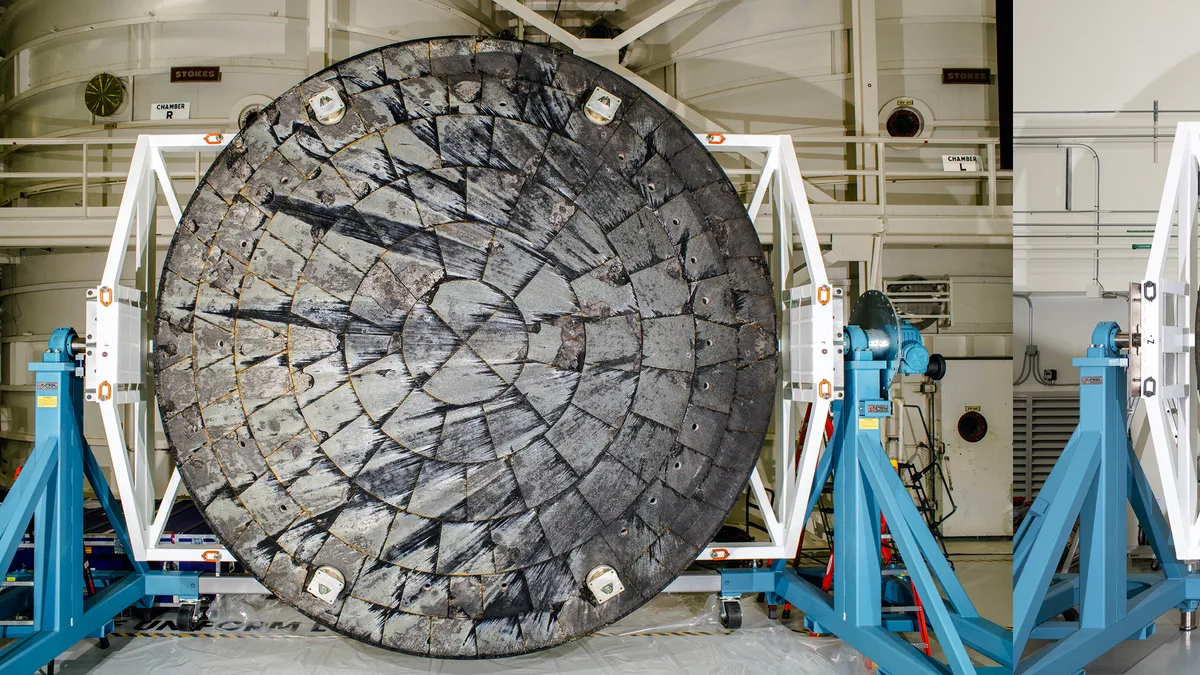
NASA has released the results of an additional analysis of the Orion capsule’s heat shield after Artemis II, the mission that took four astronauts around the Moon. Engineers found only nine spots where the charred layer came off, compared with 103 on the shield from Artemis I. Cracking and loss of that layer fell roughly tenfold.
What happened during re-entry?
The capsule splashed down in the Pacific Ocean off San Diego on April 10, 2026. It was the first crewed flight of Orion. On entry into the atmosphere it reached 39 times the speed of sound, and the outside temperature exceeded 4,000 degrees Fahrenheit, or about 2,200 C. Inside the cabin it was about 24 C (in the mid-70s Fahrenheit).
The return was also precise. Orion entered the atmosphere 59 meters (192 feet) from its target point and landed 0.95 kilometers (0.59 miles) from the planned splashdown spot. First inspections, including diver footage taken right after splashdown and a check aboard the recovery ship, already showed far fewer cracks and less char loss than on Artemis I.
Why did the shield perform better this time?
NASA credits the improvement to a change in trajectory, not to a new material. After analyzing the Artemis I findings, which also drew on testing in the arc jet tunnel at the Ames research center in California, the agency shortened the maximum distance the capsule may travel from atmospheric entry to splashdown. Pre-mission calculations showed that the shield would then spend less time in the temperature range in which the Artemis I phenomenon occurred.
The shield consists of 186 individual blocks of the ablative material Avcoat, which gradually chars and carries heat away as it warms. The post-flight inspection showed that the seams between blocks and the material around the bolts that release the compression pad performed the same as on the first mission. The capsule’s back shell, with about 1,300 ceramic tiles, also held up within predictions: there were no signs of overheating around the windows, vents, thrusters or the side hatch.
Where is the shield now, and what comes next?
After the return to Kennedy Space Center in Florida, specialists began an additional inspection, and the shield was then moved to the Marshall center in Huntsville, Alabama. There, sampling and X-ray imaging began in August. Sample processing and thermal analysis are continuing.
The shield for Artemis III has already been changed. After the Artemis I investigation, designers altered the design so that the Avcoat blocks have more uniform permeability. The shield was installed on the capsule in early July, and the crew module and service module were joined in late July. The spacecraft has since been powered on for the first time, which made it possible to check all the connections between the two modules.
Artemis III is planned for next year as a mission in low Earth orbit. It will carry Randy Bresnik, Frank Rubio and Andre Douglas of NASA and Luca Parmitano of the European Space Agency. The crew will rendezvous with test modules of the landers from Blue Origin and SpaceX. Moon landings begin with the Artemis IV mission in 2028.
What these findings do not prove
The analysis was published by NASA itself, the agency that sent the capsule into space, and the data it cites does not come from an independent check. Laser measurements of material wear have not yet been compared with pre-flight measurements, so a final figure for how much the shield actually lost has not been released. The statement says the spots where the charred layer was lost varied in size, but gives no dimensions. The 9 versus 103 comparison therefore shows how many damaged spots there were, not how much material disappeared.