Mars's South Is Hotter Inside Than Its North, Study Finds
New research in the journal Nature finds that the interior of Mars's southern hemisphere runs 200 to 400 degrees Celsius hotter than the north and is partially molten, a team from Arizona reports.
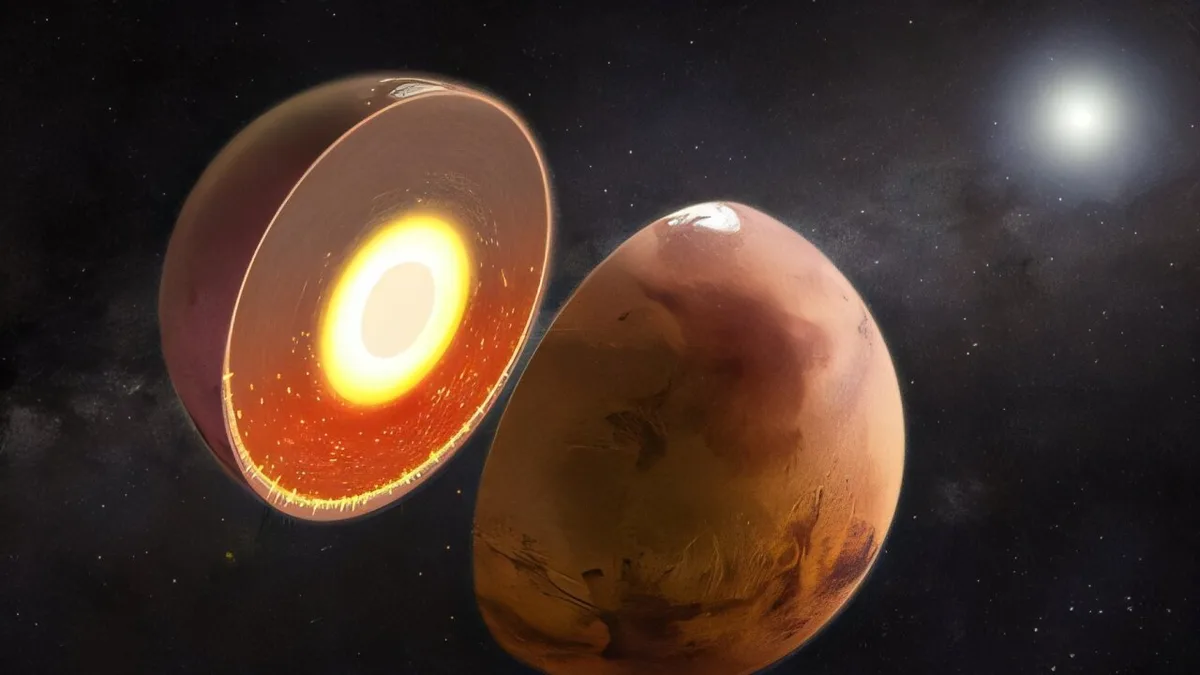
A new paper in the journal Nature, published on August 26, 2026, applies a technique called tidal tomography to Mars for the first time, and the result shows the planet is not symmetric inside. According to the paper, titled “Tidal tomography reveals a thermal anomaly beneath Mars’s crustal dichotomy” (DOI 10.1038/s41586-026-10893-x), the interior of Mars’s southern hemisphere runs 200 to 400 degrees Celsius hotter than the northern hemisphere and is partially molten. The lead author is Alexander Berne, who earned his PhD at the California Institute of Technology in 2026 and now works as a postdoctoral researcher at the University of Arizona’s Lunar and Planetary Laboratory. The paper’s co-author is Amirhossein Bagheri of Caltech, a former member of the InSight mission team.
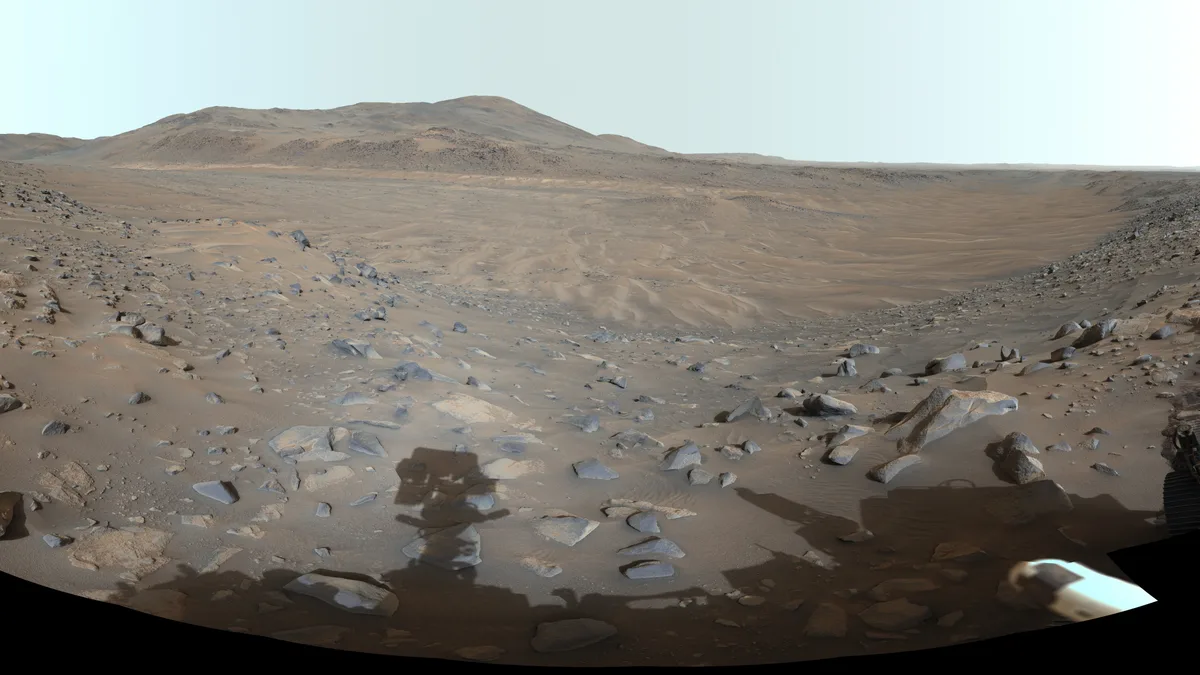
Mars’s surface asymmetry has been known for decades. The northern hemisphere is a low, smooth plain, while the southern hemisphere sits several kilometers higher, is heavily cratered, and far more rugged. The boundary between the two landscapes is known as the Martian crustal dichotomy, the single largest geological feature on the planet. Until now, almost everything known about Mars’s deep interior came from a single point: the seismometer on NASA’s InSight lander, which operated in the northern lowlands from 2018 to 2022. One station at one location cannot tell north from south, so most existing models of Mars’s interior assumed the planet was uniform, with the same rock at the same temperature at any given depth, all the way around.
“Scientists usually assume that the interiors of planetary bodies are largely spherically symmetric, but that isn’t necessarily true,” Berne said in a statement from Caltech.
To get around that limitation, the team turned to a method that doesn’t require landing on the planet. A Martian year lasts 687 days, and because of the planet’s slightly elongated orbit and tilted axis, the Sun’s gravitational pull on it varies in strength over the course of that year. That tidal force slightly changes Mars’s shape, enough to nudge the trajectories of spacecraft orbiting it. The team processed 16 years of radio tracking data from three probes, Mars Global Surveyor, Mars Odyssey, and Mars Reconnaissance Orbiter, and reconstructed how the planet’s gravitational field changed over time from tiny deviations in their orbits. The method is called tidal tomography. It has previously been used to map the interiors of Earth and the Moon, but had never before been applied to Mars.
“If Mars has a weird structure in its mantle, this signal will look different than if its interior were symmetric,” Berne explained to Scientific American.
The measured gravitational signal deviated from the symmetric scenario by as much as 300 percent. Based on how much the planet flexed over the course of a year, the team calculated that the stiffness of Mars’s mantle differs by more than 20 percent between the two hemispheres: stiff in the north, softer in the south. Softer rock is typically also hotter, but a raw reading of a 20 percent difference would imply a temperature gap of more than 1,000 degrees Celsius, which is impossible, since it would mean the entire southern half is molten, and that is not what is observed. Once the team added the planet’s slower, annual stretching into the model, they arrived at a more realistic difference of a few hundred degrees. The thickness of Mars’s crust also differs between the hemispheres, by roughly 25 kilometers.
“The closest analogy for Earth would be the difference between the continents and the ocean floor, if there were no oceans,” says Berne, a planetary scientist at the University of Arizona and the paper’s lead author.
What caused the thermal asymmetry?
The cause of the difference has not been established. The authors weigh three possibilities: a large impact that released heat from the north long ago, earlier spontaneous convection in the southern part of Mars’s mantle, or thick geological layers in the south that have kept excess interior heat from escaping for decades. According to the model, the boundary between the harder and softer rock tracks the line of the surface dichotomy almost exactly, including the places where that boundary bends north or south, a detail that surprised the team itself.
The finding is also being linked to other, previously recorded anomalies in the south: the magnetic properties of iron-bearing minerals in the southern crust, and the slower seismic wave speeds recorded by the InSight mission. Both could be explained simply by the south being hotter, and the finding is also being connected to the formation of large basins and to the past movement of water on Mars.
“The division we see between north and south is important to understand because it gives us data on processes that may have influenced the movement of water on Mars,” says Amirhossein Bagheri, a Caltech postdoctoral researcher and the paper’s co-author.
The paper has met a cautious reception from scientists who were not involved in it. Amir Khan, a planetary scientist at the Swiss Federal Institute of Technology in Zurich, calls the method noteworthy but warns that the interpretation still depends heavily on the assumptions built into the model. “It’s an interesting approach to getting data on Mars’s internal structure,” Khan tells Scientific American.
Paul Byrne, a planetary scientist at Washington University in St. Louis, points to an inconsistency the paper doesn’t address: Mars’s largest volcanic province, Tharsis, sits at the edges of the crustal dichotomy rather than in the southern highlands, where, according to the study’s findings, the mantle underneath should be hottest. “There are still questions to be answered,” Byrne tells Scientific American.
Berne adds that the method, regardless of what it found on Mars, is valuable in its own right, since it works entirely from orbit. “We always complain about space agencies’ huge budgets. This is a way to make it a lot cheaper,” he says, noting that tidal tomography could also be applied to Mercury, Saturn’s moon Enceladus, or Pluto, bodies whose interiors are unlikely to be reachable by landed instruments anytime soon.
The paper rests on modeling gravitational deviations measured from orbit, not on a direct measurement of temperature inside the planet. That means the finding does not conclusively prove either the cause of the asymmetry or that a thermal anomaly is the only possible explanation for the measured signal, a point Khan raises as well. The inconsistency around the position of the Tharsis volcanic province that Byrne flags also remains, and it does not fit easily into the current model. The next step, according to Berne, would be to directly measure temperature at multiple locations using instruments on the surface of Mars. Until then, the finding stands as a conclusion drawn from a gravitational model, not a confirmed measurement of the planet’s internal heat.