Perseverance Measures Martian Dust Grains of 100 Nanometers
The PIXL X-ray instrument found grains of about 100 nanometers on the rover's calibration target, and NASA says such particles affect spacesuit design and the health of future crews.
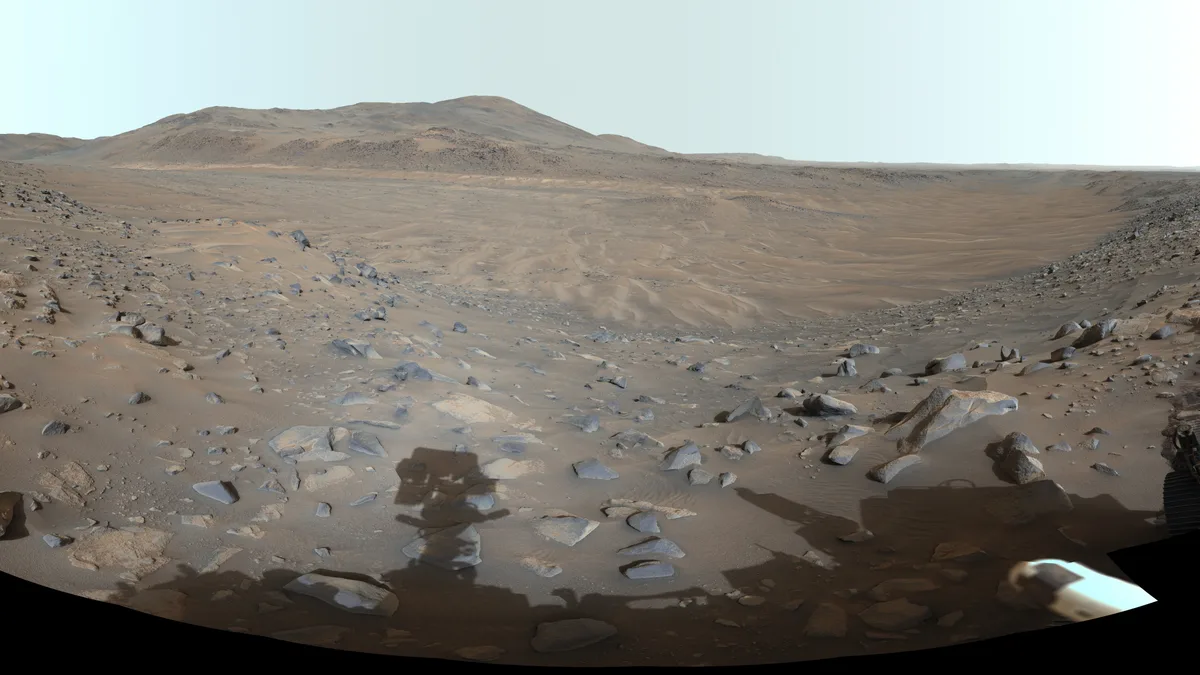
The PIXL X-ray instrument on the robotic arm of the Perseverance rover has measured Martian dust finer than anything previously measured on the planet itself. Researchers published the paper on Tuesday, October 27, 2026, in the Proceedings of the National Academy of Sciences (PNAS), and NASA and the Jet Propulsion Laboratory (JPL) presented it the same day. The smallest grains are about 100 nanometers across, which NASA says is roughly 700 times thinner than a human hair.
Earlier measurements on Mars could distinguish particles down to about 3 micrometers. PIXL found two new categories: fine particles below 2.5 micrometers and ultrafine ones of about 100 nanometers. For comparison, a human hair is about 70 micrometers wide.
How was the dust measured?
There was no dedicated device for it. PIXL (Planetary Instrument for X-ray Lithochemistry) carries a calibration target made of Teflon and polished basaltic glass. Teflon contains no elements PIXL can detect directly, so any elemental signal from that sample comes from dust that has settled on it. The target collected dust over 1,645 Martian days (sols) of work in Jezero crater.
The lead author of the paper is Scott VanBommel of Washington University in St. Louis, a scientist on the rover team. The researchers also checked spacesuit material samples on the target of the SHERLOC instrument, which sits on the same robotic arm. According to NASA, the rover carries five such samples, each about 20 millimeters square, and the team analyzed Teflon and Vectran, two materials used in spacesuits.
On the PIXL target’s Teflon and on the Vectran sample, particles averaged about 2 micrometers. On the basaltic glass and on SHERLOC’s Teflon sample, they ran down to about 100 to 300 nanometers. NASA says the size of the grains that stick to a given surface is probably determined by static electricity: grains become charged as they collide in the air, and different materials attract different sizes. The smallest particles stayed stuck even after years of driving and drilling.
VanBommel explained why the result matters in a NASA/JPL statement:
“The existence of Martian dust at these ultrafine sizes has long been predicted, and PIXL gave us the chance to measure it directly on Mars. Larger clumps, Martian dust bunnies, shake off over time. But the smallest particles stay, and they are exactly the ones that pose the biggest challenge for human life support systems.”
In chemical composition the dust matches earlier measurements and is rich in iron and sulfur. PIXL additionally found enrichment in phosphorus and traces of calcium sulfate.
Why do particles below 2.5 micrometers worry doctors?
On Earth, particles smaller than 2.5 micrometers penetrate deep into the lungs and enter the bloodstream. NASA adds that studies have shown ultrafine particles, down to 100 nanometers, can travel from the nasal cavity to the brain along the olfactory nerve.
Martian dust also carries chemically reactive compounds: perchlorates, which can disrupt thyroid function, and reactive iron, which damages cells. The grains are rounded by collisions in the wind and are therefore less abrasive than lunar dust. Lunar dust scratched visors during the Apollo missions, damaged the outer layers of spacesuits and seals, and some crew members reported symptoms resembling hay fever. Apollo 17 astronaut Harrison Schmitt reported watery eyes and persistent throat irritation after moonwalks, when dust soiled his suit and the lander.
Lindsay Hays, acting director of the Planetary Science Division at NASA headquarters in Washington, said in a statement:
“NASA has a long history of turning challenges into workable solutions and finding creative ways to use the data we have to answer questions beyond what they were originally collected for. Dust has been a surface exploration challenge since the Apollo program. Perseverance gives our engineers and flight physicians measurements they can use to improve existing solutions well before the first American astronauts reach Mars.”
What is NASA already doing about dust?
The study also showed that some materials hold less dust than others, which could guide the choice of materials and protective coatings for spacesuits and habitats. NASA lists several solutions: the suitport, a spacesuit that attaches to the outside of a habitat, and two-room airlocks. In March 2025, an electrodynamic dust shield was tested; it uses electric fields to clear lunar regolith from glass and thermal surfaces. It was developed at Kennedy Space Center and reached the Moon on Firefly Aerospace’s Blue Ghost Mission 1 lander.
The outlet TechTimes also reports that a NASA working group on Martian dust met on February 20 and 27, 2026, and recommended a limit of 0.1 milligrams per cubic meter, averaged over 24 hours, for particles smaller than 10 micrometers and for missions of up to 30 days.
Katie Stack Morgan, Perseverance project scientist at JPL, noted that the rover has this role as well:
“Perseverance’s main job is to look for signs of ancient microbial life, but the mission was also designed to help prepare for human explorers. That effort includes technology demonstrations such as MOXIE (Mars Oxygen In-Situ Resource Utilization Experiment) and Ingenuity, as well as the spacesuit samples.”
What this does not prove
The measurement describes the size of grains that stuck to surfaces on the rover, not the amount of dust an astronaut would inhale. As NASA notes, static electricity determines which sizes cling to which material, so the measured distribution also depends on the material of the target. Health risk, according to NASA, depends on the amount of dust and the length of exposure, and this study did not measure either. The data on harm come from research on Earth, not from Mars, which is why the work is described as a basis for future standards, not as proof of harm.