Japan's MMX probe heads to Mars to sample Phobos
The probe separated from the H3 upper stage about 71 minutes after liftoff from Tanegashima and is bound for Mars. Its Phobos sample is due back on Earth in 2031.
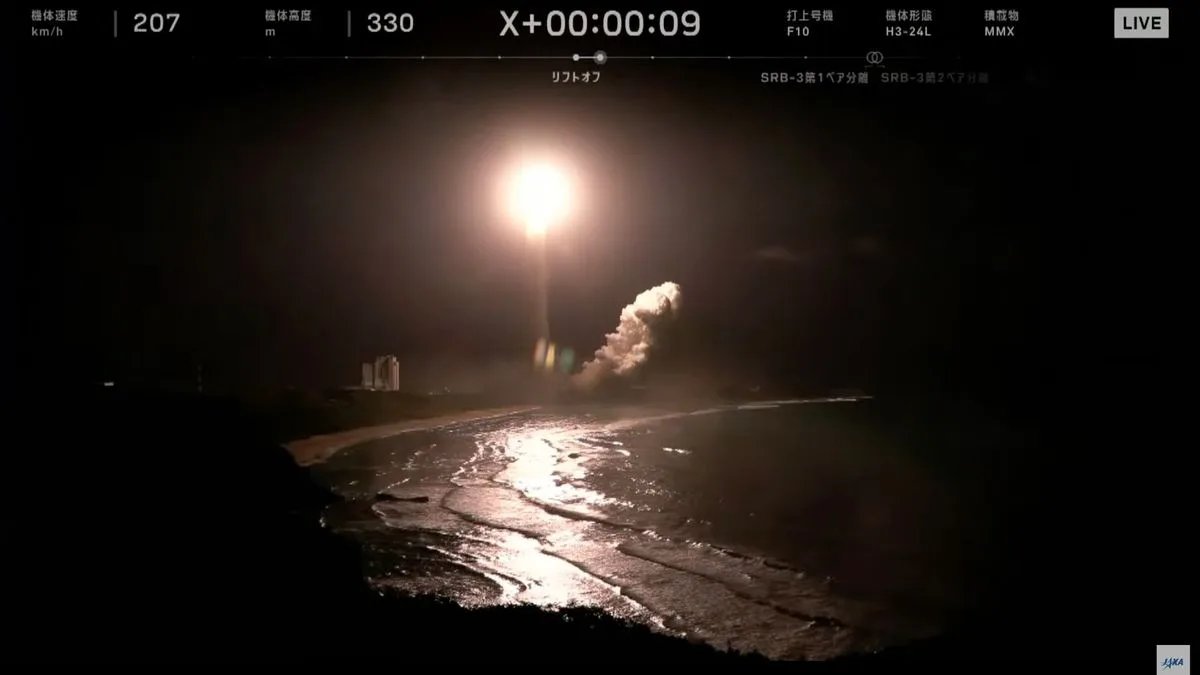
The Japan Aerospace Exploration Agency (JAXA) launched its MMX (Martian Moons eXploration) probe on Tuesday, October 20, 2026, at 4:41 a.m. local time. An H3 rocket lifted off from Launch Pad 2 at the Tanegashima Space Center, which was 19:41 UTC, or 9:41 p.m. in Serbia on Monday, October 19. The launch fell in the window announced in our earlier story on the mission. The destination is Phobos, the larger of Mars’s two moons, where the probe is meant to pick up a soil sample.
How did the H3 flight go?
It was the tenth flight of the H3 and the first time the rocket has carried a payload beyond Earth orbit. Four solid boosters were jettisoned in pairs before the two-minute mark, followed shortly by the payload fairing. The hydrogen-fueled second stage ignited twice. The second burn, about an hour and four minutes after liftoff, put the probe on its path to Mars at roughly 38,858 km/h, according to Space.com as reported by Hardware Busters. The probe separated from the upper stage about 71 minutes after liftoff.
JAXA kept its statement after the launch short: “The H3 Launch Vehicle flew as planned.”
That matters because of the rocket’s recent history. Flight 8 failed on December 22, 2025, when the second stage did not reignite normally and the Michibiki 5 navigation satellite ended up below its planned orbit. The rocket returned to service on June 12, 2026, and flight 9 followed on August 11, 2026, placing the Michibiki 7 satellite in orbit. MMX is therefore the third success in a row since that failure. The mission was originally due to leave in 2024 but slipped because of H3 problems, and the Earth-Mars alignment that allows an efficient transfer comes around only about every 26 months.
Eliot Sefton-Nash, ESA project scientist for MMX, said after the launch: “JAXA’s H3 launcher performed fantastically to send MMX onward to Mars”.
What will the probe do until 2031?
The schedule is long and patient:
- August 2027: insertion into Mars orbit
- from September 2027: orbit around Phobos and about a year and a half of remote imaging of Phobos and Deimos
- early 2029: deployment of the IDEFIX rover
- 2030: two touchdowns by the main spacecraft to collect soil
- November 2030: departure for Earth
- 2031: the return capsule lands in Australia
The IDEFIX rover weighs 25 kilograms, was built by the French space agency CNES and the German DLR, and carries four of the mission’s 11 science instruments. In Phobos’s weak gravity it would weigh about 15 grams on the surface.
The goal is to collect at least 10 grams of soil from Phobos. At least 15 percent of the sample is earmarked for NASA’s Johnson Space Center. Because of the weak gravity, the two touchdowns on a body about 22 kilometers across are considered delicate work, and between the launch and the capsule in Australia lie five more years of flight, orbit insertion, rover deployment and landings.
Why Phobos, and not an asteroid?
Phobos is about 22 kilometers across, and Deimos is roughly half that size. Both look like asteroids, but their origin is unsettled: they may be captured asteroids, or debris thrown into orbit after a giant impact on Mars. According to ESA, only a sample can decide between the two explanations. Sefton-Nash summed it up in an ESA statement: “Bringing samples to our most sophisticated labs here on Earth is a multiplier for discoveries”.
This is not Japan’s first sample return. Hayabusa brought back grains of the asteroid Itokawa, and Hayabusa2 returned samples from Ryugu in 2020. No one has ever returned material from a moon of Mars, and the last attempt, Russia’s Phobos-Grunt in 2011, never left Earth orbit.
Who contributes what?
JAXA leads the mission in cooperation with NASA, CNES, DLR and ESA. The spacecraft has three modules: propulsion, exploration and return. NASA has invested about $87 million and supplied the MEGANE spectrometer from the Johns Hopkins University Applied Physics Laboratory and a pneumatic sampler from Honeybee Robotics. ESA takes part as a Mission of Opportunity within its science program, providing deep-space communication equipment, including a transponder and a power amplifier, while its Estrack antenna network will send commands to the probe and receive its data.
What does the launch not prove?
A successful departure says only that the rocket worked and the first step is done. The probe has not reached Mars, no sample has been taken, and none of the planned maneuvers around Phobos has been carried out. The question of where the Martian moons came from stays open until the material is analyzed in laboratories, and the first such sample, if all goes to plan, arrives only in 2031.