Stickney Crater Reveals When Phobos Formed
A new computer model of Stickney crater on Phobos tests two competing theories of the Martian moon's origin, placing the impact's age at either 4.2 billion or 2.6 billion years.

Researchers at the University of the Bundeswehr Munich built a computer model of the internal structure that the impact behind Stickney crater must have left inside Phobos, and that model now serves as a test for two rival theories about the smaller of Mars’s two moons. The paper, “Stickney’s impact on Phobos geophysical observables,” written by planetary science doctoral candidate Benjamin Hazer and Thomas Andert, appeared in Monthly Notices of the Royal Astronomical Society (volume 548, issue 4, DOI 10.1093/mnras/stag753), with wider media coverage of the findings following on September 19. The news arrives ahead of a Japanese mission set to launch later this year to collect the first sample from Phobos’s surface, one that could settle a dispute the computer models alone cannot resolve.
Phobos has an average diameter of just 22.2 kilometers and completes a full orbit of Mars in 7 hours and 39 minutes, making it one of the fastest-orbiting bodies in the solar system. Its origin has remained an open question in planetary science for decades. One theory holds that Phobos formed from debris flung into orbit after a massive impact on Mars itself, an impact that created a disk of material around the planet from which both of its moons, Phobos and Deimos, later formed. The other theory holds that Phobos is an asteroid Mars later captured with its gravity, an idea supported by the moon’s irregular shape and by spectral properties resembling those of rubble pile asteroids, bodies made of many rock fragments held together by weak gravity rather than a solid structure.
Hazer and Andert did not measure Phobos directly. Instead, they calculated what an impact large enough to carve a crater roughly 9 kilometers across, nearly half the moon’s diameter, would require of Phobos’s internal structure for the moon to survive without breaking apart. The paper looks at how a mass concentration beneath Stickney affects Phobos’s gravity signal, its moments of inertia, and the amplitude of its libration, the way the moon rocks and oscillates in orbit. This is modeling, not a new direct measurement: the inputs are Phobos’s known shape, diameter, and orbital period, and the model checks which combinations of density and internal structure are physically possible at all.
Hazer explains why an ordinary rocky body could not have withstood such a blow:
You would expect an impact like that to break Phobos apart, unless the body has a very low, uniform density, like a sponge that can absorb such an impact.
According to the model, surviving the impact requires a porous, relatively uniform interior, and the estimates also allow for water ice within that interior, along with a mass concentration along the equatorial belt, likely the result of heat that melted and compacted rock beneath the crater during the collision.
The age of the impact itself hinges on which theory turns out to be correct. If Phobos formed from debris after an impact on Mars, the collision that created Stickney is roughly 4.2 billion years old. If Phobos is a captured asteroid, the same impact would be considerably younger, around 2.6 billion years old. Sources disagree on when the paper itself came out: ScienceDaily lists it as a 2026 publication without a precise date, while SciTechDaily gives April 21, 2026 as its publication date in MNRAS, though the account that brought it to wider attention did not appear until September 19.
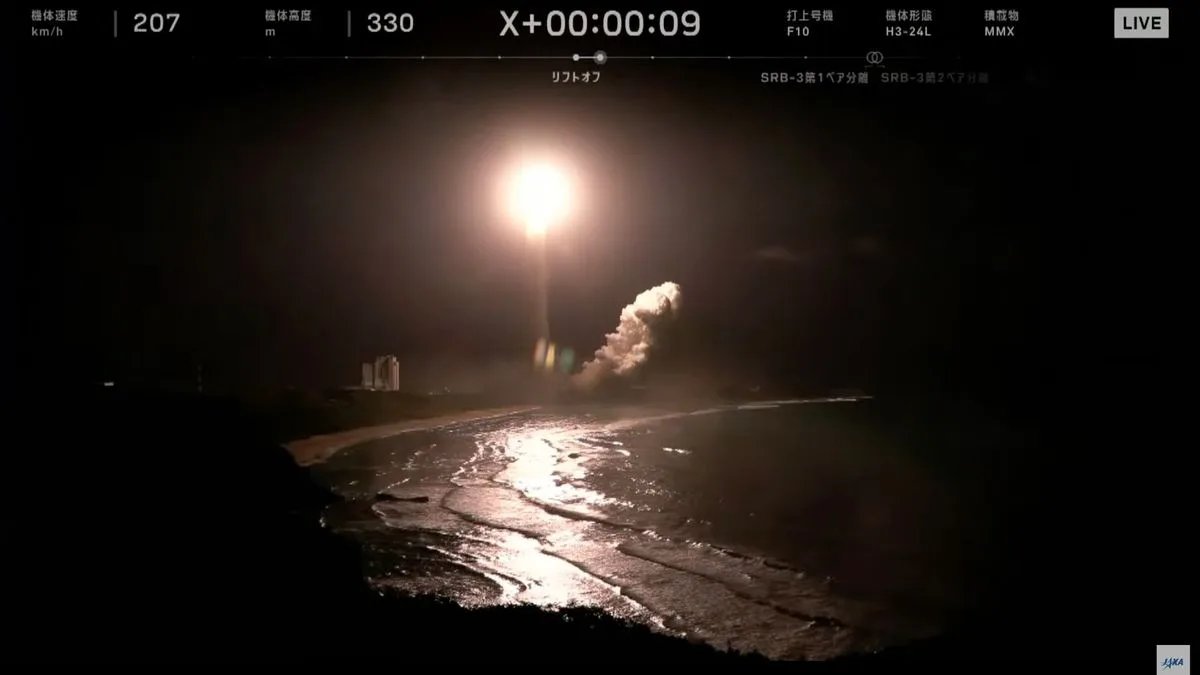
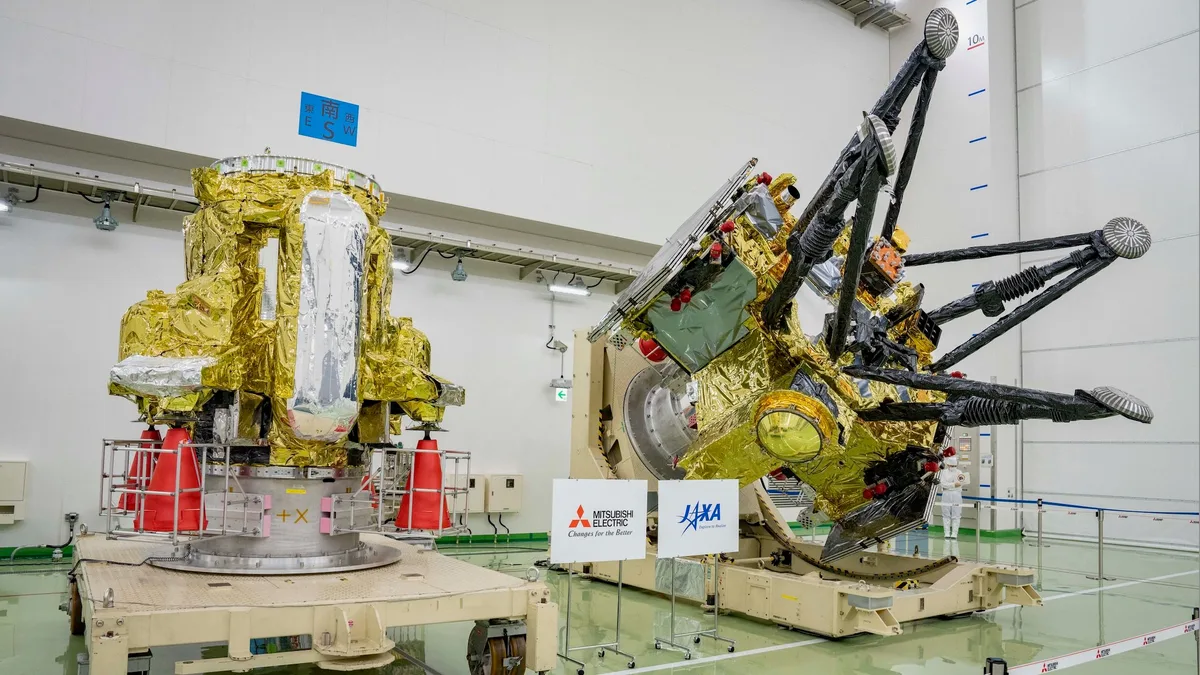
An answer may come from Japan’s Martian Moons eXploration (MMX) mission, led by the Japan Aerospace Exploration Agency (JAXA) and set to launch later in 2026. The probe will attempt to enter a quasi-stable orbit around Phobos, an extremely difficult maneuver, according to Hazer, because no orbit around this moon is stable in the strict sense: its own gravitational field is far weaker than that of nearby Mars. MMX carries two sampling systems: one collects a soil core down to a depth of 2 centimeters, while the other, a pneumatic sampler supplied by NASA, fires pressurized gas at the surface to lift material into a collection container. The samples are expected to reach Earth in mid 2031, inside a capsule built to survive reentry into the atmosphere.
The model built by Hazer and Andert does not answer which of the two theories is correct. It only shows which internal structures are physically allowed if Stickney crater formed the way scientists assume it did. That means neither the 4.2 billion year age nor the 2.6 billion year age has been proven by this work; both remain conditional on which origin theory is eventually confirmed. The paper also does not measure Phobos’s actual gravitational field, but checks which values of that field would be consistent with the moon’s known shape and orbit, leaving direct measurement to future missions like MMX. Until real samples are collected from the surface and analyzed, the question of where Phobos came from stays open.