Washington Agreement Turns Six: Serbia Outpaces Kosovo
Six years after the Washington Agreement, American analysts say Serbia has built ties with Washington more successfully than Kosovo, while the Belgrade-Pristina dialogue stands still.

Six years after the Washington Agreement was signed, American experts on the region are, for the first time, publicly comparing how Belgrade and Pristina used the opportunity it created, and the verdict is not kind to Kosovo. The agreement, signed between Serbia and Kosovo at the White House on September 4, 2020, with the mediation of then President of the United States Donald Trump, was meant to use economic cooperation to open the door to resolving political questions. Today, according to sources in Washington who spoke to Radio Free Europe, it has all but disappeared from political reality.
The document signed at the White House carried commitments on infrastructure links, energy and investment, along with points that went beyond the bilateral relationship, including an obligation for Kosovo to establish diplomatic relations with Israel, which Pristina did by opening an embassy in Jerusalem. Trump presented the agreement at the time as a historic turning point, telling then Kosovo Prime Minister Avdullah Hoti and Serbian President Aleksandar Vucic that economics would bring the two sides closer. Instead, the relationship since then has been marked by a string of crises, most of them in northern Kosovo, culminating in 2023 in an armed attack by a group of Serbs in Banjska.
Why Washington now views Belgrade differently
David Kanin, a professor of European studies at Johns Hopkins University, says Kosovo spent years operating on the assumption that Washington would “always be there,” while Serbia built its relationship with the United States more actively.
“The Serbs have been much more successful than the Kosovars in managing the relationship with Washington, especially since Kurti came to power. I broadly agree with him on the dialogue with the Europeans, but Kurti doesn’t agree with almost anyone. People don’t like him, and Vucic has managed to use that,” Kanin told Radio Free Europe.
Kanin adds that Pristina, unlike Belgrade, also misjudged energy policy. Kosovo, he says, made a mistake by turning down projects tied to American liquefied natural gas.
“Serbia, North Macedonia and other countries signed agreements to supply American gas. Kosovo made a mistake on that front,” Kanin says.
Richard Kremer, president of the American Euro-Atlantic Association, agrees that Serbia has been considerably more successful at building influence in Washington, particularly through lobbying and ties to people close to Trump. As an example, he points to the removal of former Republika Srpska President Milorad Dodik and his family from the U.S. list of sanctioned individuals in 2025.
Kremer also argues that the period after Trump’s first term marked a failure of American policy toward the region.
“I was impressed by the fact that during his first term, the Trump administration took the initiative and got directly involved, bypassing the European Union, which, despite good intentions, failed to achieve the desired results in resolving the conflict. I understand that President Biden wanted to improve relations with European allies after the often blunt approach of the Trump administration. However, handing the issue back to Europe clearly did not work,” Kremer told Radio Free Europe.
Dialogue with Washington open, dialogue with Pristina frozen
The difference in how the two sides are treated also shows up in their relationship with the American administration itself. According to news agencies, Serbia launched a Strategic Dialogue with the United States in July of this year, while the same process with Kosovo has been frozen for a year. Washington has made the resumption of dialogue with Pristina conditional on meeting certain obligations, including ones concerning the Serb community in northern Kosovo.
A similar point is made in an analysis by the Institute for Political and Economic Southeast Europe, which described a U.S. Congressional report on the Western Balkans as a shift away from the long-standing formula of “democratization, reform, European integration” toward an approach built on security, American economic interests and competition with Russia and China. According to that report, Washington increasingly views Belgrade as a partner it wants a structured, long-term relationship with, not a political problem to be solved, with emphasis on energy, investment in liquefied natural gas and possible small modular reactors, as well as expanded military and security cooperation, even though Serbia is not a NATO member.
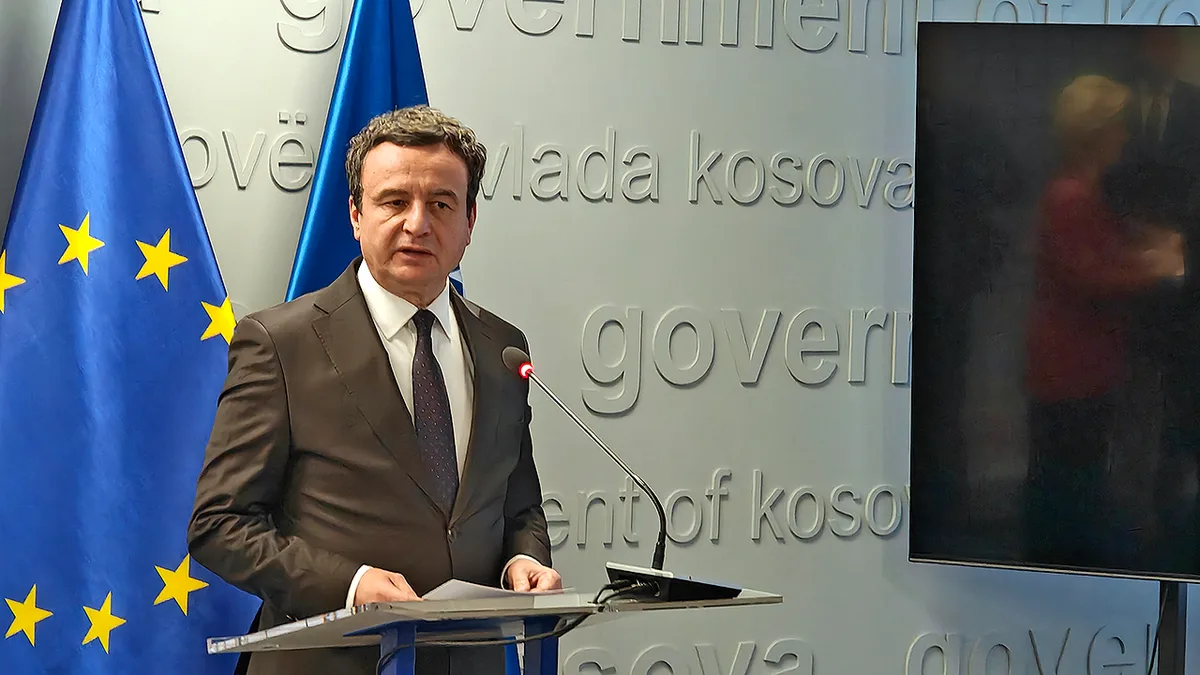
On the other side, the Belgrade-Pristina dialogue formally exists but carries no substance. The last meeting at the highest level was held in September 2023, just days before the attack in Banjska, and Vucic and Kosovo Prime Minister Albin Kurti have not met in that format since. Kurti says talks cannot resume until suspects in the attack, which he blames Serbia for planning, are extradited. The Ohrid Agreement on the path to normalization, reached in March 2023 with European Union mediation, has also not been implemented in practice. EU foreign policy chief Kaja Kallas has previously said she is working to organize a new high-level meeting, saying she is “working with both leaders separately so they can move forward with implementing the agreements that are already in force,” but no date for such a meeting has been set. Kurti, meanwhile, is governing in a technical mandate, while Pristina has been going through an institutional crisis for more than a year and a half.
Asked about the anniversary, a State Department spokesperson told Radio Free Europe that the 2020 agreement remains a historic step.
“We reiterate that normalization between Serbia and Kosovo remains essential to preserving regional peace and stability,” the State Department spokesperson said.
The risk of the status quo
Kanin warns that the current calm is deceptive, and that a new incident could easily change the picture.
“There’s no imminent threat or urgent crisis. But if something like a new Banjska, or even a more serious incident, were to suddenly happen, everyone would be caught off guard. Kosovo’s relations with the U.S. are currently on the back burner in Washington, and I’m not sure what Kurti intends to do about that,” Kanin says.
Kremer believes that in the transactional logic of the current American administration, Kosovo does not have many economic or strategic cards to play, but that it can make up for that by exiting its political crisis and taking concrete steps, including establishing the Association of Serb-Majority Municipalities.
“You have to show that you’re serious and ready to sit at the table, negotiate and talk about issues that may not be popular but need to be resolved. You need focused leadership that knows which direction Kosovo should be heading. Political conflicts don’t do citizens any good,” Kremer says.
He also warns that Belgrade, emboldened by the fact that Washington is preoccupied with other crises, could be tempted to alter the situation in northern Kosovo outside of legal and political processes, and that this very absence of American attention could open space for unilateral moves by either side.
We raised a similar question about Washington’s approach to Belgrade and Pristina when we wrote about the announced verdict for former Kosovo President Hashim Thaci, scheduled for September 16, ahead of which EULEX and Vucic are already preparing for possible consequences in northern Kosovo.
The White House today counts Kosovo and Serbia among the conflicts Trump claims his administration has ended, and in December 2025 he signed a law reaffirming American policy toward the two sides, calling for the implementation of the 2023 agreement and for strengthening bilateral relations with both countries. On the ground, as Radio Free Europe’s own sources admit, that goal looks further away than ever, and it remains an open question whether Kurti’s technical mandate will produce any progress before the seventh anniversary of the signing at the White House.