Kos regrets Oj Kosovo song at EU enlargement forum
An instrumental of the Serbian song was played at a concert ahead of the EU Enlargement Forum, and Pristina demanded an explanation. The commissioner says the choice is not the Commission's view.
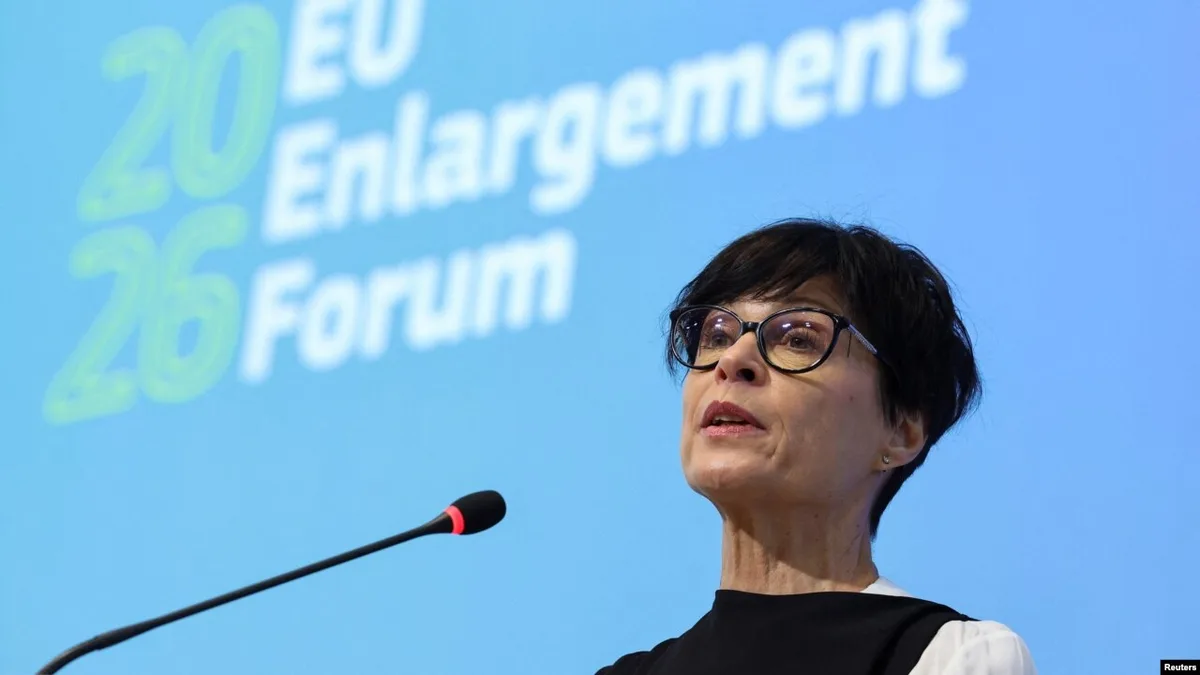
An instrumental of the song “Oj Kosovo, Kosovo” was played on Sunday evening, November 15, at the concert that opened the second European Union Enlargement Forum in Brussels. Pristina immediately asked for an explanation, and Enlargement Commissioner Marta Kos told reporters in Brussels that she regrets the choice and that it in no way reflects the views of the European Commission.
What was heard at the opening of the forum
The concert, titled “Melodies of Unity: Harmonies from European Crossroads,” was scheduled for November 15, from 6:30 p.m. to 9:30 p.m. The European Commission organizes the forum and Kos is the host. Its main part takes place on November 16 under the motto “Wider Europe, Stronger Europe.”
The program featured the Slovenian ethno quartet Marko Hatlak and Kapobanda, and the Western Balkans Youth Orchestra, in which young musicians from Albania, Serbia, North Macedonia, Montenegro, Bosnia and Herzegovina and Kosovo play together. According to media reports, the song was performed by Kapobanda. Radio Free Europe reports that it was played as an instrumental, without lyrics.
The Albanian portal Politiko notes that the song was written in 1989, when the 600th anniversary of the Battle of Kosovo was marked, by Ljubomir Ljuba Manasijevic, and that it was recorded a year later.
What Pristina is asking for
Agron Bajrami, Pristina’s ambassador to Belgium and chief negotiator in the dialogue with Belgrade, was the first to react. On X on November 15, he wrote:
“This is not cultural exchange. The song promotes explicit political claims on the territory of the Republic of Kosovo.”
The same day he added a demand:
“The Republic of Kosovo expects an urgent explanation from the European Commission and Commissioner Kos on how this repertoire was selected and approved”
Jeton Zulfaj, Pristina’s chief negotiator with the European Union, also wrote on X that “This is outrageous and unacceptable.” He also asked why Kosovo was not invited to the forum:
“We will leave it to Commissioner Kos to explain how this happened and what measures she will take, as well as why Kosovo, which has achieved the greatest democratic progress in the Western Balkans this decade and which is fully aligned with EU foreign policy and values, was not invited”
In the same post, Zulfaj linked the song to the period in which, as he puts it, Slobodan Milosevic was abolishing Kosovo’s rights.
The European Parliament’s rapporteur for Kosovo, Riho Teras, said the Commission and Marta Kos owe Pristina an explanation. In his assessment, it was either a deliberate provocation or the result of complete ignorance. Translations of his words differ: Novosti reports them as an “extremely careless and tasteless lapse,” while Radio Free Europe renders them as “extremely inappropriate and tasteless.”
Who was actually invited from Pristina?
Pristina’s daily Koha repeats Zulfaj’s claim that Kosovo was not invited. The official program partly confirms it: the speakers include no top representatives of Kosovo’s institutions. The list does include Donika Emini, founder and director of the Kosovo organization d-square, who takes part in the panel “Through Reconciliation to EU Enlargement.” According to Radio Free Europe, this is the second year in a row without representatives of Kosovo’s institutions at the forum. Representatives of the student list from Serbia were also invited to the event.
What Marta Kos said
In her statement to reporters in Brussels, the commissioner expressed regret over the choice of the song and added that the Commission is aware of the suffering of people in the former Yugoslavia. Reconciliation, she said, does not mean forgetting the past and its differences, but building a Europe in which those differences will not stand in the way of a shared future. Radio Free Europe reports her words in paraphrase, without a direct quote, so we do not put them in quotation marks either.
Donika Emini, who attended the concert, told Radio Free Europe that it was no accident:
“I don’t think it was because of carelessness”
In her words, the problem is not that the song is in Serbian, but the territorial claims that, she argues, its lyrics contain. She also criticized the commissioner for shifting responsibility for the choice onto the musicians. The incident, she warned, raises broader questions about the European Union’s attitude toward Kosovo: “The consequences are significant.”
What is still unknown
It is not known who chose the song, or whether the Commission approved individual numbers. The full repertoire has not been published, so it is also unclear which other songs were played. In the reports we read, there is no reaction from Serbian officials.
The portal KoSSev recalls that at the end of September Koha wrote in a similar vein about the performance of the Belgrade choir “Saint Joachim and Anna” at a choir festival in Herceg Novi, where the song “Gora jeci” was performed. Festival organizer Nadja Karadzic said at the time that the event had passed in an atmosphere of togetherness and socializing.