Montenegro Serbian Language Petition Sent to Government
Montenegro's Constitutional Committee took up the Srpski4EU petition, signed by about 22,000 people, and told its authors to turn to the Government and EU institutions.
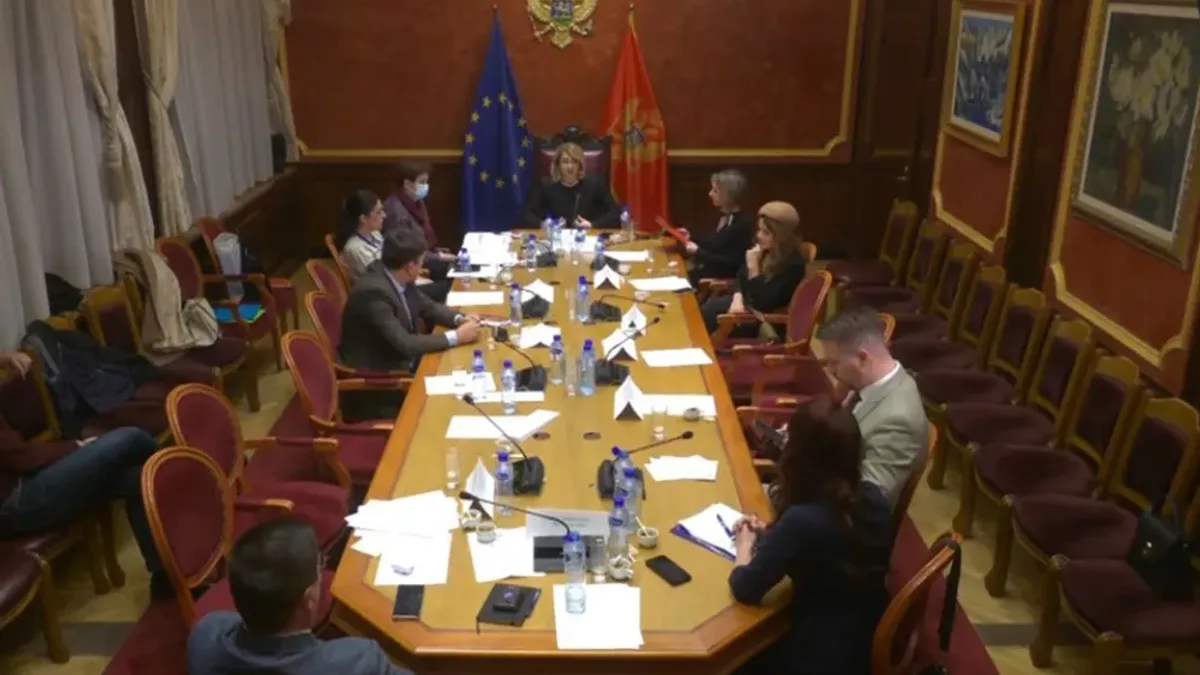
A petition for the Serbian language in Montenegro reached the Constitutional Committee of the Parliament in Podgorica on November 24, and Belgrade is following the outcome, because it concerns a language that 269,307 people, or 43.18 percent of the country’s population, named as their mother tongue in the census data published in 2024. The civic petition “Srpski4EU: an initiative for language equality” gathered about 22,000 signatures in a few days. According to the Podgorica daily Dan, the committee concluded that the petition falls within the remit of neither Parliament nor the committee itself, and that its authors should turn to the Government and European institutions.
What does the petition ask for, and who is behind it?
The petition was submitted by Professor Dusan Krcunovic of Niksic. It asks Montenegro to launch an initiative, during its EU accession process, for Serbian to be put forward as one of the Union’s official languages alongside Montenegrin. The authors point to Ireland and Malta, which have two official languages each, and the text of the petition also cites Belgium and Finland. When we wrote about the initiative on November 18, it had about 16,000 signatures, which means the figure has grown by roughly six thousand since then.
The session was called without delay by committee chair Jelena Bozovic of the New Serb Democracy, who signed the initiative herself and gave it, as she put it, institutional support. At the session she said: “The Serbian language should have the status of an official language in Montenegro.”
Why is the Constitution not the key issue here?
Bozovic recalled how hard it is to amend Article 13 of the Constitution, which governs the official language: a change needs 54 votes in Parliament, followed by a referendum in which three fifths of all voters must back the decision. “You see how closed this Constitution is, which in practice does not allow changes in that part,” she said. She added that making Serbian an official language at EU level would call for a different procedure than amending a constitutional article.
One of the authors, Stefan Sinanovic, stressed that the initiative does not seek a change to the Constitution. His main argument was a comparison with European practice:
“Our initiative is not any kind of precedent. The precedent would be to disregard this proposal of ours. Montenegro would be the only EU country in which the language spoken by the largest number of citizens has no official status.”
Sinanovic added that Serbian is not only the language of Serbs, since more than 60,000 Montenegrins and members of other nationalities use it, and that in some communities the share of speakers exceeds 80 percent.
How did the lawmakers respond?
The question of jurisdiction was raised most directly by Darko Dragovic of the Europe Now Movement, who argued that Article 38a of Parliament’s Rules of Procedure, which defines the work of the Constitutional Committee, gives the committee no authority to debate such an initiative. He recommended a different route to the authors:
“This initiative should have been sent to the executive branch, that is, the Government of Montenegro, because no legal acts or the Constitution are being changed, and in agreement with the European Commission and the Government you should try to obtain what is a completely legitimate request. And I wish you all the luck with that.”
Considering the petition was backed by Nikola Rovcanin of Democratic Montenegro, who is also a signatory of the initiative, and by Sladjana Kaludjerovic of the Socialist People’s Party. Aleksandra Vukovic Kuc of the Democratic Party of Socialists opposed it, saying: “This is not a question that should be raised now.” Parliament Vice President Boris Pejovic noted that Montenegro negotiates with the European Commission on the basis of its official language and said: “I think that even when we are an EU member, a decision by the Union’s member states will be needed for this question to be realized.”
None of the sources we read states that a vote was held on the petition, so the conclusion that the committee lacks jurisdiction is reported as it was stated at the session.
What else did the committee do that day?
At the same session the Constitutional Committee voted eight to nothing in favor of the draft Amendment XXII to the Constitution, which would remove immunity from the president and members of the Government for criminal offenses against official duty. The draft goes to the plenary session, and a proposed constitutional law to implement the amendment was also endorsed.