Pancevo Refinery Cut Off From Crude, Diesel Reserves Ready
Crude transport through JANAF to the Pancevo Refinery has been halted since November 6, with no restart date. The ministry and NIS agreed to release diesel reserves.
No crude oil has reached the Pancevo Oil Refinery through the Adriatic pipeline since November 6, 2026, and the Ministry of Mining and Energy said on Wednesday, November 18, that a more precise restart date is expected only by the end of the week. Until then the state is readying its reserves: if needed, stocks of oil products, mainly diesel, will go to the market.
What was agreed at the Ministry meeting?
The additional measures were agreed at a meeting between the Ministry and Petroleum Industry of Serbia (NIS), the Association of Oil Companies of Serbia and the Republic Directorate for Commodity Reserves. They cover releasing oil product reserves to the market, mainly diesel, if the need arises. According to the statement, the goal is stable supply until the emergency caused by the pipeline accident ends.
The Ministry’s analysis of supply and demand shows that the supply of gasoline, jet fuel and fuel oil was never in question. Diesel is the product affected: the refinery has reduced throughput, so diesel shipments from Pancevo are lower as well. The Ministry explained it in its statement this way:
“Although, as a preventive measure, the volume of crude oil processing was reduced, and with it the shipments of diesel fuel from the Pancevo Oil Refinery, the missing quantities are being successfully made up from the operational and commercial reserves of energy companies, as well as from the processing of crude oil that the state released from its reserves to the Petroleum Industry of Serbia, thereby preventing the refinery from shutting down”
That refers to 66,000 tons of crude from state reserves, which the Government earlier released to NIS so that production of oil products could continue. We wrote about that measure on November 15, when JANAF still had no deadline for the repair.
What happened on the pipeline?
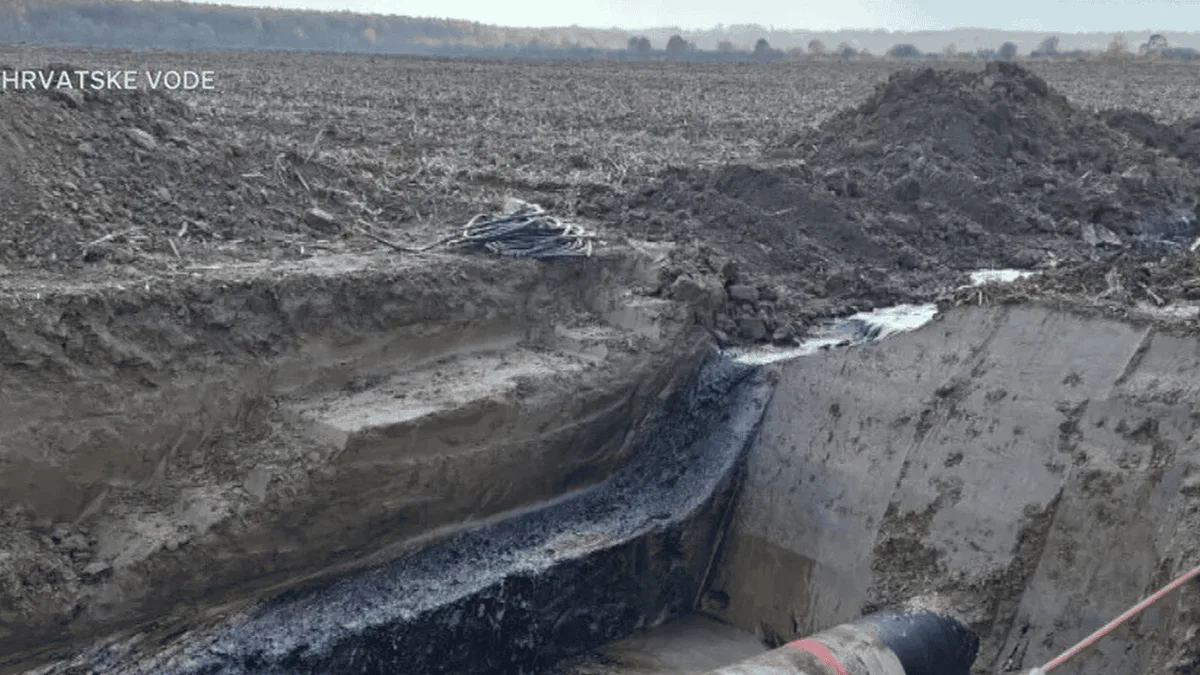
Transport stopped on November 6 because of an accident on the Sisak-Slavonski Brod section in Croatia, where about 500,000 liters of oil leaked. Croatian energy analyst Ivan Brodic, editor of the Energypress portal, told Biznis.rs that the fault occurred during revitalization work carried out by an outside contractor. The pipe is damaged, with a crack about 50 centimeters long, and transport was halted immediately by closing the Okucani and Luzani block stations.
By November 9, JANAF had moved the spilled oil by tanker truck to its terminals and started cleaning the soil surface to a depth of about two millimeters, working with Croatian Waters and specialized firms. Three days later, controlled draining of the remaining oil from the pipe itself began. Physical repair comes only after the pipe is fully empty, and the method has not been chosen yet. JANAF initially expected to fix the fault in about ten days, but there is still no precise date.
When can the pipeline run again?
Brodic estimates it could be the end of November or the beginning of December:
“However, it seems that a realistic start of the pipeline operating again, in the physical sense, is the end of November and the beginning of December”
For Pancevo that means several weeks of reduced processing. At the same time, Brodic assesses that the market faces no shortage:
“Filling stations are properly supplied, imports cover part of the needs, and state reserves have been activated. With all due understanding that NIS covers two thirds of retail, it seems to me there is still no room for any drama or panic. On the other hand, a longer interruption would raise costs, with more expensive imports and more demanding logistics, which would put pressure on prices and signal vulnerability”
Who bears the damage, and can NIS claim penalties?
NIS and JANAF have a three-year contract that expires on December 31, 2026, covering transport of 10 million tons of crude with a 10 percent tolerance. Brodic says the capacity is reserved on a pay-regardless-of-use basis:
“Capacities are reserved on a ‘take or pay’ principle: the user pays for the reserved capacity regardless of actual use. In situations like this, contract provisions on force majeure or extraordinary circumstances are typically applied. If the incident is considered unforeseeable and unavoidable, JANAF may be released from liability for the temporary interruption”
If force majeure does not apply or was not properly declared, the contract may provide for penalties or compensation for non-delivery. Responsibility may also fall on the outside contractor, who would compensate JANAF, and JANAF would indirectly compensate NIS. Brodic warns that the contract’s contents are not public:
“The details of the specific contract are not public, nor are they known to me. Situations like this are resolved through negotiations and talks, and only in the last resort through arbitration. US sanctions on NIS and OFAC’s special operating licenses for JANAF, as the company that supplies NIS, complicate the situation further. Still, this is about technical matters, not political ones or situations involving trade in sanctioned energy products”
Where do the assessments differ?
The Ministry says that by releasing oil from reserves, the state prevented the refinery from shutting down. Biznis.rs, in its own report, says NIS suffered damage because of the interrupted supply and, as it writes, very likely because of a shutdown of the Pancevo refinery itself. The Ministry thus speaks of reduced processing and another source of a possible shutdown, and that gap in the available data has not been resolved.
The next checkpoint is the end of this week, when the Ministry promises more precise information on the date oil transport to Pancevo resumes.