NASA Perseverance crosses western Jezero Crater rim, examines rocks older than four billion years
The NASA Perseverance rover has entered an area called Lac de Charmes west of Jezero Crater, where rocks likely predate the formation of the crater itself, the oldest accessible geology since the mission began.

- Perseverance has crossed the western rim of Jezero Crater into an area called Lac de Charmes.
- The rocks there predate the formation of Jezero Crater itself.
- Age estimates run close to four billion years, the oldest directly accessible geology of the mission.
- The rover handles the new terrain with an AI-driven autonomous navigation system.
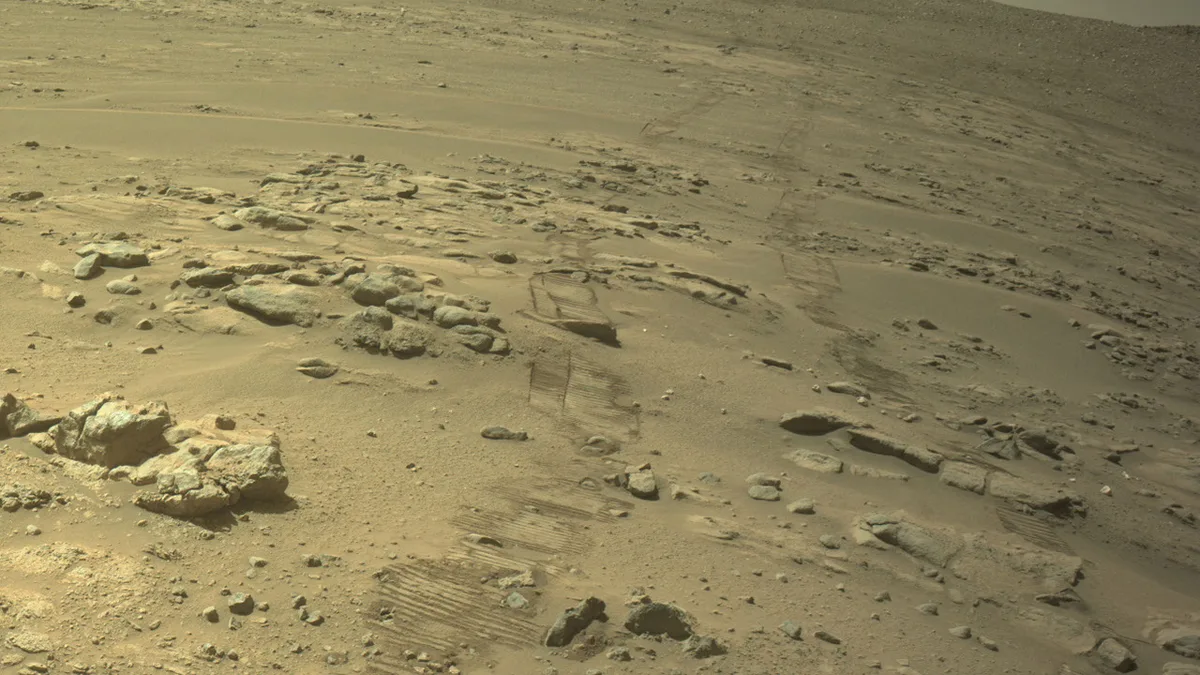
The NASA Perseverance rover has crossed the western rim of Jezero Crater and entered an area the mission team has called Lac de Charmes, the westernmost point of exploration since the landing in February 2021. The team expects rocks in this area to be older than Jezero itself, making them the oldest directly accessible material the rover has analysed so far.
The age estimate, according to data released by NASA’s Jet Propulsion Laboratory in Pasadena, is close to four billion years. That places it in a period when Mars was still geologically active and, under prevailing models, had conditions suitable for the emergence of life.
What Lac de Charmes is
Lac de Charmes is the name the mission team has given to the area west of the Jezero Crater rim. Such labels are usually drawn from terrestrial place names as a short reference inside the team.
Geologically, the area belongs to the planet’s ancient crust, which Jezero Crater cut through during the later asteroid impact about 3.9 billion years ago. That means the rover can now analyse what lay beneath the crater before it formed, something not possible earlier in the same mission.
What the rocks are expected to show
The rover has so far analysed layered sediments inside Jezero, deposited by a lake that once stood there about 3.5 billion years ago. Now entirely different rock types are expected:
- megabreccias, fragmented rocks formed by asteroid impacts in the Isidis Planitia region about 3.9 billion years ago
- possible traces of early volcanic activity, before the planet lost tectonic activity
- minerals carrying traces of early atmospheric and hydrological processes, if any took place
The first analysis was carried out on a rock outcrop named Arethusa, while a panoramic view of the surrounding terrain was taken with the Mastcam-Z camera.
Instruments and methodology
The main instruments used in the Lac de Charmes area are:
- the WATSON camera, mounted on the robotic arm, providing images at close to microscopic resolution
- Mastcam-Z, the panoramic system that records at standard and zoomed angles
- the PIXL spectrometer, which analyses the chemical composition of rock at the elemental level
- the SHERLOC instrument, which uses Raman spectroscopy to identify organic molecules
The Pasadena team decides which sites are sampled for storage in so-called sample tubes, which a future Mars Sample Return mission is to bring back to Earth.
Direct quote from the mission
We took the image when the rover was in what we call the wild west beyond the Jezero Crater rim, the westernmost point we have reached since the landing.
Katie Stack Morgan, principal mission scientist at the NASA Jet Propulsion Laboratory, describes the region as geologically the most interesting of all areas explored in the Perseverance mission so far. What makes it special is that the terrain is rougher and partly covered by small fragments, so the rover often uses an AI system for autonomous route selection.
What the study does NOT show
NASA stresses that the discovery of rocks four billion years old does not amount to direct detection of life or biosignatures. The rover analyses chemical and mineralogical composition, but conclusive evidence for past life on Mars requires analysis in Earth-based laboratories, which will be possible only with the Mars Sample Return mission planned for the next decade.
A second limitation concerns age resolution. The four-billion-year estimate is model-based, derived from comparison with the number of impact craters on the surrounding crust. Absolute ages will be set only when samples are radiometrically analysed on Earth.
Link to Serbian space science
The discovery is of interest because the Astronomical Observatory in Belgrade has had, since 2024, a research team coordinated by Goran Damljanovic following new Mars missions with a focus on geochronology. The local scientific community shares the view that Mars Sample Return is decisive for the question of the origin of life in the Solar System.
Is returning samples from Mars the most important science project of the coming decade?
Share your view: should resources go primarily to Mars Sample Return, to the exploration of Europa and Enceladus, or to cheaper rover missions? Tell us in the comments.