Perseverance Passes Opportunity With 45.22 km on Mars
The odometer on NASA's Perseverance rover read 45.22 kilometers on October 11, about 60 meters past Opportunity's record, reached in roughly five and a half years.
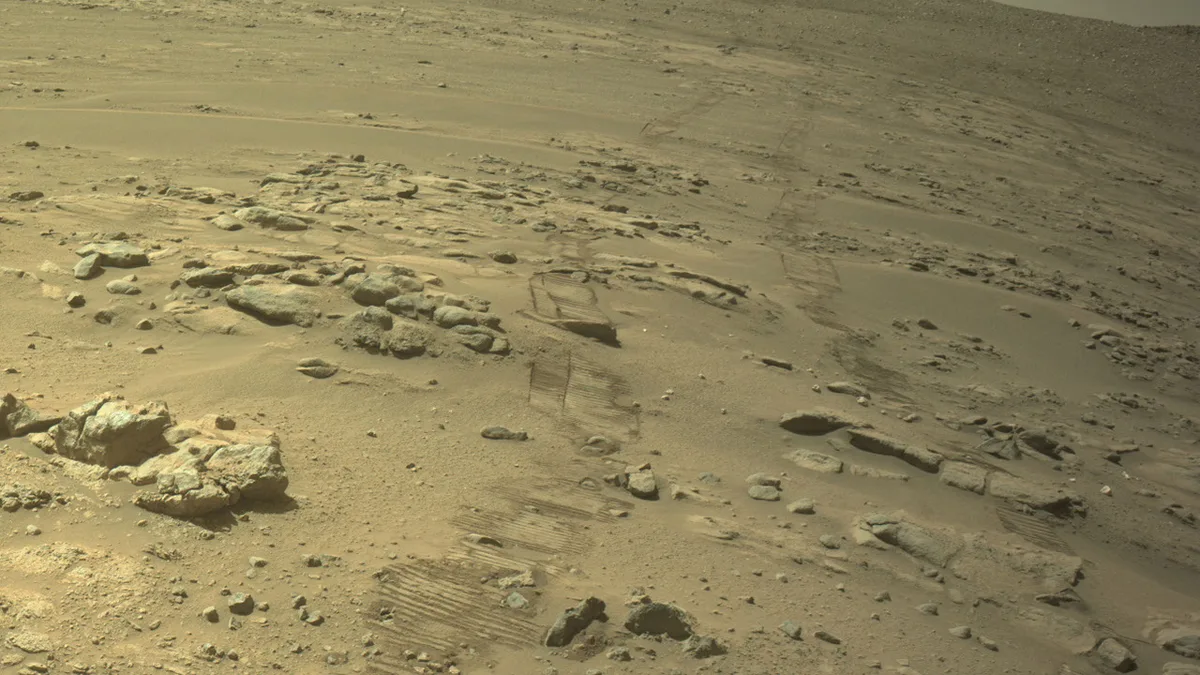
The Perseverance rover has now driven farther than any vehicle on the surface of another world. Its odometer read 45.22 kilometers (28.10 miles) on October 11, 2026, passing the 45.16-kilometer record that Opportunity had held since 2014, NASA said on October 12 on the mission blog. The record fell on the mission’s 2,006th Martian day, or sol.
Opportunity piled up that distance from 2004 to 2018, nearly fifteen years. Perseverance needed about five and a half years from its 2021 landing. The margin is small: about 60 meters on the total distance. A 91.31-meter drive made that very sol pushed it over the line.
Where was the rover headed when the record fell?
Perseverance was heading for a place called Idubi, crossing an area the mission calls Lac de Charmes, west of the rim of Jezero Crater. According to NASA, it may be the oldest terrain ever explored in the solar system, with rock formed by an impact about four billion years ago. The science team expects to find traces of ancient hydrothermal systems at Idubi.
After Lac de Charmes, the rover will continue along the crater rim to the south, toward Rainbow Falls, a block of ancient crust about 100 meters wide that was lifted by the same impact. NASA has approved the first extended mission, which began in October and runs roughly through the end of 2028.
Why is this rover faster than its predecessors?
NASA credits most of the gain to its AutoNav self-driving system. The rover images the terrain as it moves, builds a three-dimensional map of obstacles, and picks its own path between waypoints set by planners on Earth. Perseverance has covered more than 90 percent of its total distance driving this way, compared with about 5 percent for Opportunity and its twin Spirit. NASA’s first Mars rover, Sojourner, judged the path ahead from 20 measurement points, while Perseverance processes 600,000 at each look.
The longest drive the rover can make in a single sol is up to 412 meters. The original mission plan called for at most about 12.4 miles, roughly 20 kilometers, and the rover has far exceeded that limit. Steve Lee, project manager for the Curiosity and Perseverance rovers at NASA’s Jet Propulsion Laboratory (JPL), said on the mission blog:
“It is an honor to work on Perseverance at a time when the technology has matured enough that drives like these are routine. The prime mission called for a maximum of 12.4 miles of driving. We have far exceeded that, and with fully healthy mobility systems and favorable results from extended-life testing, we expect Perseverance to keep adding to this record for many years to come.”
Mark Maimone, deputy lead of the robotic operations team on Perseverance, said on the same blog:
“The rover that broke this record did so by making its own decisions about its path. When it is given the autonomy to simply go, Perseverance is a better driver than the one that landed, and we are not done. Our newest software teaches Perseverance to steer less and roll more, and to check its position against orbital maps in the middle of a drive. The next frontier is sunlight itself. Glare in the navigation cameras is the reason we park by mid-afternoon if we are driving toward the Sun, and if we teach the rover to see past those artifacts, every rover after it gets a longer workday.”
How does the record compare with other rovers?
Along with its announcement, NASA published an infographic comparing rover distances on the Moon and Mars. According to it and the blog, Sojourner covered about 100 meters in 1997 during an 83-sol mission. Spirit had driven 7.7 kilometers by 2010 and its winter standstill. Opportunity worked for 5,111 sols and finished the first extraterrestrial marathon in 2015. Curiosity, which has operated in Gale Crater since 2012, has driven more than 38.07 kilometers.
Earlier in its mission, Perseverance also passed the lunar records: the 35.7 kilometers driven in 1972 by Apollo 17 astronauts Eugene Cernan and Harrison Schmitt, and the 39 kilometers of the Soviet Lunokhod 2 rover in 1973.
What does the record not tell us?
An odometer records distance traveled, not the scientific value of the trip. NASA says as much: distance records, it states, are only a bonus. What matters more is that a rover with greater endurance brings greater geological variety within reach. Perseverance has so far collected 29 samples of rock and regolith, from the crater floor, from a delta shaped by a long-vanished river, and from the crater rim, and at a rock called Cheyava Falls it found a possible biosignature. Whether hydrothermal traces exist at Idubi is not known, and finding them is only what the team hopes to do.