Perseverance finds three episodes of water in Jezero rocks
In the Margin Unit zone, the rover found rocks that touched water at least three times, including warm groundwater. The study appeared in Communications Earth & Environment.

Rocks in the Margin Unit zone on the inner rim of Jezero crater on Mars were in contact with water at least three times, and one of those episodes left a trace of warm groundwater. The conclusion comes from the team behind the Perseverance rover. NASA’s Jet Propulsion Laboratory (JPL) published a statement on the findings on September 21, 2026, the same day the paper appeared in the journal Communications Earth & Environment.
The lead author of the study is Candice Bedford of Purdue University in West Lafayette, Indiana. Co-author Eleni Ravanis works at the University of Hawaii at Manoa.
What did the rover expect, and what did it find?
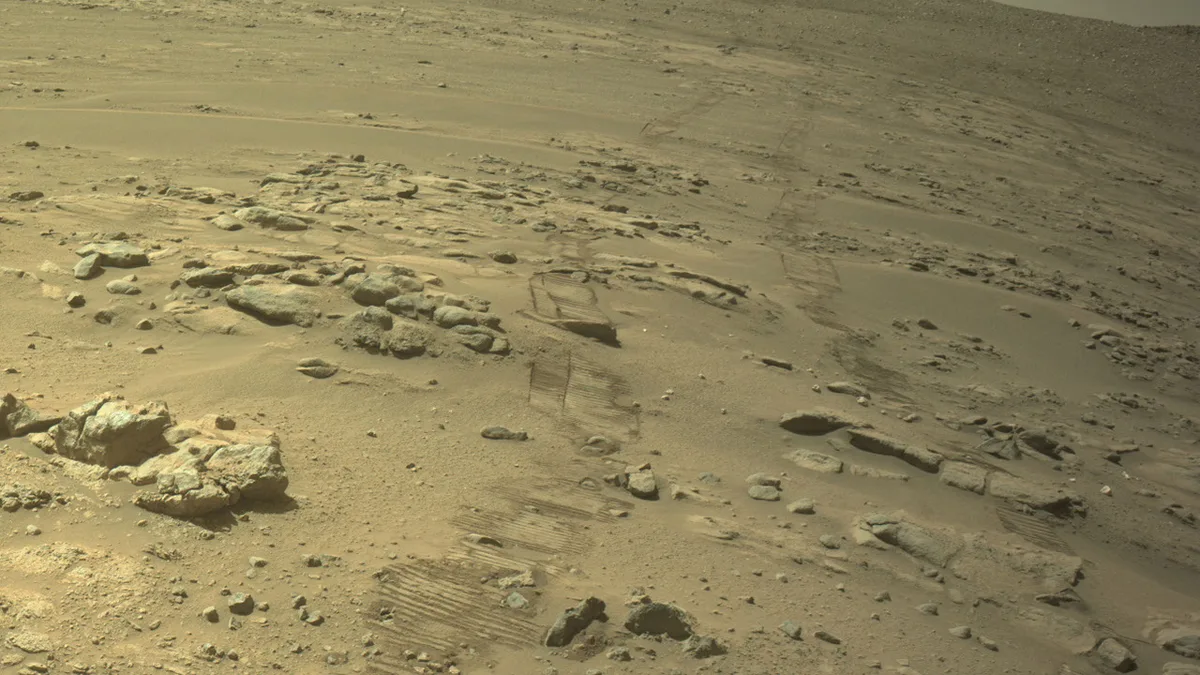
Perseverance reached the inner rim of Jezero crater in September 2023. Orbital images had led scientists to expect sedimentary rocks from the shore of the lake that once filled the crater, and orbital instruments had also detected a strong signature of carbonate minerals at the site. Instead, the rover came across igneous rocks rich in olivine, a mineral containing magnesium and iron.
Igneous minerals keep a record of the conditions in which they formed, so they can also show what happened to them later.
How was the research done?
Most of the data came from the SuperCam instrument on the rover’s mast. A laser hits a rock from up to 6.5 meters away, and the spectrum of the plasma it creates reveals the chemical makeup. The team used it to examine more than 185 targets in the Margin Unit rocks, across roughly 265 meters of elevation.
In the upper parts of the zone, the olivine is almost untouched by water. Lower down, near the former lake floor, it is heavily altered: the grains are cracked, and silica fills the spaces between them.
Three contacts with water
The sequence was established as follows:
- First episode: Groundwater rich in carbon dioxide reacted with olivine and created carbonates in cracks lower in the zone. Erosion later stripped away the softer surrounding material, so those carbonates now stand out as ridges.
- Second episode: Probably tied to the lake. More silica is found in rocks that lay below the waterline.
- Third episode: Warm groundwater. In the eastern part of the zone, the team found mineral veins about 25 centimeters thick, containing calcium sulfate and fluorite. Fluorite typically forms when hot water circulates through volcanic rock.
In the JPL statement, Bedford explains why this matters for the picture of the crater so far:
Before we got to the Margin Unit, the main hypothesis, drawn from observations from orbit, was that the carbonates seen from orbit formed in contact with the lake that existed in Jezero crater. But now we know that this place became a kind of crossroads of water systems. The findings from the Margin Unit are important because Jezero crater sits within one of the largest exposed carbonate regions on Mars, so what we learn here reaches far beyond this crater.
In the same statement, Ravanis explained the chemical link between the second episode and silica: “Some rocks in the Margin Unit also contain silica. Turning olivine into carbonate can leave silica behind, and we see more of that silica in rocks that were below the waterline.”
What could this mean for life?
On Earth, the reaction of water and olivine can produce hydrogen, which some microbes use as a source of energy. The same reactions create carbonate and silica, minerals that can preserve traces of past microbial activity. That is why these minerals are the focus of researchers assessing where early Mars could have been habitable.
Bedford closed the statement with this:
If I have learned anything after ten years of working with rovers on Mars, it is that Mars keeps surprising you. It is very rare for things to be what we expect based on data from orbit. I hope this work will help scientists see the water history of Jezero crater and of all of Mars differently. Ultimately, I hope it will help planetary scientists reconstruct the changing climate and the conditions for life on early Mars.
What the study does not show
The authors can reconstruct the order of the three episodes, but not when each one happened. The paper does not claim that life existed in the Margin Unit, only that reactions took place here of the kind that can support it on Earth, and that the same minerals can preserve their traces. The conclusions apply to one zone on the rim of Jezero crater, and the study does not measure how far the same pattern repeats elsewhere on Mars.