NASA attempts first robotic reboost of the Swift telescope
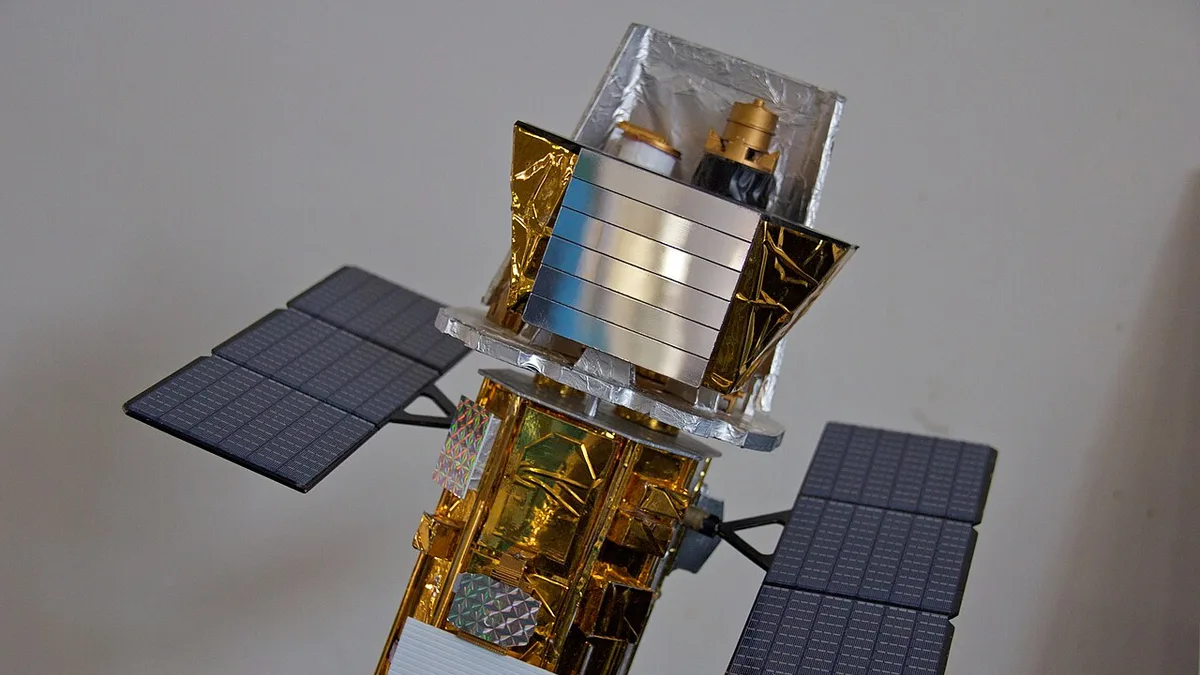
NASA on June 17 detailed a mission in which the private LINK spacecraft would, in late June, capture and raise the Swift telescope, whose orbit is decaying due to atmospheric drag.

- On June 17, 2026, NASA held a media event about the mission to boost the orbit of the Neil Gehrels Swift telescope.
- The private LINK spacecraft is built by Katalyst Space, with launch planned for late June aboard a Pegasus XL rocket.
- If it works, it would be the first known case of a private robotic spacecraft autonomously approaching and raising an active government science satellite never designed to be serviced.
- Swift launched in 2004, and its orbit is now decaying due to atmospheric drag, with a risk of reentry in the autumn.
On June 17, 2026, NASA held a media event to present its mission to raise the orbit of the Neil Gehrels Swift telescope. The plan is for a private servicing spacecraft named LINK, built by Katalyst Space, to approach the telescope in late June, capture it, and lift it onto a higher path around Earth. Launch is set aboard a Northrop Grumman Pegasus XL rocket, which is released from the L-1011 Stargazer carrier aircraft.
Swift launched in 2004 and has since led NASA’s fleet of telescopes studying gamma-ray bursts, the most powerful explosions in the universe, along with other sources of high-energy radiation. The telescope was not designed to be serviced in orbit, so it has no capture points or fixtures meant for grappling. That is part of why this attempt is being watched closely: the spacecraft must autonomously approach an object that was never prepared for it.
The trouble is that Swift’s orbit is slowly decaying. At the altitudes where the telescope circles, a very thin atmosphere still exists, and friction with it slows the spacecraft and gradually drags it downward. According to NASA, heightened solar activity has further heated and expanded the upper atmosphere, speeding up that decline. Without intervention, the telescope risks entering denser layers of the atmosphere as early as the autumn of 2026.
Why is this reboost different?
Servicing satellites in orbit is not new in itself. Astronauts repaired the Hubble telescope several times, and in recent years commercial spacecraft have extended the working life of certain communications satellites that were built for it. The difference is that LINK, if it succeeds, would be the first known case of a private robotic spacecraft autonomously approaching, capturing, and raising an active government science satellite that was never designed to be serviced.
That pushes the boundary of what is considered feasible. A great many science satellites were launched with no features for later maintenance, because servicing missions simply were not part of the plan when they were built. If it turns out that even such objects can be captured and boosted, it opens the possibility of extending the life of expensive instruments rather than letting them decay. NASA describes this mission as a chance to test that technology on a real, active telescope.
What does the mission not yet prove?
It is worth staying cautious. The mission is still in preparation: the robotic spacecraft arrived at NASA’s Wallops facility in Virginia in early June for integration with the rocket, and launch is announced for late June. Until the approach, capture, and reboost maneuver are actually carried out, this remains a plan rather than a result. Autonomously closing in on an object that does not cooperate with the spacecraft is technically demanding, and delays or partial success are possible.
A single successful attempt would also not mean that servicing arbitrary satellites has become routine. Each telescope has a different shape, mass, and behavior in orbit, so every future mission would require its own preparation. What this mission can show is whether the concept itself is feasible, not that the problem of decaying satellites has been solved. Would you rather see NASA extend the life of existing telescopes or build new ones?