

Leonid meteors peak near 00:45 on Nov. 18, Moon-free sky
The Leonid meteor shower offers 10 to 15 meteors an hour this year. Forecasts of the peak differ by up to an hour, and the Moon sets in Belgrade at 23:15.
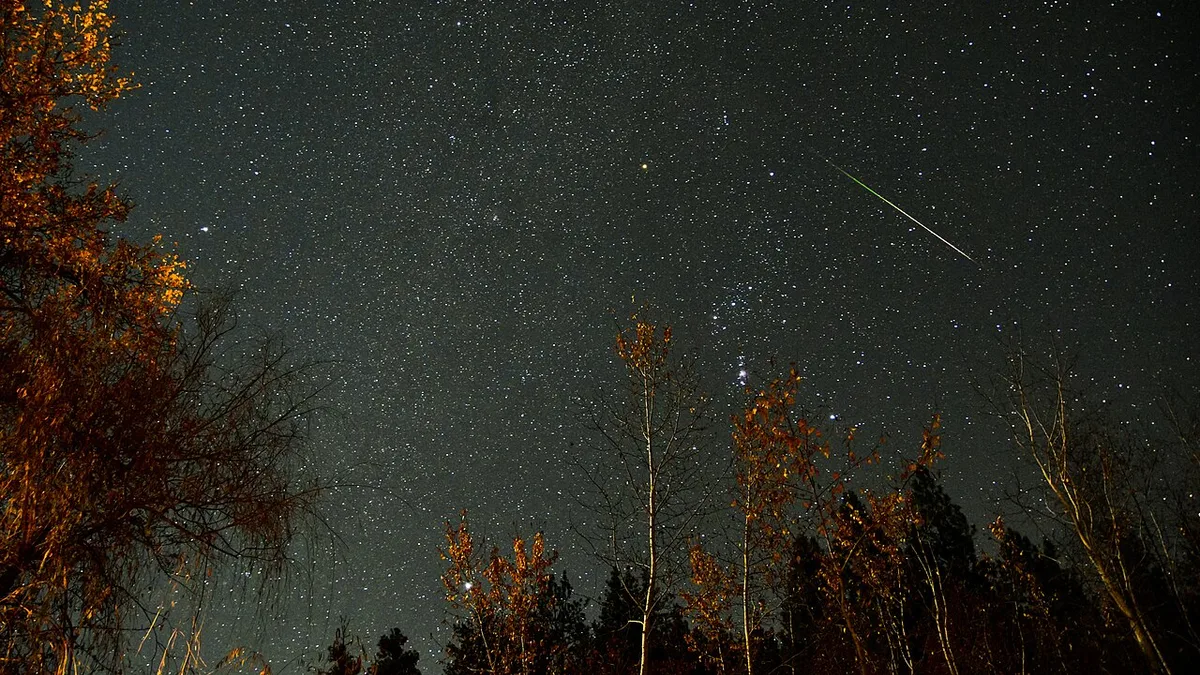
The Leonid meteor shower peaks on the night between Tuesday and Wednesday, November 17 to 18, 2026, and the Moon will set in Belgrade at 23:15. After that the sky over Serbia stays free of moonlight until morning, about the best setup a meteor watcher could ask for.
The Leonids take their name from the constellation Leo, home to their radiant, the point in the sky from which the meteors appear to stream. The radiant rises around midnight and stands highest just before dawn. According to EarthSky, more meteors show up once the radiant clears the eastern horizon, so the best viewing window runs from midnight to dawn.
When exactly should you look, if the sources disagree?
The sources do not give the same peak hour. The gap is smaller than it looks, though, because the first two forecasts differ by only fifteen minutes:
- The International Meteor Organization calendar, as relayed by Star Walk, puts the maximum at 23:45 Universal Time on November 17, which is 00:45 on Wednesday, November 18 in Serbia.
- The American Meteor Society, cited by EarthSky, gives 0:00 Universal Time on November 18, or 01:00 local time.
- Mikhail Maslov, whose alternative forecast Star Walk cites from the same calendar, places the peak at 16:00 Universal Time on November 17, which is 17:00 in Serbia.
EarthSky also warns that predicted peak times can shift. The practical advice is therefore the same in both sources: watch after the Moon has set and before morning twilight begins, and do it on both nights, November 17 and 18.
The Moon reaches first quarter on November 17 at about 12:47 Belgrade time. According to timeanddate.com, that day it rises in Belgrade at 12:35, sets at 23:15 and is 52 percent illuminated. While it is above the horizon, its light hides the fainter meteors. On November 18 the Moon does not set before midnight in Belgrade, so the first night is the better one.
What can you see, and how many meteors should you expect?
Under a fully dark, Moon-free sky, 10 to 15 meteors an hour are expected. That figure is an estimate for ideal conditions: the number of meteors visible in one hour when the sky is completely dark and the radiant is directly overhead. Star Walk cautions that the number a real observer sees is usually lower.
No meteor storm is forecast this year. EarthSky notes that most astronomers count a storm from more than 1,000 meteors an hour. Star Walk says models do predict an encounter with a few rare dust trails, so smaller bursts of activity are possible between November 17 and 19.
You need neither a telescope nor binoculars. Pick a dark spot with an open horizon and give your eyes about 30 minutes to adapt to the darkness. There is no need to stare at Leo: meteors seen farther from the radiant have longer apparent paths across the sky, which makes them easier to spot and photograph.
The Leonids are among the fastest meteors. They hit the atmosphere at 71 kilometers per second and can leave a long blue-green trail. Photographer Eliot Herman of Tucson, Arizona, told EarthSky:
“The Leonids are the greenest meteors I see.”
Where do the Leonids come from, and why are they remembered?
The shower comes from comet 55P/Tempel-Tuttle, which circles the Sun about every 33.17 years. Wilhelm Tempel discovered it on December 19, 1865, in Marseille, and Horace Tuttle of the Harvard Observatory found it independently on January 5, 1866, which is why his name was added to the comet. The comet next returns in early 2031.
The Leonids owe their fame to storms, which come at intervals of about 33 years, though not reliably. The 1833 storm was the first great one of the modern era: Star Walk speaks of tens of thousands of meteors an hour, while EarthSky cites a widely accepted estimate of up to 150,000 an hour. The storm helped shift meteors from being seen as an atmospheric phenomenon to being understood as particles from space. In January 1834, Denison Olmsted proposed that they came from a cloud of particles in space. In 1899 the expected storm failed to appear.
November 2026 is also the 60th anniversary of the 1966 storm. Star Walk records that observers in North America saw 40 to 50 meteors per second on November 17, for about fifteen minutes. EarthSky says observers in the southwestern United States reported up to 70 meteors per second over 15 to 20 minutes. Later trajectory calculations tied that storm to a dense trail of particles the comet left behind on its 1899 return.
The next forecast storm is on November 17, 2033. Maslov predicts 300 to 400 meteors an hour for it, while a more recent model points to as many as 1,400 an hour. Star Walk labels those numbers uncertain.
What this forecast does not guarantee
All the figures above are forecasts, not measurements. The hourly rate applies to an ideal dark sky, so observers near a city will see fewer meteors, and the predicted peak hour differs from source to source. The 2033 forecast has not been verified, because it depends on calculations of dust trajectories rather than on observation.


