Voyager 1 Reaches One Light-Day From Earth on Wednesday
NASA has set the exact moment: on Wednesday at 11:16:07 a.m. Belgrade time, the probe launched in 1977 will be 25.9 billion km away, and a radio signal will need a full day to cross.
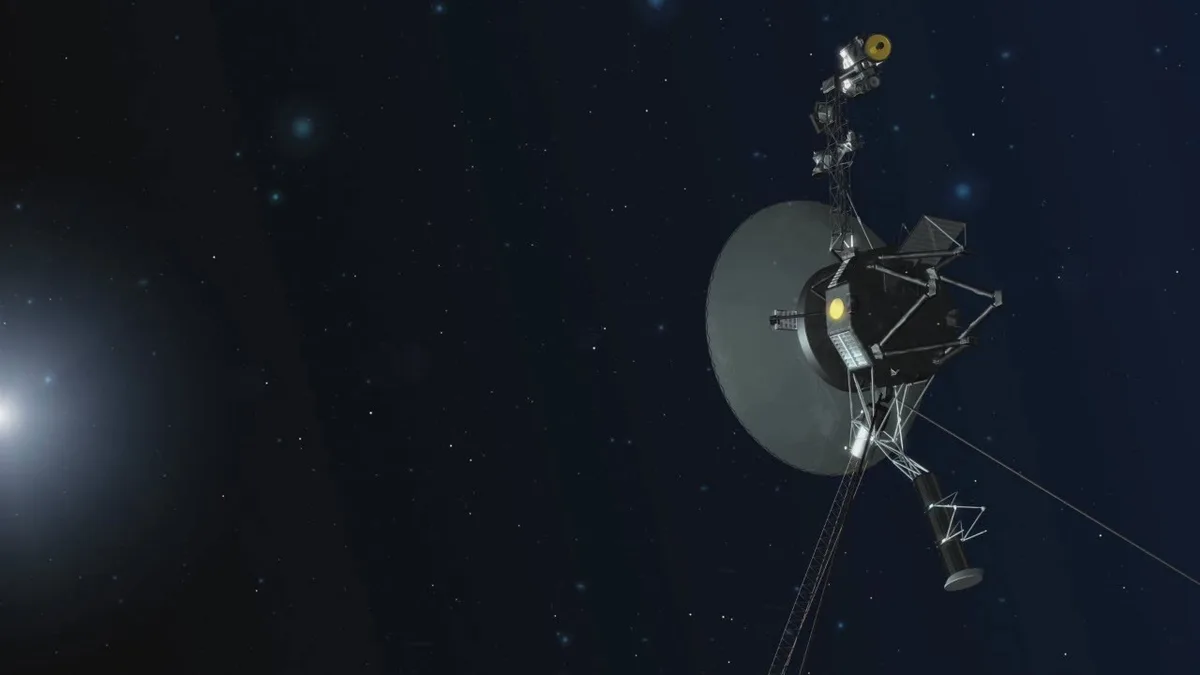
On Wednesday, November 18, 2026, at 11:16:07 a.m. Belgrade time (10:16:07 UTC), the Voyager 1 probe becomes the first human-made object to be one light-day from Earth, about 25.9 billion kilometers. NASA announced the exact moment on November 16, along with a call for people around the world to join a campaign called Shine Bright after sunset tonight, November 17.
What is a light-day, and how far is it?
A light-day is a unit of distance, not of time: it is the path light travels in a vacuum in 24 hours. According to NASA, that is 25.89 billion kilometers, or 173.14 astronomical units. For comparison, sunlight needs about eight minutes and 20 seconds to reach Earth, and a radio signal between Earth and Mars takes from three to 22 minutes, depending on where the planets are.
The probe was launched on September 5, 1977, and travels at about 61,000 kilometers per hour (38,000 miles per hour). It took 49 years, two months and 11 days to get here, by EarthSky’s calculation.
What does the distance mean for contact with the probe?
A radio message from Earth takes about 24 hours to reach the probe, and the reply takes another 24 to come back. Suzy Dodd, Voyager project manager at the Jet Propulsion Laboratory (JPL) at Caltech, explained it to CNN with an example:
“If I send a command and say ‘good morning, Voyager 1’ at eight in the morning on Monday, I will get the answer from Voyager 1 on Wednesday morning, at around eight.”
The link is slow in capacity as well. According to BBC Sky at Night Magazine, commands to the probe go at 16 bits per second, while data comes back at about 160 bits per second. In late 2023 the probe sent unreadable data, and engineers needed five months to find and fix the cause: a memory chip had failed.
In its statement, NASA describes the distance as a record, not a fault:
“Voyager 1 will be the first human-made object to reach this distance from Earth, adding another historic first to the mission’s long list.”
How did the probe get here?
Its original assignment was to fly past Jupiter in 1979 and Saturn in 1980, and it completed both. Since February 1998, when it overtook Pioneer 10, Voyager 1 has been the most distant human-made object. It crossed the heliopause, the boundary up to which the Sun’s influence prevails, on August 25, 2012, and has been in interstellar space ever since.
By BBC Sky at Night Magazine’s calculation, at the moment it reaches one light-day it will be about 5.6 times farther from Earth than Neptune. The distance to the nearest star, Proxima Centauri, is still only a small fraction of the way. The same source notes that the probe has not yet reached the Oort cloud, which, by that estimate, it will enter in about 300 years.
Voyager 2, launched a few weeks earlier, is heading a different way and moving more slowly. It reaches one light-day in November 2035. It is the only spacecraft that has visited Uranus and Neptune, and both probes are in interstellar space and still sending data.
How much longer can the probe keep working?
Voyager 1 gets its power from the heat of decaying plutonium-238, so its output is now roughly half of what it was at launch. That is why NASA is switching off instruments one by one. The cameras took their last images in 1990.
Sources disagree about what is still switched on:
- ScienceAlert says two instruments remain: the magnetometer and the plasma wave subsystem;
- EarthSky writes that NASA turned off the low-energy charged particle instrument in April 2026, with the possibility of turning it back on later;
- BBC Sky at Night Magazine lists the magnetometer, the electron density instrument and the low-energy particle detector as active.
Sources also estimate differently how long the link will last. NASA hopes the probe will keep communicating until the early 2030s, while BBC Sky at Night Magazine says the signal is expected to become too weak for NASA’s antennas by 2036.
How can you join in tonight?
NASA is asking people to point a flashlight, a phone or a glow stick at the sky after sunset on Tuesday, November 17, and send the letters V-G-R, the probe’s designation, in Morse code:
- V: dot, dot, dot, dash;
- G: dash, dash, dot;
- R: dot, dash, dot.
Anyone who does not want to memorize the signals can use NASA’s automatic blinker on a phone.