Kurti to Zelensky: Kosovo is not Putin's precedent
In an op-ed for Kyiv Post, the Kosovo prime minister asks the Ukrainian president to recognize Kosovo's independence and rejects comparisons with Crimea.
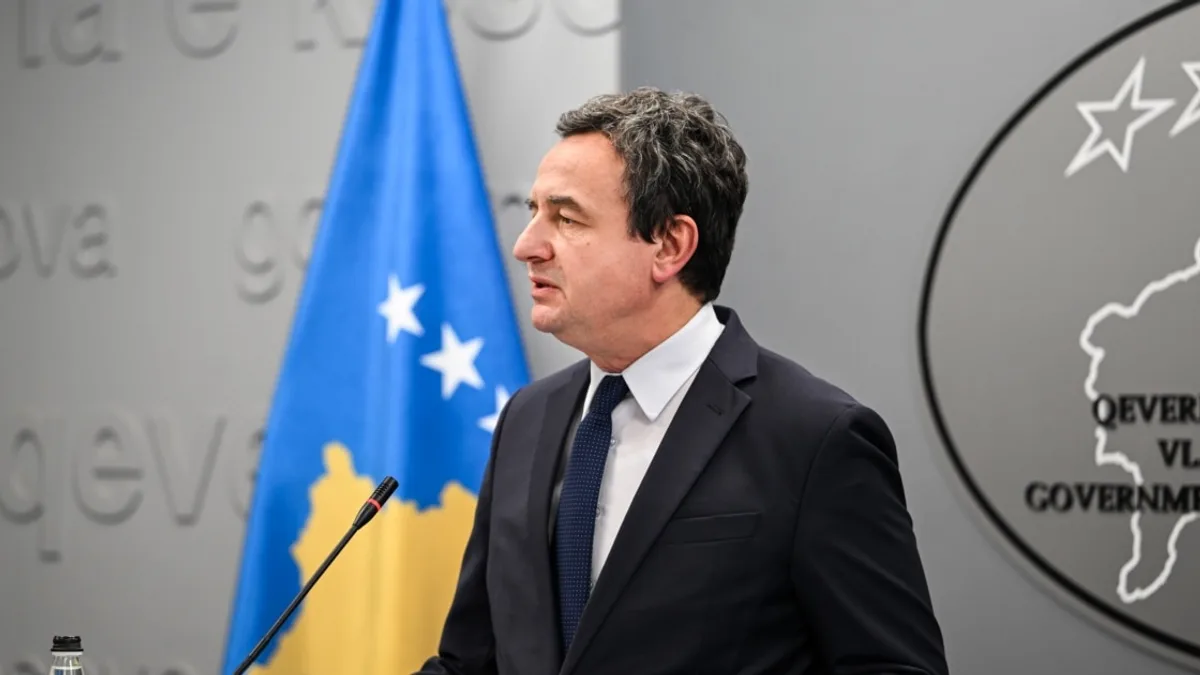
Kosovo Prime Minister Albin Kurti is asking Ukrainian President Volodymyr Zelensky to recognize Kosovo, in an op-ed for the Ukrainian paper Kyiv Post. Radio Free Europe and Danas carried the text on November 20. Kurti also rejects the comparison between Kosovo and Crimea that Moscow invokes.
The trigger was a statement Zelensky made in Belgrade on August 8, 2026. The Ukrainian president said then that Ukraine respects the “territorial integrity of our partners and international law,” and that “for Kosovo, the position remains unchanged.” Kurti comments on that moment this way:
“What stood out was that the statement was made in Belgrade, the capital of Serbia, one of Russia’s closest allies.”
The Kosovo prime minister also criticizes Ukraine’s rapprochement with Serbia, which, he notes, has not imposed sanctions on Moscow. Serbia backed United Nations resolutions condemning the Russian invasion but did not join Western sanctions.
What has Kosovo done for Ukraine?
Kurti lists what Pristina has done since the Russian invasion began:
- it condemned Russian aggression
- it aligned with European Union and United States sanctions
- it hosted Ukrainian journalists
- it provided military aid and training
On that record he builds his main request. Kurti writes that recognition would not be a favor to Pristina:
“President Zelensky should recognize Kosovo, not as a favor to us, but because it would strengthen the very international order that Ukraine has been defending for years: an order in which history is not a license for occupation, borders are not changed by force, and larger states do not deny smaller countries a future.”
Why does Kurti say Kosovo is not Crimea?
Kurti recalls that Vladimir Putin cited the Kosovo precedent after the annexation of Crimea. Putin repeated the Russian line on April 26, 2022, when, speaking about Donetsk and Luhansk, he said: “The fact is that many Western states have recognized Kosovo as an independent state. We have done the same with the republics of Donbas.” Kurti argues that Putin is not interested in international law, only in discrediting the West.
That is why his message is short: “Kosovo is not Putin’s precedent.” He explains the difference between the two cases with the example of voting:
“Ballot boxes in a referendum must not be carried by soldiers of a neighboring country, as Russian soldiers did in Crimea.”
He adds that “Crimea is Ukraine. And Kosovo is Kosovo.” As legal grounds, he points out that Kosovo declared independence in 2008, that more than 120 countries recognize it, that the International Court of Justice ruled in 2010 that the declaration did not violate international law, and that international supervision of its independence ended in September 2012.
Why does Kyiv not recognize Kosovo?
Ukrainian authorities invoke the principle of territorial integrity. They also fear that Russia could use recognition of Kosovo as a precedent for the occupied parts of Ukraine.
Oleksandr Merezhko, chair of the Verkhovna Rada’s committee on foreign policy and inter-parliamentary cooperation, told Radio Free Europe earlier that opinions in Ukraine differ, but that the final decision belongs to Zelensky. Among the reasons against recognition he named the fear of Russia exploiting a precedent, Serbia’s support for Ukraine’s territorial integrity and, to some extent, Serbian ammunition that ends up in Ukraine. He says he is personally skeptical of those arguments and believes recognition would not violate international law.
Zelensky’s August position was also criticized by some Ukrainians. Opposition lawmaker Oleksiy Honcharenko judged the statement a “diplomatic mistake” and said Ukraine should recognize Kosovo. Ukrainian war veteran Yuriy Hudymenko, chair of the Public Anti-Corruption Council at the Ministry of Defense, said he felt “disgusted and ashamed.”
There were reactions in Pristina and Tirana as well. Kosovo Foreign Minister Glauk Konjufca expressed regret but added that Pristina would welcome recognition from Kyiv and that Kosovo continues to offer “unwavering support” for Ukraine’s sovereignty and territorial integrity. Municipal authorities in Pristina removed a large Ukrainian flag reading “Freedom for Ukraine” from the city center. Albania’s foreign ministry said that any attempt to equate Kosovo with any other international situation is “wrong, opportunistic and completely inaccurate.”
Zelensky’s response to Kurti’s op-ed is not mentioned in media reports.