

SpaceX Dragon CRS-35 launches with final solar arrays
A Falcon 9 launched the cargo craft from Cape Canaveral with about 2,860 kilograms of cargo and the last pair of iROSA panels. Docking is set for Thursday at 5 p.m. Serbian time.
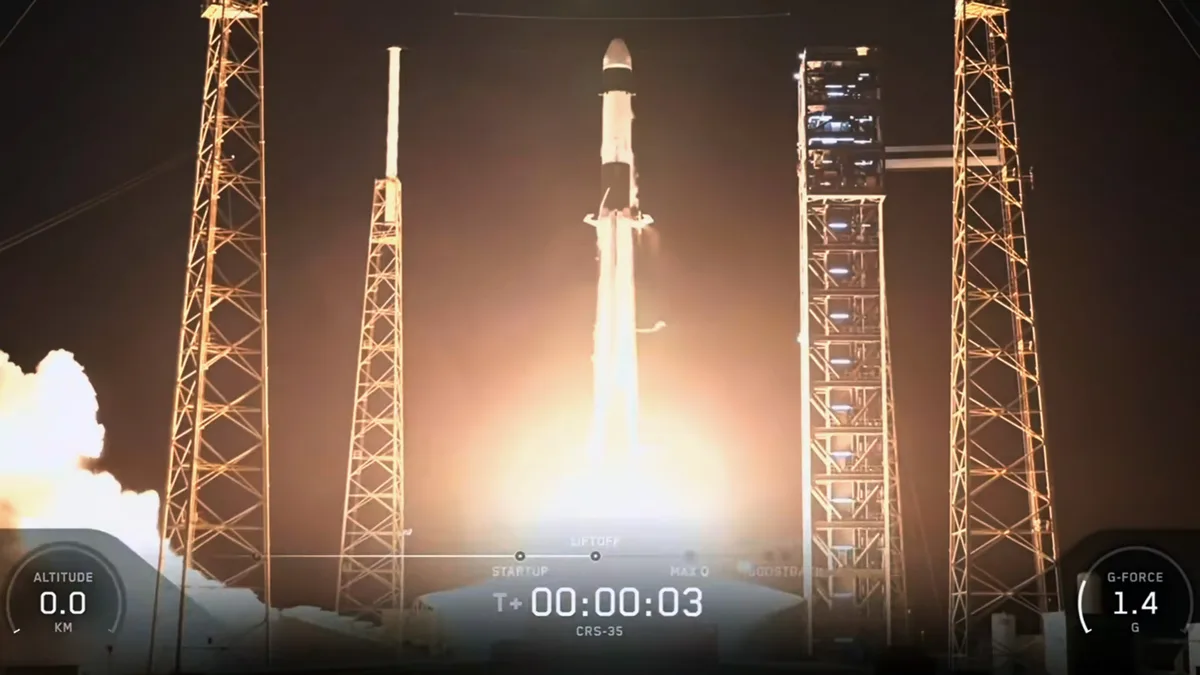
A Falcon 9 rocket lifted the Dragon cargo spacecraft off Launch Complex 40 at Cape Canaveral in Florida today, October 13, at 12:33 p.m. Central European Time. According to NASA’s space station blog, the launch went exactly to plan, at 6:33 a.m. Eastern Time, which is 10:33 UTC.
The flight is the CRS-35 mission, SpaceX’s 35th resupply flight to the International Space Station under its NASA contract. On board are more than 6,300 pounds, about 2,860 kilograms, of scientific experiments and equipment. Spaceflight Now reports that after leaving the pad the rocket headed out on a northeasterly path.
What happened in the first nine minutes of the flight?
About nine minutes after liftoff, Dragon separated from the rocket’s second stage, opened its nose cone and began a series of engine burns that bring it closer to the station.
The first stage is booster B1096, flying for the eighth time. It has previously launched the IMAP probe and the CRS-34 mission, and its record also includes NROL-77, NROL-95, GPS-III 9, Kuiper Falcon 01 and Starlink 6-87. The Dragon C211 capsule is on its fourth flight, after CRS-26, CRS-29 and CRS-33.
What is in the cargo, and why are the solar arrays front and center?
The unpressurized section of the spacecraft holds the last pair of roll-out solar arrays, known as iROSA. They are meant to boost power generation on the aging station. The same section carries a clamshell-shaped carrier for the faulty wrist joint of the Canadarm2 robotic arm, which was removed during a spacewalk on June 30. The joint will return to Earth in that carrier.
The cargo also includes a part for the toilet, sensors and a tool for robotic maintenance of the station. Bill Spetch, deputy manager for commercial flights in NASA’s Low Earth Orbit Program, listed what goes into that part of the cargo ahead of the launch:
“Additional equipment we’re launching includes a dose pump for our toilet, some pre-treat quality sensors,”
Spetch also mentioned the robotic maintenance tool, and Spaceflight Now carried the statement. The same speaker described the science portion of the cargo:
“We also have a wealth of science experiments on board, including studies to manufacture artificial retinas, understand how microgravity affects the growth of 3D heart tissue models, study how glass forms when made with non-traditional elements, and better understand how inflammation is linked to neurodegenerative diseases.”
In weightlessness, then, researchers will make artificial retinas and grow three-dimensional heart tissue, and they will also study how glass forms from unusual elements and how inflammation relates to neurodegenerative disease.
When does Dragon reach the station?
Arrival is planned for Thursday, October 15, at about 11 a.m. Eastern Time, or about 5 p.m. in Serbia. NASA will begin its coverage of the rendezvous and docking at 9:15 a.m. Eastern Time, which is 3:15 p.m. in Serbia.
Dragon is expected to dock at the upper, zenith port of the Harmony module. The Crew Dragon Freedom capsule recently vacated that port, splashing down on October 8 with the four members of NASA’s Crew-12 mission. The cargo spacecraft will stay at the station for about a month.
So far only the launch is done. The panels are still on their way and docking is scheduled, not completed, so Thursday will show whether it goes by the timetable NASA and SpaceX have published.


