Vacuum Birefringence Possibly Detected in Magnetar
NASA's IXPE satellite and the Parkes radio telescope spent over 140 hours on magnetar 1E 1547.0-5408. The X-ray polarization found points to vacuum birefringence, an effect predicted in 1936.

An international team of astrophysicists published a measurement in the journal Nature on Wednesday, August 5, 2026, that could be the first direct trace of vacuum birefringence, an effect Werner Heisenberg predicted nearly 90 years ago. The observation target was magnetar 1E 1547.0-5408, a neutron star whose magnetic field is roughly a trillion times stronger than Earth’s and which completes one full rotation every 2.1 seconds. The paper carries the DOI 10.1038/s41586-026-10859-z.
Magnetars are a rare class of neutron star with the strongest known magnetic fields in the universe, and this one stands out further for emitting strong radio and X-ray radiation at the same time, a combination astronomers still cannot fully explain. That is why it was chosen for a job no laboratory on Earth can do. According to Marcus Lower of Swinburne University in Australia, one of the paper’s authors, detecting the effect requires a field more than 100 million times stronger than anything humans have built.
How the Measurement Was Made
The observations ran for more than 140 hours between March and April 2025. The campaign brought together:
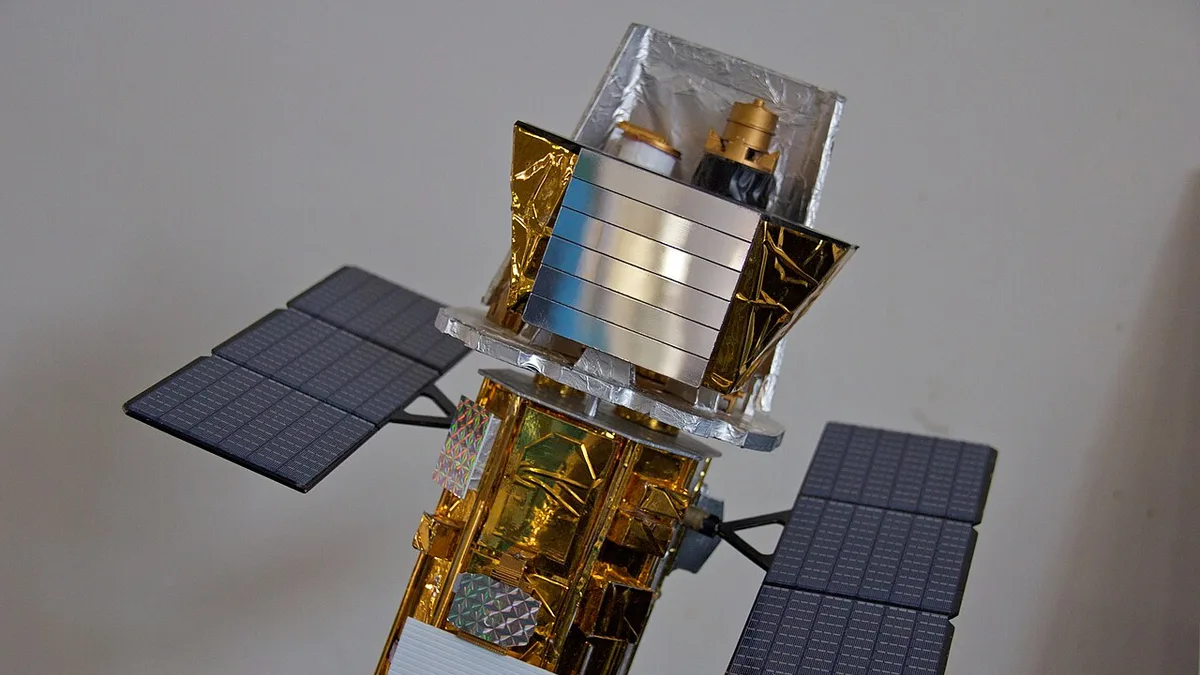
- NASA’s IXPE satellite, the only instrument that measures X-ray polarization, in orbit since December 2021
- the NICER instrument aboard the International Space Station
- the Australian Parkes radio telescope, also known by its Indigenous name Murriyang, operated by the CSIRO
It was the first coordinated measurement of a magnetar’s radio and X-ray polarization together, and the result came in outside the expected range. The polarization degree measured 40 percent in the upper radiation cone and 80 percent in the lower one, nearly three times higher than in comparable objects. Standard models of radiation from a neutron star’s surface do not account for that level, so the team looked for an additional mechanism boosting the polarization.
The second clue was direction. The polarization stayed locked to the orientation of the magnetic field and tracked the behavior of the radio waves as the star rotated.
What Is Vacuum Birefringence?
It is a 1936 prediction of quantum electrodynamics holding that empty space is not truly empty. According to Heisenberg, virtual particles are constantly appearing and vanishing within it. When a strong enough magnetic field passes through that space, those particles align with the field, and the vacuum starts behaving like a prism or filter, transmitting differently oriented light differently. The result is an increase in overall polarization.
“Because of the strength of the magnetic field, Heisenberg’s virtual particles align with the direction the field points,” Lower explained.
The paper’s lead author is Rachel Stewart, a doctoral candidate at George Washington University, with Hoa Din Ti, a postdoctoral researcher at Rice University, as co-lead author. Stewart said in a NASA statement:
The information we’ve gathered by observing that distant stellar core also gives us hints about the nature of the very structure of reality as we know it.
The team’s simulations support that possibility. “Reproducing the observed X-ray polarization features requires the presence of vacuum birefringence in the vicinity of the neutron star,” Hoa Din Ti said in the same statement.
What the Result Does Not Yet Prove
NASA describes the result as a possible first direct observation, not as conclusive proof, and that distinction is worth holding onto. A separate analysis of the same data argues the system’s geometry could differ from what the team assumes, and that high polarization alone is not sufficient evidence. The measurement was taken on a single object, over a single period, and the mechanism by which this magnetar radiates is not fully understood even without accounting for quantum effects.
Lower himself says the same thing:
We need more data and better simulations to separate the vacuum birefringence signal from the other processes happening around magnetars.
Confirmation will have to come from further observations, of this magnetar and others. IXPE is a joint mission of NASA and the Italian Space Agency, with collaborators from 12 countries, led by NASA’s Marshall Space Flight Center in Huntsville, Alabama. The mission has been in orbit for just over four and a half years, meaning more magnetars like this one already sit in its archive, and the next test will be whether the same pattern shows up on an object with a different field geometry. If it does, vacuum birefringence stops being a theoretical possibility. If it does not, the explanation will have to be sought in the star’s surface itself.