Vera Rubin asteroid, 2.5 km wide, spins in about 4 minutes
A University of Washington team found asteroid 491384 in Rubin Observatory data, the largest ultrafast rotator known so far. The paper has not yet been peer reviewed.
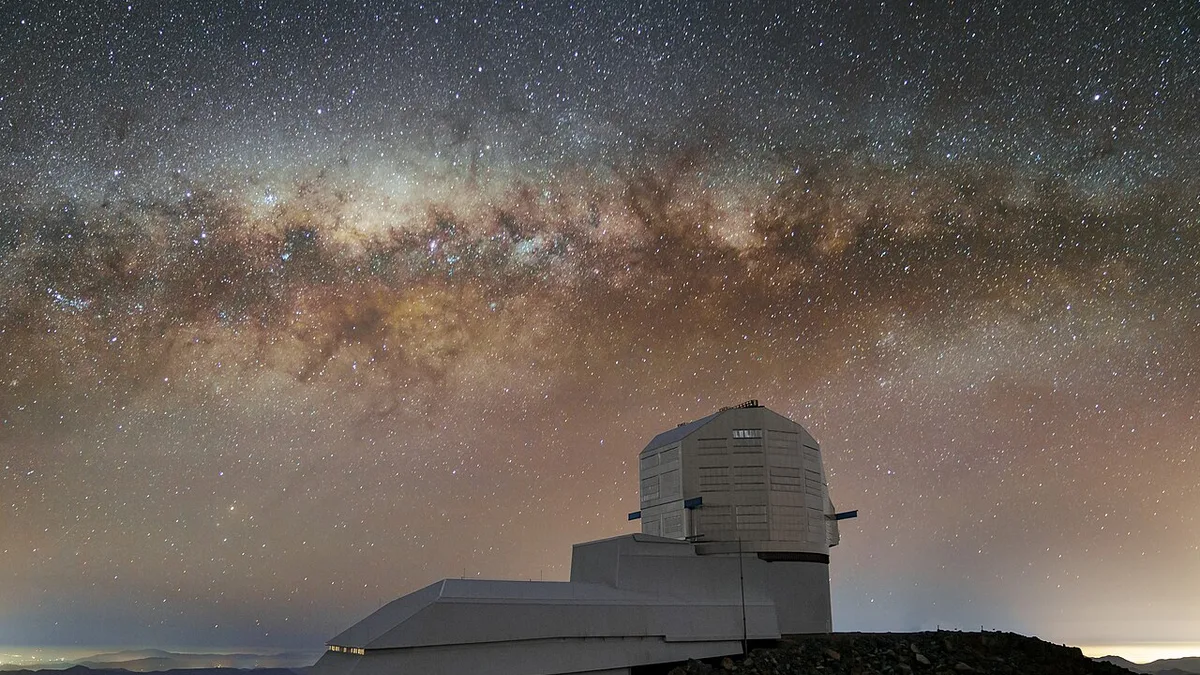
Asteroid 491384 is about 2.53 kilometers across and completes one rotation in about 4.18 minutes. A University of Washington team led by Dmitry Vavilov found it in data from the Vera C. Rubin Observatory in Chile, and the paper was submitted to arXiv on October 6, 2026. According to the authors, it is the largest ultrafast rotator known to date. The paper has not been peer reviewed.
Why measure how fast an asteroid spins?
Most asteroids are thought to be “rubble piles”: loose collections of rock held together only by their own weak gravity. A body like that falls apart if it spins too fast. For this reason, asteroids wider than about 150 meters rarely complete a full rotation in less than 2.2 hours. The literature calls this limit the “spin barrier.”
If a larger asteroid beats that limit anyway, something is holding it together more strongly than gravity can. Spin rate therefore reveals what a body is made of. The measurement is indirect: asteroids are not perfect spheres, so they reflect more or less sunlight as they turn, and the rotation period is estimated from how their brightness changes over time.
What did Vavilov’s team do differently?
Telescopes like Rubin photograph the same asteroid at irregular intervals, and gaps in coverage easily produce a wrong period. Checking by hand is possible, but for the enormous number of objects Rubin observes it takes too long.
Vavilov and his colleagues, Siegfried Eggl and Sarah Greenstreet, built a program that processes each asteroid separately. It uses a Fourier series, a mathematical description of the brightness curve, with an order chosen for each object individually. The program spots gaps in coverage and flags suspect brightness measurements. When a period cannot be pinned down uniquely, it does not pick a single value but offers a list of possible periods, each with an estimated probability.
The method was applied to Rubin’s Data Preview 2 catalog, which covers Solar System objects. It processed 9,417 asteroids and found 66 candidates rotating faster than the 2.2-hour limit.
Which two asteroids stand out?
Two of those candidates are wider than 2 kilometers and rotate roughly once every five minutes:
- 491384, about 2.53 kilometers across, period of about 4.18 minutes
- 566130, wider than 2 kilometers, period of about five minutes
For comparison, 2.2 hours is 132 minutes, so by these numbers 491384 spins about 32 times faster than the limit believed to apply to most asteroids of its size. To avoid breaking apart at that rate, the body must have considerable internal strength. In its report on the paper, Phys.org says it is closer to a single compact rock than to a pile of rubble, while the arXiv abstract speaks of “significant internal cohesion.”
What did Rubin already show in January?
This is not the first result of its kind. A paper published on January 7, 2026 in The Astrophysical Journal Letters, with Sarah Greenstreet of NSF NOIRLab and the University of Washington as first author, analyzed data collected over about ten hours of observing spread across seven nights in April and May 2025. It was the first peer-reviewed scientific paper based on data from the LSST camera. It found 76 asteroids with reliable periods, among them 19 super-fast and ultrafast rotators.
The fastest of them is 2025 MN45, 710 meters across, which completes a full rotation in 1.88 minutes. Greenstreet said at the time:
“It is clear that this asteroid must be made of material with very high strength to stay in one piece while spinning this fast. We calculated that it would need cohesive strength similar to solid rock. That is somewhat surprising, because most asteroids are believed to be so-called rubble piles, made of many small pieces of rock and debris that clumped together under gravity.”
The new asteroid is therefore about 3.6 times wider than 2025 MN45, but it rotates more slowly.
What this paper does not prove
The work by Vavilov and colleagues is a preprint, meaning journal reviewers have not yet examined it and the numbers may change. Even the available descriptions differ: Phys.org gives 2.53 kilometers and 4.18 minutes, while the arXiv abstract mentions only a diameter of about 2.5 kilometers and a period of about five minutes.
The rotation period comes from sparsely spaced brightness measurements, exactly the kind that produce false periods, so the reliability of each result is an estimate with a probability, not a fixed fact. The conclusion about a strong interior is derived from spin rate and size, not from direct insight into the asteroid’s structure, and it does not say what material the body is made of. The authors also say that further refinement of the program could automate the study of asteroids in large sky surveys, but that is a goal, not an achieved result.