Van Gogh's Starry Night may be from July, not June
A study published October 22 links the Moon, Venus and stars in the painting to the sky over Saint-Remy around July 22, 1889, a month after the usual date.
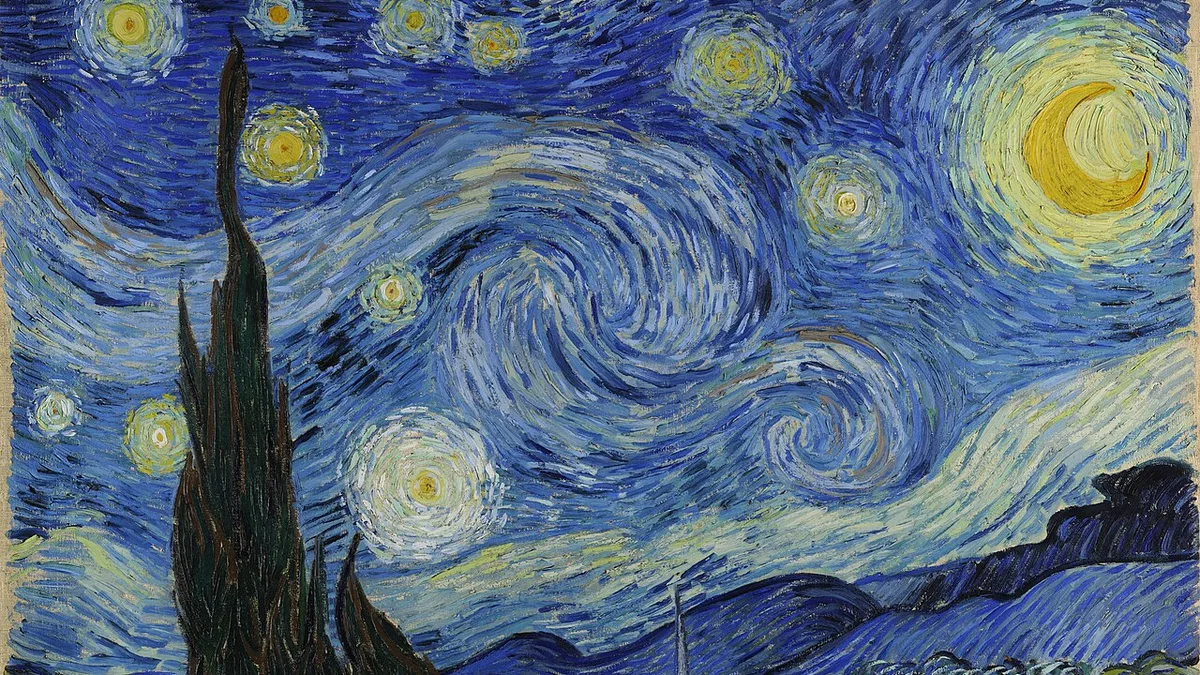
The sky in Vincent van Gogh’s The Starry Night matches the real predawn sky over the French town of Saint-Remy-de-Provence around July 22, 1889, according to a team from South Korea’s Kyung Hee University. Art historians have so far placed the painting in June of that year, so the proposed date would be about a month later. The study was published on October 22, 2026, in Scientific Reports (DOI 10.1038/s41598-026-73025-5), and the Associated Press also put questions about the conclusions to its authors.
The painting shows a crescent Moon and a bright point of light that the Museum of Modern Art in New York, which owns it, identifies as Venus, the morning star. Blue and yellow strokes swirl above the village, and a cypress rises on the left. Van Gogh painted the canvas in a studio at the Saint-Remy asylum, working from sketches and memory, so researchers have long argued over how much of it is observed sky and how much is imagination.
What did the team compare with the canvas?
The team was led by Elijah Jeong-hyun Kim, a doctoral student at Kyung Hee University’s School of Space Research and the director of SLLAB, a South Korean telescope maker. He was struck by a V-shaped group of stars near the center of the painting and recognized in it the Hyades star cluster in the constellation Taurus. Earlier studies had seen the constellation Aries in that spot, and astronomical readings of the painting have never agreed.
The Moon was a second problem. In mid-June 1889 it was waning and more than half lit, which does not fit the thin crescent on the canvas. “The strongest evidence is the sky itself,” Kim told ScienceAlert. “A waning Moon around June 18 doesn’t match the thin crescent in the painting.”
The team therefore rebuilt the sky over Saint-Remy by computer. It took the field of view from an earlier drawing tied to the village landscape. During two trips to France in 2019 it also photographed places Van Gogh had drawn and painted, to judge how narrow a slice of the landscape he recorded. Among the June and July dawns when the Moon sat above Venus, as in the painting, three entered the frame: June 23, and July 22 and 23. Only around July 22 were the Hyades in the middle, which gave the closest match.
Next, the team measured the layout of the five central stars on the canvas. A mathematical procedure that shifts, rotates and uniformly scales patterns found a close link with the Hyades: for those five points, every other pairing with stars of the cluster produced a worse fit. The match was even closer with Van Gogh’s later pen drawing of the scene, and the tilt of the group toward the horizon agreed with the reconstructed sky. The team ran the same procedure on two night scenes from Arles painted in 1888, and for Cafe Terrace at Night it found a possible match in three bright stars of the Summer Triangle.
What do the letters and the weather say about the date?
Kim was in France twice in 2019, first in mid-June and again around July 22, and noticed that stars are brighter before dawn in July than in June. Analyses of the weather suggest the sky could then have been clear enough for Van Gogh to see all of it.
The dating also leans on letters to his brother Theo. In a letter of June 18, Van Gogh mentions a new study of a starry sky, but the authors do not read that as proof that the canvas was finished then. The attack of illness, usually placed in mid-July, began later in their view, and letters that mention cicadas point to warmer July weather. No medical notes from the period survive to confirm when the attack started.
“I am sure that July 22 is the better date. I would bet on that date,” Kim wrote in an email to the Associated Press. He added that the days before and after could also have inspired it. “No two skies are the same. Something always changes. I believe Vincent noticed those changes and put them into the painting.”
What does a physicist who was not part of the study say?
Jose Luis Aragon of Mexico’s National Autonomous University has studied this painting as a physicist before. He called the Moon’s shape in mid-June 1889 a “real puzzle”, since it was not a thin crescent, and judged the study careful and truly interdisciplinary. His conclusion is still cautious: “Still, I would view the July date as an interesting hypothesis, not a final answer.”
What he finds most convincing is the broader message: “The painting is not pure fantasy. Van Gogh observed the real sky very closely.”
What does the study not prove?
The limits are visible in the study itself. The authors say other groups of stars also give close geometric matches, so shape alone cannot settle which stars were painted. The match carries weight only when the layout of the stars, the positions of the Moon and Venus, and the place of the Hyades in the reconstructed frame all line up.
The date is not settled either. Kim says the sky in the painting fits the dawn around July 22, but that this alone does not fix the day the canvas was finished, and he believes Van Gogh combined the sky of several days before and after that date on a single canvas. Aragon adds that the sky was probably assembled from more than one night, which the authors also acknowledge. The claim that the illness began later rests on letters and weather records, not on medical documentation. The study therefore proposes one possible chronology, which art historians still have to assess.
Kim, who has studied the painting for years, has never seen it in person. “Now that the paper is out, I have to go and see The Starry Night in person, don’t I?” he said.