November 2026 Sky: Mars and Jupiter, Leonids, Full Moon
The Moon is at last quarter tonight and stands beside Mars and Jupiter before dawn tomorrow. A guide to November's sky events with dates and times, from the Leonids to Uranus.
The Moon reaches last quarter today, November 1, at 9:28 p.m. our time, and before dawn tomorrow it stands close to Mars and Jupiter in the constellation Leo. That meeting opens a month in which two planetary pairings, three meteor showers, Uranus at opposition and a full Moon on November 24 all crowd the calendar. Times below are Central European Time, which applies in Serbia, unless Universal Time is stated explicitly.
In brief
- November 2: the Moon near Mars and Jupiter before dawn, and near the star Regulus on November 3
- November 9: new Moon at 8:02 a.m., the darkest nights of the month; Venus about 1.2 degrees from the star Spica
- November 16: Mars and Jupiter at their smallest separation, about 1.2 degrees
- Night of November 17/18: Leonid peak, about 15 meteors per hour
- November 20 and 21: Mercury at greatest western elongation, 19.6 degrees from the Sun
- November 24: full Moon at 3:53 p.m., and that evening about 4.5 degrees from the Pleiades
- November 25: Uranus at opposition at 11:41 p.m.
First meeting: the Moon, Mars and Jupiter
The lunar phases run like this: last quarter on November 1, new Moon on November 9 at 8:02 a.m., first quarter on November 17 at 12:47 p.m. and full Moon on November 24 at 3:53 p.m. For the full Moon and the first quarter the portal 3Bmeteo gives times a minute later, 3:54 p.m. and 12:48 p.m., which is a difference in rounding, not in the data.
Before dawn on November 2 the waning Moon passes through Leo and sits near two planets, and the next morning it is near Regulus, the brightest star of that constellation. Jupiter shines at about -2.1 magnitude in November, roughly twelve times brighter than Mars, which is only 6 to 8 arcseconds across and is still approaching its opposition, predicted for February 2027. Both planets rise around 11 p.m. and stand more than 50 degrees above the horizon before dawn.
What happens on November 16?
The best sight of the month needs no equipment at all. On November 15 Mars and Jupiter are 1.2 degrees apart, on November 16 the gap is at its smallest, and on November 17 it is 1.3 degrees. The pairing therefore stretches over three days, so a single cloudy night does not ruin it. The best time is from 3 to 6 a.m., when both planets are high in the southeast. Jupiter is white and steady, Mars beside it is orange and fainter, and binoculars catch them in the same field of view together with Jupiter’s four large moons.
The pairing is not the end of the story. Mars then moves toward Regulus and on November 26 is about 1.7 degrees from it.
Venus and Mercury in the morning
Venus passed inferior conjunction at the end of October and is now returning to the morning sky as a thin crescent. Early in the month it stands low in the east around 6 a.m., but it has its largest diameter then, about 60 arcseconds. By the end of November that shrinks to 39 arcseconds, the crescent widens, and the brightness grows from about -4.2 to -4.9 magnitude. The Moon and Venus are about 2.7 degrees apart on November 7, and on November 9 Venus passes about 1.2 degrees from Spica.
Mercury is at inferior conjunction with the Sun on November 4, so it cannot be observed then, and afterward it returns to the morning sky. It reaches its greatest western elongation, 19.6 degrees from the Sun, on November 20 at about 11:30 p.m. Universal Time, which is just after midnight between November 20 and 21 our time. The sources disagree by a minute, so “about” is the fair word. For observing, what matters more is that Mercury is best placed from November 17 to 25, when around 7 a.m. it stands low in the east-southeast, at a height of about 10 degrees. To find it, follow the much brighter Venus down toward the horizon.
Leonids and Taurids: where the swarm is dense and where the flashes are rare
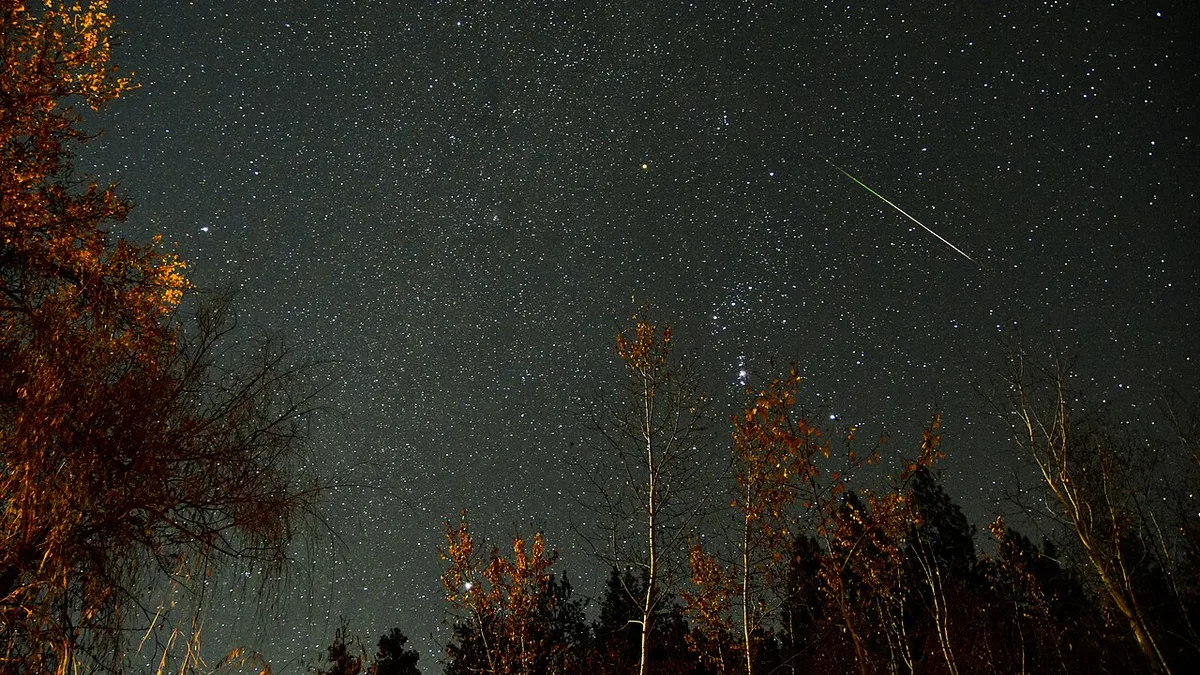
The Leonids are the fastest shower of the month: particles from comet 55P/Tempel-Tuttle hit the atmosphere at about 71 kilometers per second. The peak falls on the night of November 17 to 18, with about 15 meteors per hour under dark skies. The sources differ on the exact moment of the peak: Sterngucker gives about 3:52 p.m. Central European Time on November 17, in daylight, while Forecastbar gives 11:43 p.m. Universal Time. For that reason the whole night counts, not a single minute.
The Moon is at first quarter and interferes with the early part of the night, but it sets around 11:30 p.m., when it is 54 percent illuminated. The radiant in Leo rises at 10:25 p.m. and is high enough from about 2 a.m. The best window is from 2 to 5:30 a.m., before dawn. The portal 3Bmeteo points out that the Leonids have produced true meteor storms in the past, but no source says one is expected this year.
The Taurids deliver few meteors, but often bright ones. The Southern Taurids peak on November 5 and the Northern Taurids on November 12, and both showers come from comet 2P/Encke and enter the atmosphere at about 28 kilometers per second. For the Southern Taurids Forecastbar gives 7 meteors per hour, while 3Bmeteo and Sterngucker give about 5; the Northern Taurids have about 5 per hour. Both peaks fall around the new Moon, so conditions are favorable. The Alpha Monocerotids peak around November 22 with fewer than five meteors per hour and occasional bursts, but this year the nearly full Moon drowns them out.
Full Moon on November 24 and Uranus on November 25
The full Moon of November 24, traditionally called the Beaver Moon, falls near perigee. According to 3Bmeteo it will be about 360,770 kilometers from Earth, and that source calls it a supermoon, the first of the year. That evening it stands about 4.5 degrees from the Pleiades, though its light washes out the cluster’s fainter stars. The same source says that on December 24 the Moon will be closer still, at about 356,740 kilometers.
Uranus is at opposition on November 25 at 11:41 p.m., which means it is visible all night in the constellation Taurus. Its brightness is about 5.6 magnitude, at the limit of the naked eye under truly dark skies, and around midnight it stands about 58 degrees high. It lies roughly 5 degrees southeast of the Pleiades and about 8 degrees northwest of Aldebaran. Binoculars show it as a point of light, and only a telescope at about 100 times magnification reveals a small blue-green disk.
Saturn stays in Cetus in the evening, at about +0.5 magnitude; on November 15 it culminates at 9:02 p.m. at a height of 38 degrees.
What this data does not cover
This overview was assembled from three calendars, one German, one American and one Italian, and none of them is a peer-reviewed scientific paper. The rise, set and culmination times were computed for Berlin or Rome, so they differ in Serbia and should be checked for your own location. The number of meteors per hour is a theoretical value for an ideal sky, without light pollution and with the radiant at the zenith, so a city observer sees far fewer. These calendars predict neither clouds nor the strength of any single shower, and for that reason none of the events listed here is guaranteed.