BepiColombo enters Mercury orbit after eight-year journey
ESA flight control has confirmed that the European-Japanese probe was captured into Mercury orbit. The orbiters separate on December 9 and 10, and science begins in April 2027.
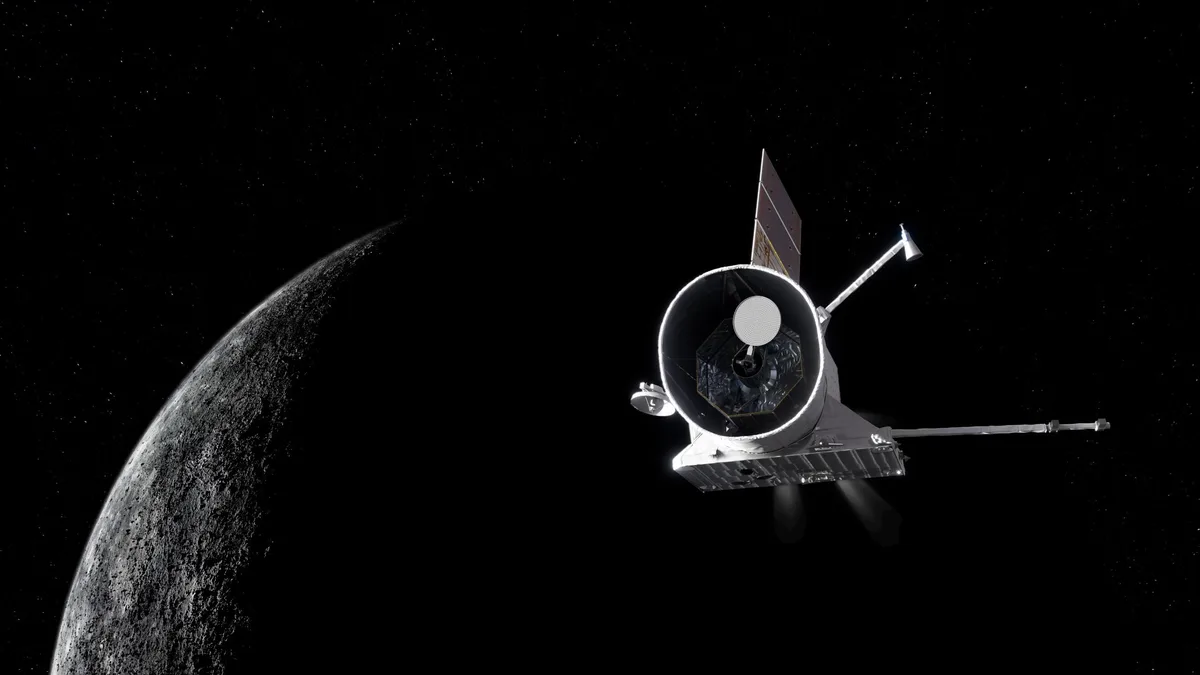
Flight control at the European Space Agency (ESA) has confirmed that the BepiColombo probe was captured into orbit around Mercury. The engine burn was scheduled for Saturday, November 21, 2026, at 19:24 Central European Time, which is also Belgrade time. The spacecraft has since re-established contact with Earth, and teams at the ESOC control center in Darmstadt are assessing its telemetry. We reported yesterday that the capture was expected that evening, and the first outcomes are now known.
What did ESA say about the orbit insertion?
The official ESA Operations account announced that the Flight Dynamics team had confirmed the capture. EarthSky relayed the post and, according to its report, it arrived on Sunday, November 22.
“Flight Dynamics has already confirmed that orbit insertion around Mercury has been achieved!”
ESA Operations wrote this on Bluesky, adding that it would share the next update with the following steps early in the coming week.
Sources differ on when the confirmation came. Aerotime reports that ESA confirmed the capture on November 21, while Euronews and the Express Tribune say the announcement came on Sunday. ESA Operations posted the burn announcement on November 20, and the maneuver itself took place on Saturday evening as scheduled.
How was the spacecraft slowed down?
Mercury is close to the Sun, so an approaching spacecraft accelerates under solar gravity and has to shed a large share of its kinetic energy before Mercury’s weaker gravity can hold it. That made the engine burn decisive. According to Space.com, it was planned to last 37 minutes, while the Express Tribune, citing a news agency report, says the engines ran for more than half an hour.
Four thrusters on the European orbiter, MPO (Mercury Planetary Orbiter), reduced the speed. Until separation, the MPO handles every maneuver for the combined spacecraft. According to Aerotime, the initial orbit is elliptical and polar, ranging from about 590 to about 11,640 kilometers above the surface.
Azul Pinochet-Barros, an operations editor at the ESOC control center, explained the difficulty of the task during a live broadcast on September 3, 2026, as reported by Eos:
“Getting to Mercury is actually harder than getting to Pluto. The challenge is not getting closer to the Sun. The challenge is losing enough energy to follow Mercury’s path around the Sun.”
Who entered the orbit?
Two science orbiters, still joined together, went into orbit: the European MPO and the Japanese Mio (Mercury Magnetospheric Orbiter), built by the Japanese agency JAXA. A dedicated sunshield protects Mio until separation. The transfer module, MTM, which carried both orbiters and powered them with electric engines, was jettisoned on September 3, 2026.
The spacecraft launched in October 2018 on an Ariane 5 rocket from French Guiana. Along the way it made nine planetary flybys: one of Earth, two of Venus and six of Mercury. The last Mercury flyby was on January 8, 2025. Figures for the distance traveled differ: Aerotime gives about 9.9 billion kilometers, and the Express Tribune says more than 10 billion.
Arrival was originally planned for December 2025. A 2024 fault reduced the power of the electric thrusters, so the trajectory was corrected and arrival slipped by a year. Space.com ties that fault to the solar panels that power the thrusters, while Eos describes it as a problem with the thrusters themselves.
What comes after the capture?
The orbiters separate on December 9 and 10, 2026. Mio then moves into its final, highly elliptical polar orbit. Through a series of burns, the MPO is due to reach its science orbit by March 10, 2027. The Express Tribune says the European orbiter will pass just 480 kilometers above the surface, while the Japanese one will go out to about 11,000 kilometers from the planet.
Science measurements begin in April 2027, and Space.com gives April 6 as the date. The primary mission lasts one year, with an extension planned through 2029. The MPO will map the surface and its composition, and Mio will study the magnetic field and the plasma environment. Mercury has a magnetic field, but researchers do not know what sustains it or why it is offset from the planet’s center.
BepiColombo is the second mission to enter Mercury orbit, after NASA’s MESSENGER, which operated there from 2011 to 2015. Before that, only Mariner 10 had flown past the planet. Santa Martinez, the BepiColombo mission manager at ESA, said at a press conference on August 31, according to Eos:
“Mercury is a demanding destination. What makes this mission truly unique is that for the first time in the history of space exploration we are bringing two spacecraft to a planet and placing them in orbit around this mysterious body.”
What does this confirmation not prove?
The confirmation means the spacecraft was captured into orbit, not that the mission is complete. Telemetry is still being assessed, and ESA has announced a fuller update only early in the coming week. The orbiters have not yet separated, neither is in its final science orbit, and no science measurement has started. The available sources also say nothing about the spacecraft’s condition after the burn, beyond the fact that contact was established and telemetry is being assessed.